Specializing in the production of Plastic Pulverizer Machines.

Views: 217 Author: Site Editor Publish Time: 2026-05-18 Origin: Site
In the world of polymer processing, the transition from bulk scrap to usable raw material is a journey of precision. While shredding is the first step, the true value is unlocked during micronization. This is where the Plastic Pulverizer Machine becomes essential. It bridges the gap between raw waste and high-performance manufacturing by creating fine, consistent powders. Whether you are working with rotomolding, masterbatch creation, or 3D filament production, you need a reliable method to reduce flakes into a "flour-like" state.
This guide serves as a deep dive into the technology behind the Industrial Plastic Pulverizer Machine. We will explore how these systems operate, why efficiency matters, and how to choose the right setup for specific materials like PVC, PE, and PP. By focusing on actionable insights and technical depth, we help you master the art of plastic powder production for maximum profitability.
Understanding how a Plastic Pulverizer Machine operates is the first step toward optimizing your production line. Unlike a granulator that uses a "scissor" action to cut plastic, a pulverizer uses high-speed centrifugal force and friction to grind material. The core of this system is the grinding disc, which must be engineered to handle the specific molecular structure of different polymers.
A standard Industrial Plastic Pulverizer Machine typically consists of a high-speed rotating disc and a stationary disc. The material enters through the center and is forced outward by centrifugal force.
Centrifugal Movement: As flakes enter the chamber, they move toward the periphery of the discs. The gap between these discs narrows toward the edges, ensuring the powder reaches the desired mesh size before exiting.
Shearing and Friction: The interaction between the stationary and moving teeth creates a shearing effect. This process generates heat, which must be managed to prevent the plastic from melting.
Sieve-Free Design: Most High Efficiency Plastic Pulverizer Machines use an air-classifier or a vibration screen rather than a traditional internal sieve. This prevents clogging and allows for continuous operation.
Every part of the machine must work in harmony to ensure high-quality output.
Vibratory Feeder: This ensures a steady flow of material. If the feed is inconsistent, the motor load fluctuates, wasting energy and producing uneven powder.
Grinding Chamber: This is where the actual reduction happens. It must be lined with wear-resistant materials to handle abrasive plastics.
Cyclon Separator: Once the powder is fine enough, air suction pulls it out of the chamber and into a cyclone. This separates the powder from the air stream for collection.
Dust Collection System: To maintain a clean facility, a pulse-jet dust collector captures the finest "dust" particles that are too light for the cyclone.
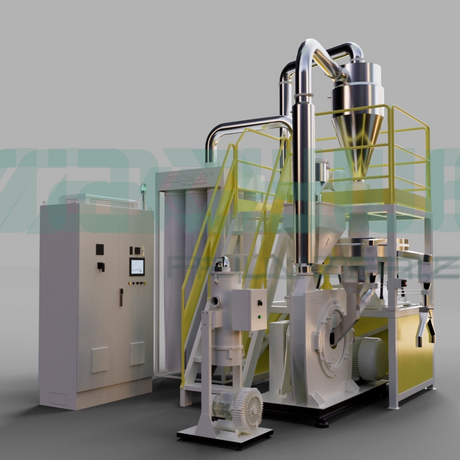
PVC (Polyvinyl Chloride) is uniquely challenging to pulverize because of its thermal sensitivity. If the temperature rises too high, PVC releases chlorine gas and degrades, turning the powder yellow or black. A specialized PVC Plastic Pulverizer Machine is designed to solve this specific problem through advanced cooling and disc geometry.
The key to high-value PVC powder is keeping the material cool.
Water Cooling Jackets: The main housing and the bearing seats are surrounded by water-cooling channels. This prevents the heat of friction from transferring into the machine's structure.
Air Volume Control: High-volume fans move a massive amount of air through the grinding chamber. This air acts as a coolant, carrying the heat away from each individual plastic particle as it is ground.
Temperature Sensors: A High Efficiency Plastic Pulverizer Machine for PVC uses digital thermometers to monitor the discharge temperature. If it exceeds 60°C, the system can automatically adjust the feed rate.
Why invest in a high-end Industrial Plastic Pulverizer Machine for PVC?
Pipe and Profile Extrusion: Manufacturers use recycled PVC powder as a core layer in co-extruded pipes. This reduces costs while maintaining structural integrity.
Flooring Underlayment: Finely ground PVC is a primary ingredient in high-quality vinyl flooring layers.
Plastisol Preparation: In some flexible PVC applications, the powder is mixed with plasticizers to create a liquid paste used in dip molding.
Feature | Impact on PVC Quality |
|---|---|
Water Cooling | Prevents thermal degradation and yellowing |
Chromium Alloy Discs | Resists abrasion from PVC fillers (like CaCO3) |
Automatic Feeder | Ensures consistent particle size for better extrusion |
Polyethylene (PE) and Polypropylene (PP) behave differently than PVC. They are more "rubbery" and have lower melting points. A PE PP Pulverizer Machine must focus on cutting efficiency to prevent the material from "smearing" across the discs.
The secret to a High Efficiency Plastic Pulverizer Machine when handling PE or PP is the tooth profile.
Knife-Edge Design: For PE, the disc teeth are often sharper and more "knife-like." This allows the machine to slice the polymer chains rather than crushing them.
Disc Clearance: PE/PP grinding requires a very tight gap between the discs. Modern Industrial Plastic Pulverizer Machines feature micro-adjustment screws that allow operators to set this gap within 0.05mm.
Static Elimination: Plastic powder carries a high static charge. Advanced machines include anti-static bars in the collection system to prevent the powder from clumping together.
PE powder is the "gold standard" for the rotational molding industry.
Water Tanks and Kayaks: These large hollow parts require powder that flows like water into every corner of the mold.
Consistent Wall Thickness: If your Plastic Pulverizer Machine produces a wide range of particle sizes, the wall thickness of the molded part will be uneven, leading to structural failure.
Surface Finish: Fine powder ensures a smooth "Class A" finish on the exterior of consumer goods like coolers and playground slides.
As factories move closer to urban areas, noise pollution becomes a major legal and safety concern. A Low Noise Plastic Pulverizer Machine is no longer a luxury; it is a necessity for modern compliance.
Grinding plastic at high speeds is naturally loud. However, we can mitigate this through specific design choices.
Acoustic Enclosures: The entire grinding unit is often encased in a sound-dampening cabinet. This uses thick insulation to absorb high-frequency sounds.
Vibration Dampening: Vibration is a major source of noise. By using rubber mounts and dynamically balancing the main shaft, a High Efficiency Plastic Pulverizer Machine runs much smoother.
Muffled Exhaust: The air discharge from the dust collector can be loud. Using a high-performance silencer on the exhaust fan reduces the decibel level significantly.
A quieter environment leads to a more productive workforce.
Reduced Operator Fatigue: Constant exposure to 100dB+ noise leads to stress and mistakes. A Low Noise Plastic Pulverizer Machine keeps levels below 85dB.
Clear Communication: In a loud factory, instructions are often misheard. Reducing noise improves safety by allowing workers to hear alarms and each other.
Night Shift Feasibility: If your facility is quiet, you can run a 24-hour operation without disturbing the surrounding neighborhood, effectively doubling your production capacity.
Choosing the right Plastic Pulverizer Machine requires comparing different technical specifications. Not all machines provide the same return on investment (ROI).
Feature | Disc Pulverizer | Turbo Pulverizer |
|---|---|---|
Main Use | PVC, PE, PP, PS | Soft plastics, rubber, additives |
Mesh Size | 20 - 80 Mesh | 40 - 120 Mesh |
Energy Consumption | Low (High Efficiency) | Moderate |
Maintenance | Simple (Replaceable Discs) | Complex (Beater plates) |
PVC Powder (40 Mesh): A standard 600mm Industrial Plastic Pulverizer Machine can produce 150-350 kg/h depending on the motor power.
PE Powder (35 Mesh): The same machine might produce slightly less (120-250 kg/h) because PE requires more cooling time and a tighter gap.
PP Powder (40 Mesh): Similar to PE, but requires careful monitoring of the "glass transition temperature" to prevent clumping.
To maintain a High Efficiency Plastic Pulverizer Machine, you must follow a strict maintenance schedule. If the machine is neglected, energy consumption will rise, and powder quality will drop.
The discs are the "heart" of the system. Dull discs are the #1 cause of poor powder quality.
Visual Inspection: We recommend checking the tooth wear every 48 hours of operation.
Professional Sharpening: Many Industrial Plastic Pulverizer Machines use discs that can be resharpened on a dedicated surface grinder. This extends the life of the disc by 3-4 times.
Balancing: Whenever you replace or sharpen a disc, it must be re-balanced. An unbalanced disc will destroy the bearings within days.
High-Speed Bearings: These bearings spin at 3000+ RPM. They require specialized high-temperature grease.
Water Channel Descaling: If you use hard water for cooling, minerals will build up in the jackets. Regular flushing with a descaling agent is necessary to maintain High Efficiency cooling.
Belt Tension: If your Plastic Pulverizer Machine is belt-driven, ensure the tension is checked weekly. Slipping belts waste energy and generate heat.
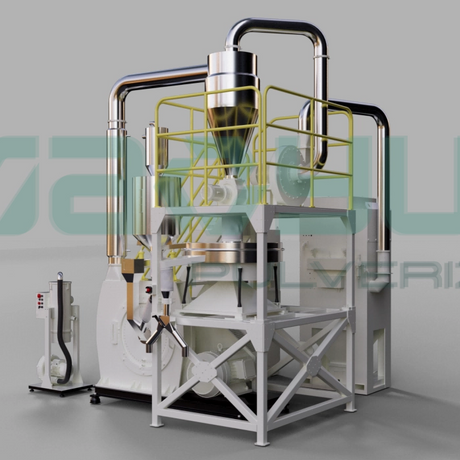
The demand for plastic powder is only going up. As we look toward the future, the Industrial Plastic Pulverizer Machine is evolving to meet new challenges.
Remote Monitoring: Many modern machines now feature Wi-Fi connectivity. Owners can monitor amperage, temperature, and output from a smartphone.
Predictive Maintenance: AI algorithms can predict when a bearing or disc is likely to fail, allowing you to schedule repairs before a breakdown occurs.
Automated Bagging: For high-volume production, the pulverizer can be linked directly to an automated weighing and bagging station, reducing labor costs.
Closing the Loop: Manufacturers are now using High Efficiency Plastic Pulverizer Machines to grind their own factory scrap and feed it directly back into the production line.
Ocean Plastic Recycling: Specialized pulverizers are being used to process reclaimed ocean plastics, which are often degraded and difficult to grind with traditional methods.
Bio-Plastics: As we move toward biodegradable materials, pulverizer technology is adapting to handle the unique textures of PLA and other starch-based polymers.
Mastering the use of a Plastic Pulverizer Machine is a competitive advantage in the modern recycling market. By understanding the technical nuances of your equipment—from heat management in PVC Plastic Pulverizer Machines to the precision required for PE and PP—you can produce high-value powders that command premium prices.
Investment in a High Efficiency Plastic Pulverizer Machine is not just an expense; it is a commitment to quality and sustainability. By focusing on maintenance, noise reduction, and smart engineering, your facility can become a leader in the global push for circular plastic manufacturing.
Most industrial models can produce powder between 20 and 80 mesh. For specific high-end applications like 3D printing, some High Efficiency models can reach 100 mesh or more with specialized air-classifier settings.
Yes, but you will likely need to change the disc set and adjust the cooling parameters. A PVC Plastic Pulverizer Machine is built for rigid materials, while a PE Plastic Pulverizer Machine handles softer, more ductile polymers.
Focus on the feed rate. Overfeeding causes the motor to draw excess amperage without increasing output. Using a High Efficiency Plastic Pulverizer Machine with an inverter (VFD) allows the motor to adjust its speed to the material density, saving significant power.
This is almost always due to excessive heat. If the cooling system is clogged or the air volume is too low, the plastic will stay in the chamber too long and begin to thermally degrade. Check your Industrial Plastic Pulverizer Machine cooling jackets immediately.
On a well-maintained Plastic Pulverizer Machine, a set of discs can last between 300 and 800 hours before needing sharpening, depending on the abrasiveness of the material (e.g., filled PVC wears discs faster than virgin PE).
Maoyue Plastic Pulverizer is a premier manufacturer dedicated to providing cutting-edge solutions for the plastic processing industry. We specialize in the design and production of Industrial Plastic Pulverizer Machines that prioritize High Efficiency and Low Noise performance. Our goal is to empower recyclers and manufacturers with the tools they need to succeed in a demanding market.
To explore our full range of pulverizing technology and discover the right fit for your operation, visit us at Maoyue Plastic Pulverizer.


