Specializing in the production of Plastic Pulverizer Machines.

Views: 0 Author: Site Editor Publish Time: 2026-07-04 Origin: Site

With the continuous development of high-performance plastic materials, PBT has become one of the most important engineering plastics in modern industry. As a semi-crystalline polyester resin, PBT offers excellent mechanical strength, heat resistance, chemical resistance, dimensional stability, and good processing performance. As a result, it is widely used in fiber manufacturing, electronics and electrical appliances, automotive production, home appliances, and various industrial components.
However, to fully realize the performance advantages of PBT materials, high-quality PBT powder plays a crucial role. The particle size uniformity, flowability, purity, and thermal stability of PBT powder directly affect the dispersion performance and melt processing behavior of masterbatch, and ultimately determine the color consistency, mechanical properties, and long-term stability of fiber products. Therefore, for chemical fiber masterbatch manufacturers, how to produce high-quality PBT powder in a stable and efficient way has become an important challenge for improving product competitiveness and production efficiency.
With the increasing demand for high-performance fiber materials, advanced plastic grinding technology is playing an increasingly important role. Through high-precision, low-temperature, and stable pulverizing processes, it is possible to ensure that PBT powder has a uniform particle size distribution, good flowability, and excellent dispersion performance, providing a solid raw material foundation for high-quality chemical fiber masterbatch and final fiber products.
PBT belongs to the family of polyester engineering plastics and features a highly regular molecular chain structure. Its semi-crystalline nature allows the material to crystallize rapidly during processing, giving it excellent rigidity, toughness, dimensional stability, and wear resistance. Compared with many other engineering plastics, PBT offers a faster crystallization rate, lower processing temperature, and better compatibility with pigments and additives, making it an ideal carrier resin for the masterbatch industry.
The widespread use of PBT in the chemical fiber masterbatch industry is mainly attributed to its excellent overall performance, including:
High mechanical strength and excellent impact resistance
Outstanding heat resistance and thermal stability
Excellent dimensional stability with low shrinkage
Low moisture absorption, ensuring more stable processing performance
Excellent electrical insulation properties
Good melt flowability and easy molding performance
Thanks to these outstanding comprehensive properties, PBT not only meets the requirements of the chemical fiber masterbatch industry for high strength, high stability, and high processing efficiency, but also provides more reliable material support for high-performance fiber products.
However, to fully realize these performance advantages, high-quality PBT powder is essential. Only PBT powder with uniform particle size, good flowability, high thermal stability, and excellent dispersion performance can ensure more consistent mixing during production, more stable processing behavior, and superior final product quality. Therefore, advanced pulverizing technology and high-performance plastic grinding equipment have become key factors for chemical fiber masterbatch manufacturers to improve product quality and enhance market competitiveness.

Masterbatch is a highly concentrated granular material composed of high-concentration pigments, functional additives, and carrier resins. In chemical fiber production, masterbatch not only provides rich and stable coloration to fibers but also improves processing performance and enhances overall product quality.
Modern chemical fiber manufacturers are placing increasingly higher demands on masterbatch performance, including:
More uniform pigment dispersion to ensure bright, stable, and color-consistent fibers
Higher processing stability to maintain consistent melt flow during continuous production and reduce issues such as filament breakage and screen clogging
Better color consistency to meet the strict requirements of high-end textile applications for color accuracy and batch-to-batch stability
Higher production efficiency to shorten production cycles and improve equipment utilization
Lower overall production cost by reducing raw material waste and energy consumption, thereby improving economic efficiency
Improved mechanical strength and heat resistance to meet the requirements of high-performance and functional fiber applications
Therefore, the use of high-precision, low-temperature, and stable plastic grinding equipment to produce high-quality PBT powder has become a key factor for chemical fiber masterbatch manufacturers to enhance product competitiveness and achieve high-quality manufacturing. It also provides a solid foundation for the stable production of advanced high-performance fiber products.
In recent years, driven by global manufacturing transformation, industrial upgrading, and the growing emphasis on sustainable development, the chemical fiber industry has entered a new phase of technological innovation. With the rapid growth of industries such as new energy vehicles, smart textiles, high-end apparel, industrial fibers, and composite materials, the market is placing increasingly higher demands on the performance, quality, and production efficiency of chemical fiber products. At the same time, advances in green and low-carbon manufacturing, intelligent production, and new material technologies are accelerating the industry’s transition toward higher quality and higher efficiency development.
In the future, the global chemical fiber industry will mainly evolve along the following trends:
High-performance development
Functionalization
Lightweight design
Energy efficiency improvement
Environmental sustainability
Against this backdrop, PBT is increasingly becoming a key carrier resin for high-end chemical fiber masterbatch, thanks to its excellent mechanical strength, heat resistance, dimensional stability, melt flow properties, and strong compatibility with pigments and functional additives. Compared with traditional carrier resins, PBT significantly improves pigment dispersion, processing stability, and the overall performance of final fiber products. As a result, it has broad application prospects in functional fibers, industrial fibers, high-end textile materials, and engineering plastic modification.
With the continuous development of chemical fiber products toward higher performance, functionalization, and higher added value, masterbatch is no longer only responsible for providing color. It also directly influences processing efficiency, mechanical properties, surface quality, and long-term service stability of fiber products. As an engineering plastic with excellent overall performance, PBT has become one of the key carrier resins in high-end chemical fiber masterbatch due to its outstanding mechanical properties, thermal stability, melt flow behavior, and excellent compatibility with pigments and functional additives.
In both masterbatch production and subsequent fiber processing, PBT can significantly enhance the overall performance of products and provide stable and reliable material support for high-quality chemical fiber applications. Its advantages are mainly reflected in the following aspects.

PBT can significantly improve the tensile strength, impact resistance, and durability of fiber products, enabling them to meet the requirements of more demanding industrial applications.
Chemical fiber production typically involves high processing temperatures. PBT exhibits excellent thermal stability and maintains a stable molecular structure during extrusion processing, effectively reducing the risk of material degradation and ensuring consistent product quality.

Good melt flow performance allows pigments and additives to disperse more evenly within the polymer system, effectively reducing issues such as color spots, streaks, and agglomeration, while improving overall product consistency.
In summary, PBT’s excellent mechanical properties, thermal stability, and processing flowability not only significantly enhance the processing efficiency and product quality of chemical fiber masterbatch, but also provide strong support for the development of high-performance fiber materials.
However, to fully realize these advantages, high-quality PBT powder is essential. Only PBT powder with uniform particle size distribution, good flowability, and stable thermal performance can ensure more uniform mixing, stable processing, and consistent final product quality. Therefore, the use of high-precision, low-temperature, and stable plastic grinding processes for producing PBT powder has become a key factor in improving masterbatch quality and enhancing market competitiveness.
With its excellent mechanical properties, heat resistance, dimensional stability, and good processing performance, PBT has become one of the most widely used engineering plastics in the modern chemical fiber industry. From industrial manufacturing to high-end textiles and engineering composite materials, PBT continues to expand its application scope thanks to its stable and well-balanced overall performance. As demand for high-performance fibers continues to grow, the application value of PBT in the chemical fiber industry has become increasingly prominent, providing reliable material support for a wide range of high-quality fiber products.
Different application scenarios place different requirements on material performance. Thanks to its excellent comprehensive properties, PBT is able to meet diverse application needs and is therefore widely used in the following key fields.

In industrial applications, fiber products are often required to withstand long-term exposure to high tensile forces, friction, impact, and complex working environments. As a result, the requirements for mechanical strength and durability are extremely demanding. PBT offers excellent tensile strength, abrasion resistance, fatigue resistance, and good chemical resistance, enabling it to maintain stable physical properties during long-term continuous use.
Therefore, PBT is widely used in conveyor belts, safety belts, industrial ropes, tire cord fabrics, filtration materials, industrial webbings, and various high-strength industrial fiber products. These applications not only require high load-bearing capacity but also demand stable performance under high temperature, high humidity, and complex operating conditions. PBT is well suited to meet these stringent requirements.

With the continuous increase in consumer demand for functional textiles, PBT fibers are being increasingly used in the apparel industry. Compared with traditional polyester fibers, PBT fibers offer excellent elastic recovery, a soft and comfortable hand feel, good wrinkle resistance, and outstanding moisture-wicking performance, significantly improving wearing comfort and durability.
Thanks to these advantages, PBT fibers are widely used in sportswear, yoga wear, swimwear, outdoor functional clothing, quick-dry fabrics, stretch fabrics, knitted fabrics, and high-end fashion garments. In addition, PBT also provides excellent wash resistance and color retention, allowing textiles to maintain vibrant colors and a high-quality appearance even after long-term use, making it highly favored by premium textile brands.

In addition to traditional chemical fiber applications, PBT is increasingly widely used in engineering-grade composite materials. By compounding with glass fibers, mineral fillers, and other reinforcing materials, PBT can further enhance mechanical strength, dimensional stability, and heat resistance, providing more reliable performance support for engineering plastics.
At present, PBT is widely applied in automotive components, electrical and electronic parts, industrial equipment, rail transit systems, precision machinery, and high-performance composite material applications. Its excellent fatigue resistance, dimensional stability, and long-term thermal resistance enable it to maintain stable performance under complex operating conditions, delivering long-lasting reinforcement effects for engineering products.
With the continuous growth of high-performance fiber and functional material markets, the application scope of PBT continues to expand. From industrial fibers to high-end textiles and engineering composites, PBT consistently demonstrates outstanding overall performance. However, the full performance potential of PBT depends heavily on high-quality PBT powder. Only PBT powder with uniform particle size, excellent flowability, high purity, and strong thermal stability can ensure superior dispersion in masterbatch and stable processing performance, thereby further improving product quality and production efficiency across various chemical fiber applications.
Therefore, advanced plastic pulverizing technology and high-precision grinding equipment have become essential technical foundations for promoting the widespread application of PBT in high-end chemical fiber industries.
Compared with PET, PBT offers a faster crystallization rate, shorter molding cycle, and lower processing temperature, which can effectively reduce production time, improve equipment utilization, and lower overall energy consumption. In addition, PBT provides better melt flowability, allowing pigments, functional additives, and other compounding materials to disperse more evenly during extrusion, blending, and masterbatch production. This helps reduce color variation, specks, and agglomeration, thereby improving the consistency of masterbatch quality.
Furthermore, PBT demonstrates superior dimensional stability and processing stability. Even under continuous high-temperature processing conditions, it can maintain stable physical properties. Therefore, for chemical fiber masterbatch manufacturers that pursue high efficiency, high quality, and continuous production, PBT is generally a more suitable carrier resin for high-end masterbatch applications than PET.
Compared with PA (polyamide/nylon), PBT has significantly lower moisture absorption, resulting in better dimensional stability and more consistent long-term performance. Even in humid environments, PBT maintains relatively stable physical properties, reducing dimensional changes and performance degradation caused by moisture absorption. At the same time, its low moisture absorption means shorter drying time before processing, helping to reduce preparation time and improve production efficiency.
In addition, PBT offers better melt flowability and more stable processing behavior. During high-speed extrusion, compounding, and spinning processes, it maintains a uniform melt state, allowing pigments and functional additives to disperse more effectively. This ensures consistent masterbatch coloration, stable processing performance, and reduces production issues such as filament breakage and screen clogging.

Pigment dispersion uniformity is one of the core indicators for evaluating the quality of color masterbatch, and it is also a key factor affecting the appearance quality and processing performance of chemical fiber products. In the production of masterbatch, if pigments and functional additives cannot be fully and evenly dispersed within the carrier resin, it can easily lead to quality issues such as color variation, specks, black spots, agglomeration, and streaks. These defects not only affect product appearance but may also cause a decline in fiber mechanical properties, unstable melt flow, and difficulties in subsequent spinning processes, ultimately increasing scrap rates and production costs.
As a high-performance engineering plastic, PBT offers excellent melt flowability and good pigment compatibility, which can effectively improve the wetting performance of pigments and functional additives, enabling more uniform and stable dispersion within the polymer system. At the same time, PBT’s inherent thermal stability and processing stability help reduce pigment migration and degradation during high-temperature processing, ensuring more stable color performance and superior processing characteristics of the masterbatch.
However, to fully leverage PBT as a carrier resin, high-quality PBT powder is a critical foundation that cannot be overlooked. The particle size uniformity, fineness, flowability, and purity of PBT powder directly affect pigment encapsulation efficiency, mixing uniformity, and the final dispersion performance of the masterbatch. The more uniform the particle size distribution, the larger the contact area between pigments and resin, and the higher the mixing efficiency, resulting in better color consistency and improved product stability.
Therefore, the production of high-quality PBT powder relies on advanced pulverizing technology and precision equipment. With over 30 years of expertise in plastic grinding technology, Mao Yue (Changzhou MaoYue Intelligent Equipment Co., Ltd.) adopts high-precision grinding disc structures, optimized air classification systems, and low-temperature pulverizing processes to effectively control particle size distribution and processing temperature rise. This enables the production of high-quality PBT powder with uniform particle size, excellent flowability, and stable dispersion performance. Such improvements not only enhance pigment and additive dispersion efficiency but also significantly improve processing stability and final product consistency in chemical fiber applications.
With the continuous improvement of quality requirements in the high-performance chemical fiber and functional masterbatch markets, uniform, stable, and high-quality PBT powder has become a key factor in enhancing masterbatch competitiveness. At the same time, advanced grinding equipment and mature powder processing technologies are increasingly becoming essential for masterbatch manufacturers to achieve high-quality production and sustainable development.
The production of high-quality PBT powder depends not only on the raw material itself, but also on the precise control of the entire pulverizing and powder processing workflow. From raw material pre-treatment, grinding, classification, to final powder collection, every stage can influence the particle size distribution, flowability, thermal stability, and final dispersion performance of the powder.
For the chemical fiber masterbatch industry, stable and high-quality PBT powder is a key factor in ensuring masterbatch quality and the consistency of downstream fiber processing. Therefore, advanced pulverizing technology and high-performance plastic grinding equipment play a particularly important role in achieving reliable and efficient production.
Proper control of the pulverizing temperature is essential to prevent thermal degradation of the material and to maintain stable material properties. During high-speed grinding, excessive heat generation can lead to softening, agglomeration, or even molecular structure damage, which ultimately affects downstream processing stability and final product quality.
By effectively managing the temperature during the grinding process, the material can remain within a stable processing window, ensuring that PBT powder retains its original mechanical and thermal performance, which is critical for consistent masterbatch production and fiber processing.

Uniform particle size distribution plays a key role in improving feeding stability, pigment dispersion efficiency, and overall processing performance.
When the powder particle size is consistent, it ensures smoother material flow during conveying and dosing, reduces fluctuations in feeding systems, and improves mixing uniformity with pigments and additives. This leads to more stable masterbatch quality, better color consistency, and higher production efficiency in downstream processing such as extrusion and fiber spinning.

As an enterprise with over 30 years of experience in the R&D and manufacturing of plastic pulverizing equipment, Changzhou Mao Yue Intelligent Equipment Co., Ltd. has always focused on the innovation and upgrading of high-performance plastic grinding technology. We are committed to providing efficient, stable, and energy-saving plastic pulverizing solutions for global industries including plastic processing, masterbatch, chemical fiber, modified plastics, and engineering plastics.
In response to the processing characteristics of engineering plastics such as PBT, Mao Yue continuously optimizes the grinding disc structure, air classification system, and cooling technology. This enables the equipment to ensure high output while consistently producing high-quality PBT powder with uniform particle size, narrow particle size distribution, good flowability, and high bulk density. As a result, we provide more stable and reliable raw material support for the chemical fiber and masterbatch industries.

For chemical fiber and masterbatch manufacturers, the particle size stability of PBT powder directly determines the overall production process quality. Excessive particle size fluctuation can easily lead to unstable feeding, poor mixing uniformity, reduced pigment dispersion efficiency, and even issues such as color variation, color spots, and inconsistent batch quality, ultimately increasing rework rates and production costs.
Through high-precision grinding discs and an optimized air classification system, MaoYue achieves precise control over PBT powder particle size. The final product features a narrower particle size distribution, fewer coarse particles, and a more stable fine powder ratio. For customers, this brings the following benefits:
More stable feeding, reducing interruptions and inconsistent material supply;
Easier and more uniform mixing of pigments and functional additives, improving masterbatch pass rates;
Reduced color differences, specks, and agglomeration, lowering rework and raw material waste;
Improved stability in extrusion and spinning processes, enabling continuous production;
Consistent powder quality across different batches, ensuring stable final fiber color and reducing customer complaints.
For masterbatch producers, stable powder particle size means not only better product quality, but also less waste, higher production efficiency, and lower overall manufacturing costs. This is also a key reason why MaoYue plastic pulverizing equipment continues to create long-term value for customers.

For masterbatch and chemical fiber manufacturers, PBT powder is not only required to reach the target fineness, but also to possess good flowability and relatively high bulk density. Only when the powder can flow steadily and be conveyed uniformly can the entire production line operate continuously and efficiently.
Thanks to MaoYue’s mature pulverizing process and stable particle size control capability, the PBT powder produced by the equipment exhibits excellent flowability. This means that in actual production, customers can achieve more stable automatic feeding performance, reduce issues such as powder bridging, clogging, and feeding fluctuations, and minimize manual intervention. As a result, extrusion, compounding, and pelletizing processes become smoother, while downtime and material waste caused by unstable feeding are significantly reduced.
At the same time, PBT powder produced by MaoYue pulverizers has a higher bulk density. For customers, this means that more usable powder can be stored within the same storage volume, reducing storage and transportation costs. During production, the equipment enables more stable and continuous feeding, increases the effective throughput per unit time, improves mixing uniformity, and helps maintain stable masterbatch quality.
Ultimately, what customers obtain is not only a batch of PBT powder with good flowability and high bulk density, but more importantly, more stable production, less downtime, lower material loss, and higher production efficiency—thereby effectively reducing overall manufacturing costs and improving market competitiveness.

PBT is an engineering plastic with relatively high requirements for processing temperature control and powder quality. During the grinding process, excessive temperature rise or unstable particle size can easily lead to material softening, agglomeration, and reduced flowability, which in turn negatively affects masterbatch compounding performance and downstream spinning stability.
To meet these demands, Mao Yue's independently developed disc-type plastic pulverizer adopts high-precision wear-resistant grinding discs and an optimized grinding chamber structure. While ensuring continuous and stable production, it effectively controls temperature rise during the grinding process and reduces material property changes caused by frictional heat.
For customers, this means:
Reduced defective products and rework caused by fluctuations in powder quality, improving first-pass yield;
Stable physical properties of PBT powder, enabling smoother downstream compounding, pelletizing, and spinning processes;
Lower risk of powder agglomeration and processing abnormalities caused by high temperature, reducing production line downtime;
Consistent production of uniform and high-quality PBT powder, ensuring batch-to-batch stability and meeting high-end masterbatch production requirements.
Through stable grinding performance, MaoYue not only helps customers produce high-quality PBT powder, but also reduces process instability, improves equipment utilization, and lowers overall manufacturing costs—ensuring that every batch of raw material can reliably enter the next stage of production.
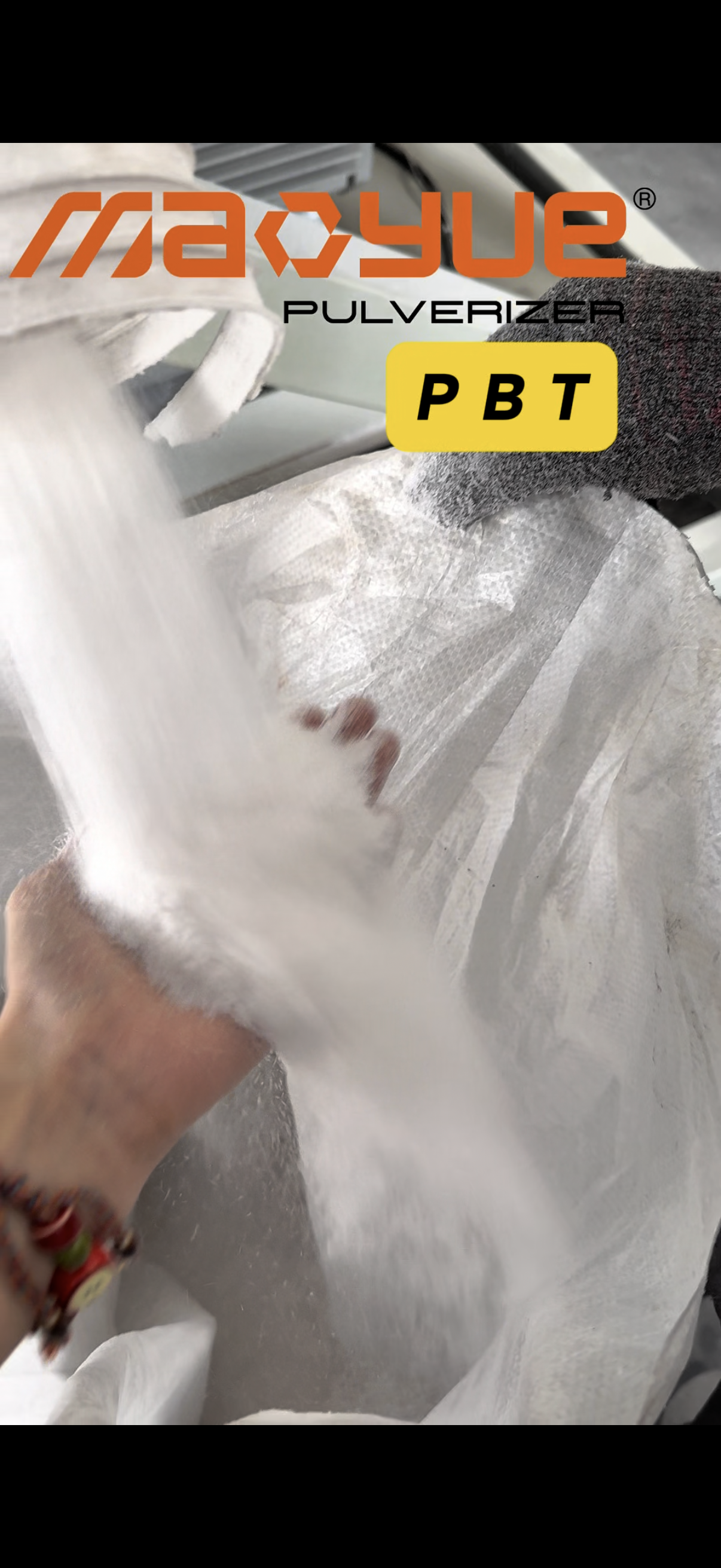
Modern chemical fiber and masterbatch production is increasingly moving toward automation, continuous operation, and large-scale stable manufacturing. In this production model, enterprises not only require stable PBT powder quality, but also place greater emphasis on whether the equipment can operate reliably over long periods, reduce energy consumption, minimize downtime, and improve overall output efficiency.
MaoYue plastic pulverizers are optimized around these real production needs. Through improvements in grinding disc structure, transmission system, and overall airflow circulation, the equipment achieves higher unit capacity and lower operating energy consumption while maintaining stable production of high-quality PBT powder.
For customers, this means:
Higher output within the same time frame, improving overall line capacity;
Lower energy consumption per unit product, reducing long-term operating costs;
More stable operation with fewer fluctuations, minimizing downtime losses caused by equipment instability;
Reduced maintenance frequency and cost, lowering labor and spare parts expenses;
Better suitability for continuous and large-scale production, improving overall plant efficiency.
In addition, MaoYue equipment emphasizes long-term operational stability and ease of maintenance in its structural design, enabling it to adapt to extended continuous running conditions and reducing production interruptions caused by equipment failure or maintenance downtime.
Ultimately, customers gain not only energy-saving and high-output equipment, but also higher line utilization, lower overall production costs, and more stable long-term production capability—giving them a stronger competitive advantage in terms of cost efficiency and delivery reliability.
PBT is not just a common engineering plastic, but a key foundational material driving continuous innovation in the chemical fiber masterbatch industry. Its excellent mechanical properties, heat resistance, dimensional stability, and processing performance provide a solid foundation for high-quality fiber and premium masterbatch production.
With the continuous growth of demand for high-performance materials, green manufacturing, and precision processing, the market places increasingly higher requirements on PBT powder quality. Advanced pulverizing technology will therefore play an increasingly important role in particle size control, powder dispersion, and production efficiency.
Leveraging over 30 years of technical expertise, Changzhou MaoYue Intelligent Equipment Co., Ltd. continues to provide global customers with high-efficiency, low-energy-consumption, and high-precision plastic pulverizing solutions. Through advanced grinding technology, excellent manufacturing craftsmanship, and comprehensive after-sales service, MaoYue helps customers consistently produce high-quality PBT powder, improve masterbatch quality, and continuously empower the high-quality development of the global chemical fiber industry.


