English


Views: 0 Author: Site Editor Publish Time: 2026-09-22 Origin: Site
A good rotomolded product does not begin when the mold starts rotating. It begins with powder preparation.
For rotomolding, PE powder is not simply a matter of “the finer, the better.” The powder needs to feed consistently and move, spread, heat, melt, and fuse properly as the mold rotates, ultimately forming a uniform and stable product wall. Therefore, powder quality can directly affect downstream rotomolding performance and product consistency.
A PE powder suitable for rotomolding typically requires comprehensive consideration of:
Flowability
Bulk density
Particle size and particle size distribution
Particle morphology
Powder temperature
Feeding stability
Compatibility with the final application
Therefore, the goal of rotomolding powder production is not to pursue a single parameter, but to produce powder that matches the raw material, rotomolding process, and final product requirements.
This is also the starting point for Mao Yue’s PE pulverizing solutions: first understand the actual material, target powder requirements, and final application, and then determine the appropriate PE pulverizer and supporting configuration.
A good PE rotomolding powder cannot be evaluated based on a single number or parameter.
Its performance during feeding, mold loading, rotation, and heating is determined by the combined effect of multiple powder properties.
Powder Property |
Impact on Production |
|---|---|
Flowability |
Affects how the powder passes through the feeding equipment and moves and distributes inside the mold |
Bulk Density |
Affects powder volume, packing, and material conveying |
Particle Size Distribution |
Affects melting, fusion, surface formation, and overall powder processing performance |
Particle Morphology |
Affects particle movement, packing, and flowability |
Powder Temperature |
Helps reduce the risk of softening and agglomeration during pulverizing |
Stability |
Helps maintain consistent powder quality between batches during continuous production |
Therefore, “finer” powder or a higher value for any single property does not necessarily mean that the powder is more suitable for rotomolding.
The ideal rotomolding powder is one that achieves a reasonable balance between flowability, particle size, bulk density, temperature, and stability while matching the raw material, equipment, processing conditions, and final application.

Flowability is one of the important indicators for evaluating PE rotomolding powder.
Good powder flowability helps the material pass smoothly through the hopper, feeding equipment, and conveying system. It also helps the powder move and distribute consistently as the mold rotates, reducing problems such as bridging, material blockage, unstable feeding, and localized accumulation.
If powder flowability is poor, it may result in:
Unstable feeding
Bridging or material blockage
Uneven powder distribution
Difficult material conveying
However, flowability is not an independent property. Particle size distribution, particle morphology, bulk density, and overall powder condition can all affect actual flow performance. Therefore, PE rotomolding powder should be evaluated based on the actual material and production conditions rather than relying on a single test result.
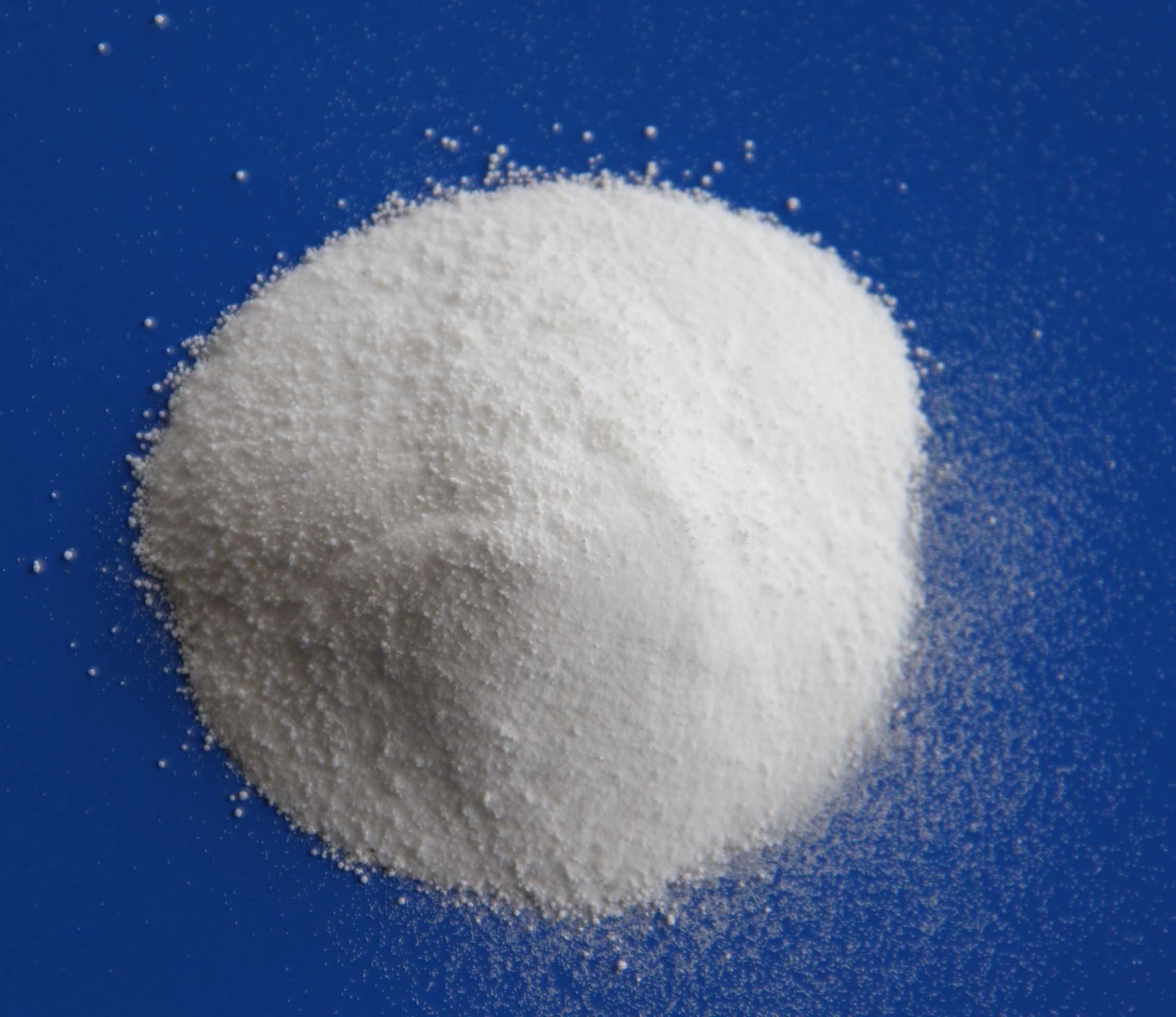
Bulk density reflects the mass contained in a unit volume of powder and is also affected by the spaces between particles.
For PE rotomolding powder, bulk density can affect powder storage, conveying, feeding, and mold loading. An appropriate bulk density helps maintain stable material handling and packing behavior.
However, higher bulk density is not necessarily better. It needs to be considered together with particle size distribution, particle morphology, flowability, resin type, and the final application.
Therefore, in actual production, the goal is not to achieve the highest possible bulk density, but to achieve a reasonable bulk density that matches the powder characteristics and rotomolding process.

Particle size is one of the important indicators for evaluating PE rotomolding powder, but it is not the only one.
A high proportion of coarse particles may affect powder melting and surface formation, while an excessive amount of ultrafine particles may increase dust and affect flowability and packing behavior.
Therefore, the focus of rotomolding powder production is not to pursue finer powder at all costs, but to achieve a stable and reasonable particle size distribution that is suitable for the final application.
Some industry references list a particle size range of approximately 150–500 μm for PE rotomolding powder. However, the actual target should be determined based on the resin type, equipment, mold, processing conditions, and final product.
In other words, the right particle size distribution is more important than simply pursuing smaller particles.
Even when two PE powders have similar particle sizes, they may perform differently during actual processing. One important reason is particle morphology.
Particle shape, surface condition, and degree of regularity can affect powder flow, packing, and movement as the mold rotates. Elongated, sharp, rough, or highly irregular particles may exhibit different flow characteristics compared with more compact and uniform particles.
Therefore, particle size alone should not be used to evaluate rotomolding powder.
Particle size determines “how large the particles are,” while particle morphology affects “how they move.” Both need to be considered together when evaluating the actual processing performance of the powder.
Temperature is a key factor that needs to be controlled during high-speed PE pulverizing.
PE is a thermoplastic material. During the pulverizing process, high-speed movement and friction continuously generate heat. If the temperature rises too quickly or becomes too high, the material may soften, stick, or agglomerate, affecting powder quality, output, and continuous operating stability.
Therefore, a cooling system is an important part of a PE pulverizing solution. The actual cooling method should be selected based on the material type, target particle size, output, operating time, and equipment configuration.
Maoyue can configure air cooling, water cooling, or combined air-and-water cooling according to actual production requirements, helping control temperature rise during pulverizing and supporting stable PE powder production.
The production of high-quality PE rotomolding powder is not simply a matter of making PE material finer. It is a complete process that requires coordinated control across multiple stages.
A typical production process is:
Feeding → Pulverizing → Cooling → Sieving → Powder Collection
Stable feeding affects output and pulverizing conditions. Pulverizing determines particle size and particle size distribution. Cooling controls temperature rise during processing. Sieving helps control powder specifications, while powder collection affects subsequent conveying and use.
Therefore, the final powder quality depends on the entire production system, not just the pulverizing stage.

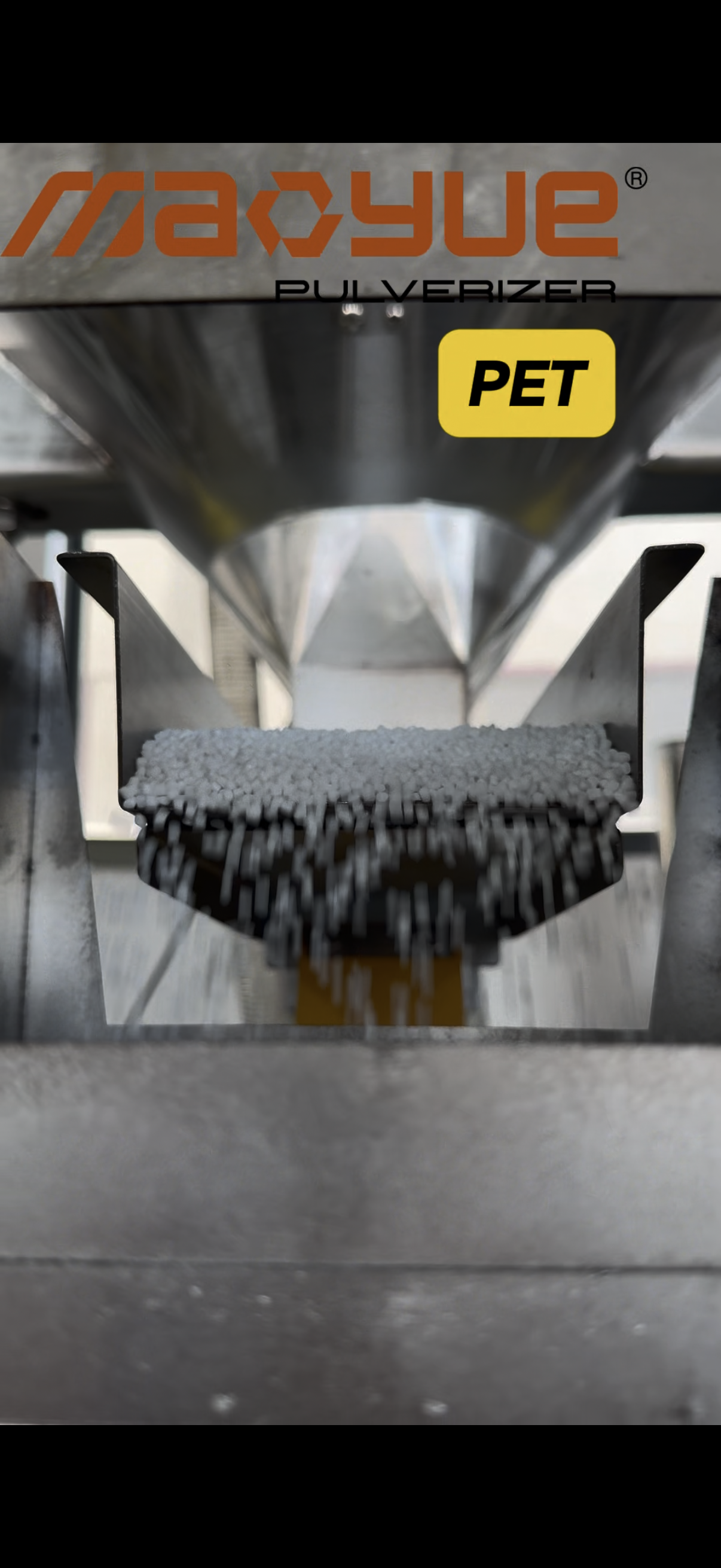
Stable feeding is the foundation of continuous PE powder production.
Feeding too quickly may increase equipment load and temperature rise, while feeding too slowly or with significant fluctuations may reduce output and affect pulverizing conditions.
Therefore, the feeding system should be matched to the material characteristics, target output, and pulverizer configuration, ensuring that the material enters the pulverizing chamber continuously and evenly to support stable production.
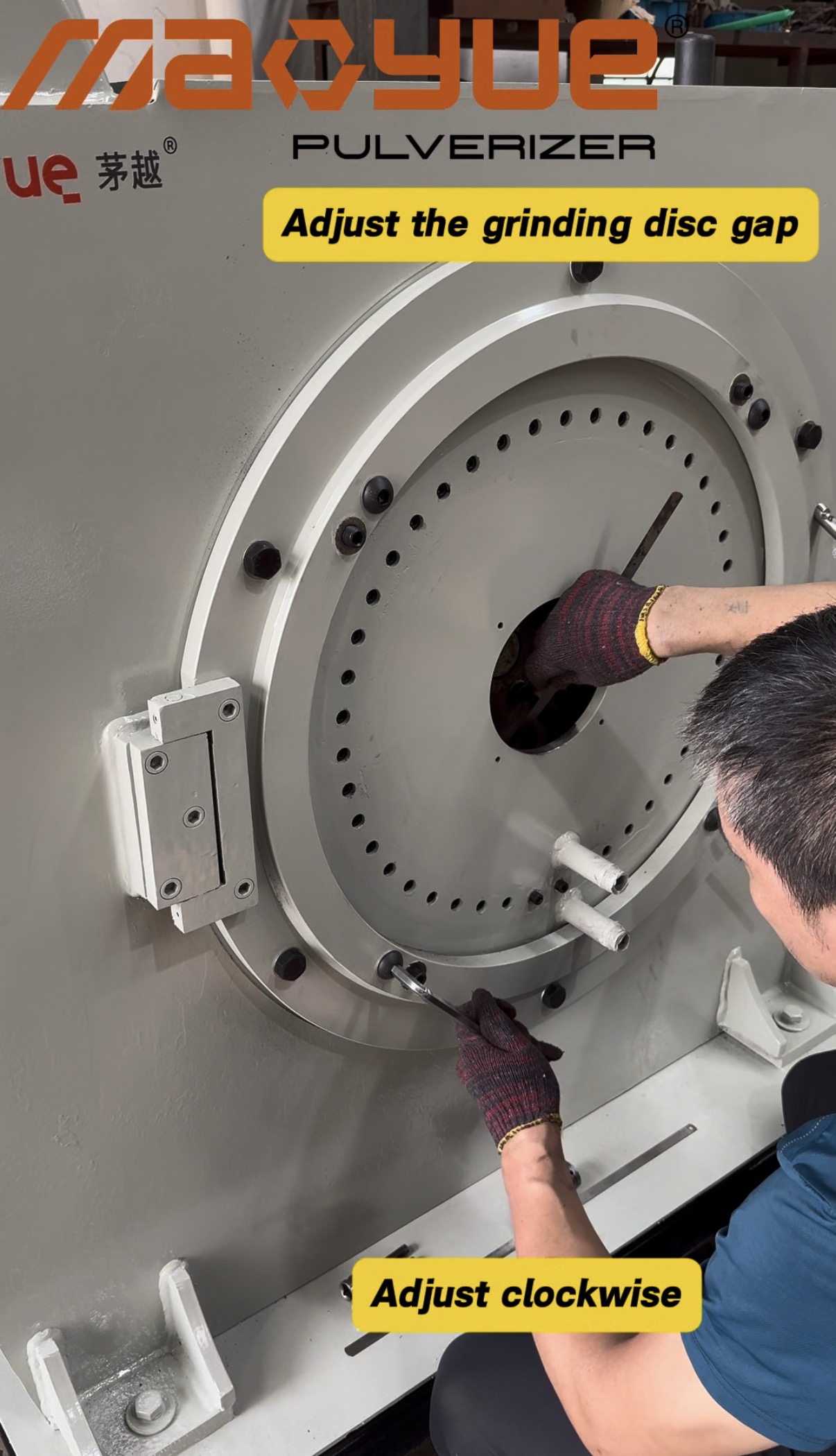
The pulverizer is the core equipment used to process PE granules or pre-treated PE material into powder, but the purpose of pulverizing is not simply to reduce particle size.
A stable pulverizing process needs to balance particle size, particle size distribution, particle morphology, output, temperature, and powder stability. Among these factors, the disc working gap is an important adjustment parameter that affects powder fineness and output.
In general, a smaller disc gap helps produce finer powder, while a larger gap is more suitable for coarser target particle sizes or higher output.
However, there is no fixed “optimal gap” that applies to all PE materials. The actual parameters should be adjusted according to the material characteristics, target particle size, and output requirements.
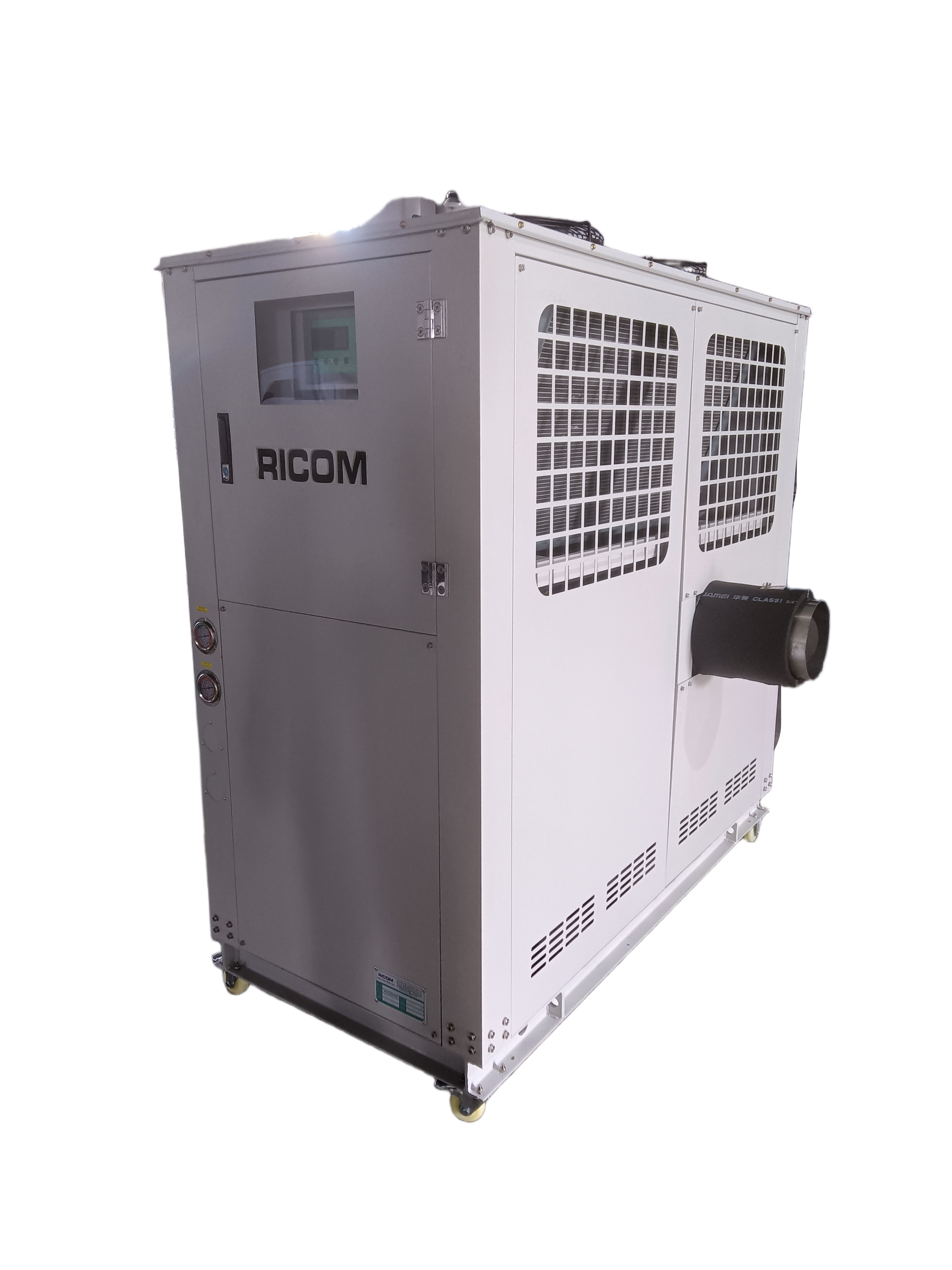
The cooling system is mainly used to control the heat generated during continuous PE pulverizing and help maintain stable pulverizing conditions.
For some PE applications, air cooling can provide sufficient temperature control. For high-output applications or operating conditions with a higher thermal load, water cooling or combined air-and-water cooling can provide stronger heat dissipation.
Therefore, the cooling method should not be selected based on a fixed configuration. It should be determined according to the material characteristics, target particle size, output, and actual operating conditions.
The ultimate goal is to control temperature rise during processing and reduce the risk of material softening, sticking, and agglomeration.

After pulverizing and cooling, the powder can be further classified through sieving to remove oversized particles and help maintain consistent particle size and powder quality.
The powder collection system is responsible for efficiently collecting and conveying the powder generated during the pulverizing process. Equipment such as cyclones and dust collectors can work together to separate, collect, and remove dust from the powder, supporting subsequent conveying and use.
Therefore, sieving and powder collection not only affect powder quality but also play an important role in the continuous operation of the entire PE powder production system.
The role of a PE pulverizer is not simply to “make the plastic smaller.” The equipment design, pulverizing parameters, and supporting systems can all affect the final powder performance.
For example, the disc gap affects particle size and particle size distribution, while pulverizing speed and the cooling system affect temperature. The feeding system influences production stability, while the sieving and powder collection systems affect powder consistency and subsequent handling.
Therefore, when selecting a PE pulverizer for rotomolding applications, the equipment should be selected based on the target powder, actual material, and production requirements rather than relying solely on the machine’s rated output.
Even two machines with the same rated capacity may produce different powder results when processing different PE materials.
Therefore, before finalizing the equipment configuration, testing the actual material to verify particle size, output, temperature rise, and powder condition is an important step.
When choosing a PE pulverizer, you should not look only at the machine power or rated output. More importantly, the equipment configuration should be determined based on the actual material, target powder, and production requirements.
Selection Factor |
What to Consider |
|---|---|
PE Material |
LLDPE, HDPE, recycled PE |
Initial Feed Size |
Particle size of the material before pulverizing |
Target Powder Particle Size |
Required particle size and particle size distribution |
Output |
Required output capacity (kg/h) |
Operating Time |
Intermittent or continuous production |
Cooling Method |
Air cooling, water cooling, or combined cooling |
Disc Gap |
Adjustable working gap to meet different powder requirements |
Sieving |
Required powder classification method |
Powder Collection System |
Cyclone separator, dust collector, and conveying system |
Material Testing |
Actual material testing before finalizing the equipment configuration |
Ultimately, a suitable PE pulverizer should achieve a reasonable balance between target particle size, output, temperature control, and continuous operating stability.

LLDPE offers good flexibility, impact performance, and processing adaptability, making it widely used in rotomolded products.
However, different LLDPE resin grades may have different properties and processing characteristics, which can also affect their pulverizing behavior and the condition of the final powder.
Therefore, when pulverizing LLDPE, the appropriate pulverizing parameters and equipment configuration should be determined based on the specific raw material, target powder particle size, and final product requirements.
HDPE offers good stiffness, chemical resistance, and environmental resistance, making it suitable for rotomolded products such as storage tanks, containers, and industrial components where material performance is important.
Different HDPE resin grades may vary in hardness and processing characteristics, which can also affect their pulverizing parameters and powder performance.
In actual production, the appropriate PE pulverizing solution should be selected based on the specific raw material, target particle size, required output, and final application.
Compared with virgin PE, recycled PE typically has a more complex material composition. Differences in composition, impurities, moisture, previous processing history, and initial particle size can all affect temperature rise, output, and the final powder condition during pulverizing.
Therefore, a recycled PE pulverizing solution should not simply follow fixed parameters. Testing the actual material to verify particle size, output, and processing stability can help determine the appropriate equipment configuration.
The Dry Flow Test is used to measure the time required for a specified amount of powder to pass through a standard funnel under defined test conditions.
Under the same testing conditions, a shorter flow time generally indicates better powder flowability. The Association of Rotational Molders (ARM) also provides relevant test methods for evaluating the flowability of rotomolding powders.
This test can be used as a reference for assessing the flow performance of PE rotomolding powder. However, actual production performance should still be evaluated in combination with factors such as particle size, particle morphology, and bulk density.

The Bulk Density Test is used to measure the mass corresponding to a given volume of powder, reflecting the powder’s packing characteristics.
This parameter helps evaluate powder performance during storage, conveying, feeding, and mold loading. It can also serve as a reference for assessing powder consistency and material handling characteristics.
However, higher bulk density is not necessarily better. Its practical significance should still be evaluated together with particle size distribution, particle morphology, and flowability.
Particle size distribution should be determined through actual testing rather than estimated based solely on experience.
Through sieving, the proportion of powder within different particle size ranges can be identified, helping detect issues such as an excessive proportion of coarse particles or ultrafine powder.
Therefore, particle size analysis is an important reference for determining whether PE rotomolding powder meets the target specifications. It can also help optimize pulverizing and sieving parameters.
Powder Problem |
Possible Impact |
|---|---|
Poor Flowability |
Unstable feeding and uneven powder distribution |
Unsuitable Bulk Density |
Affects packing, conveying, and material handling |
Excessive Ultrafine Powder |
Increases dust and may affect flowability |
Excessive Coarse Particles |
May affect melting and processing performance |
Wide Particle Size Distribution |
Reduces consistency in powder processing performance |
High Powder Temperature |
Increases the risk of softening, sticking, or agglomeration |
Unstable Feeding |
Causes fluctuations in pulverizing load and production conditions |
These problems are usually not caused by a single factor. Material characteristics, pulverizing parameters, cooling, sieving, and feeding conditions can all interact with each other and should be analyzed based on actual production conditions.
Mao Yue focuses on developing rotomolding powder production solutions based on the final application, rather than selecting equipment based solely on a single particle size parameter.
We are not only asking:
“Can this machine produce 40-mesh powder?”
More importantly:
“What kind of powder does your rotomolding process actually require?”
Because “40 mesh” only describes a particle size range. It does not fully reflect flowability, bulk density, particle morphology, temperature, or actual processing performance.
Therefore, a suitable PE pulverizing solution should start with the actual material, target powder, and final application, and then determine the appropriate equipment and process parameters.


For LLDPE, HDPE, and recycled PE used in rotomolding applications, Mao Yue provides PE plastic pulverizing equipment and supporting solutions.
The equipment is designed around stable pulverizing, adjustable working gap, temperature control, stable feeding, and efficient powder collection, helping different materials achieve more consistent powder characteristics.
The ultimate goal is not simply to make the powder “look fine,” but to produce powder that is truly suitable for subsequent rotomolding processes.

Pulverizing components come into direct contact with the material, and their structural design, machining accuracy, and surface condition can all affect pulverizing performance.
Mao Yue manufactures its core pulverizing components in-house and uses CNC precision machining and strict inspection to control dimensions and machining consistency.
For PE pulverizers, precision not only affects the initial pulverizing performance but can also influence the working gap, dynamic balance, wear, and long-term operating stability.
Therefore, the machining precision of pulverizing components is an important foundation for stable equipment operation and consistent production.

Mao Yue places strong emphasis on its in-house manufacturing capabilities for core pulverizing components. Except for certain externally sourced components such as motors and electrical parts, the main core pulverizing components are manufactured in-house by Mao Yue.
This allows better control over component compatibility, machining quality, and equipment maintenance, while also making it easier to continuously optimize equipment configurations based on actual production requirements.
In-house manufacturing of core components also means having more direct control over the overall machine performance.
Rotomolding powder production often requires the pulverizer to operate continuously for several hours. Therefore, equipment performance should not be evaluated only by whether it “can produce powder,” but also by whether it can maintain stable production over extended periods.
During continuous operation, temperature, vibration, bearing condition, disc gap, and electrical load can all affect equipment stability and powder consistency.
Therefore, a PE pulverizer suitable for continuous production should not only provide stable pulverizing performance, but also offer effective temperature control, mechanical stability, and reliable continuous operation to help reduce production fluctuations.

PE rotomolding powder is widely used for water tanks, storage tanks, chemical containers, road barriers, kayaks, playground equipment, outdoor furniture, agricultural tanks, and various industrial products.
Different products have different requirements for flexibility, impact resistance, stiffness, UV resistance, and chemical resistance. Therefore, different PE raw materials and powder characteristics need to be matched accordingly.
The material itself determines some of the final product properties, while the powder’s particle size distribution, flowability, temperature, and processing stability can also affect its melting, spreading, and molding performance during rotomolding.
Therefore, suitable PE rotomolding powder should be matched with the specific raw material, powder requirements, and final application.
Even within the same PE category, different materials may behave differently during pulverizing. Raw material properties, initial particle size, moisture content, recycled material ratio, additives, and target powder particle size can all affect feeding, pulverizing temperature, output, and the final powder condition.
Therefore, selecting a PE pulverizer should not rely solely on the power and output specifications listed in a product catalog. The actual material and production requirements also need to be considered.
Through actual material testing, powder fineness, output, temperature rise, and operating stability can be evaluated more directly, providing a basis for equipment configuration and process parameter selection.
When choosing a PE pulverizer, you should not focus only on machine power or rated output. More importantly, you should consider whether the equipment matches your actual production requirements. Key questions include:
Material: Has the actual PE raw material been tested? Does it contain recycled PE?
Powder: What are the target particle size and particle size distribution?
Output: What output can the machine achieve when processing the actual material?
Temperature: How is temperature rise controlled during continuous pulverizing?
Pulverizing: Is the disc working gap adjustable?
Cooling: Is air cooling, water cooling, or combined cooling more suitable?
Powder Collection: How will the powder be sieved, collected, and conveyed?
Operation: Can the equipment support long-term continuous production?
Ultimately, the appropriate PE pulverizer and system configuration should be determined based on the actual material, powder requirements, and target production capacity.
There is no single optimal particle size that is suitable for all rotomolding products.
The appropriate particle size distribution should be determined based on the resin, mold, processing conditions, and final product.
Not necessarily.
Excessively fine powder may increase dust and affect flowability and packing behavior.
The key is to control a particle size distribution that is suitable for the final application, rather than simply pursuing the finest possible powder.
Particle size distribution, particle morphology, the proportion of fines, bulk density, moisture content, and other material characteristics can all affect the flowability of PE powder.
Bulk density affects powder packing, material handling, and the volume occupied by a given mass of powder.
Therefore, bulk density should be evaluated together with flowability and particle size distribution.
Yes, but the composition and previous processing conditions of recycled PE may vary significantly.
Cooling is generally an important part of the process because pulverizing generates heat.
Whether to use air cooling, water cooling, or combined air-and-water cooling should be determined based on the PE material, output, target particle size, and actual operating conditions.
Disc-type plastic pulverizers are commonly used for producing thermoplastic plastic powders.
The specific equipment configuration should be determined based on the material, target particle size, output, and final application.
A good rotomolding powder production solution should start with the actual PE material and production requirements, rather than relying solely on equipment specifications.
You can provide Maoyue with:
PE material information and initial particle size
Target powder particle size
Required output and daily operating hours
Final rotomolded product and application
Mao Yue can conduct tests using your actual material to evaluate powder fineness, output, temperature rise, feeding, and operating performance, and then further determine the appropriate equipment and system configuration.
What really matters is not simply “Can this type of PE be pulverized into powder?” but whether it can be processed consistently into PE powder that meets the requirements of the rotomolding process.
Send us your PE material and production requirements, and contact Mao Yue for actual material testing.
Good PE rotomolding powder is not defined by a single particle size or parameter. It is determined by the combined performance of flowability, bulk density, particle size distribution, particle morphology, temperature stability, and other factors.
These powder properties also depend on a complete production process:
Feeding → Pulverizing → Cooling → Sieving → Powder Collection
For Mao Yue, the goal is not simply to make PE granules smaller, but to help customers produce PE powder that is truly suitable for rotomolding through stable feeding, precise pulverizing, effective cooling, proper sieving, and stable powder collection.
Therefore, finer powder is not necessarily better. The right rotomolding powder should achieve a balance between flowability, particle size distribution, packing behavior, and processing stability, ultimately meeting the molding requirements of the final product.


