Specializing in the production of Plastic Pulverizer Machines.

Views: 0 Author: Site Editor Publish Time: 2026-09-07 Origin: Site
Does an 800 kg/h Plastic Pulverizer Really Only Need a Bigger Motor?
Absolutely not.
True high-output production is not just about reaching the target capacity. It also requires stable powder quality, controlled grinding temperature, and reliable long-term continuous operation.
That’s why Mao Yue does not simply increase the machine’s power. Instead, we optimize the entire system—from raw material, feeding, grinding discs, and cooling to airflow, screening, and the control system—to ensure that every component works together.
For Mao Yue, 800 kg/h is not just a capacity figure—it is a stable and sustainable production capability.
An industrial plastic pulverizer is like a high-performance engine. Running at high speed is not the difficult part—the real challenge is maintaining stable performance under heavy loads for long periods of time.
When the capacity reaches around 800 kg/h, feeding rate, grinding disc gap, and cooling performance can all directly affect production. If feeding is unstable, the grinding disc gap is not properly adjusted, or temperature control is insufficient, the result may be reduced output, inconsistent powder quality, or even increased machine load.
Therefore, the real challenge of achieving 800 kg/h is not simply reaching the target capacity. It is maintaining stable output, consistent particle size, and reliable operating conditions even under high-capacity production.
At Mao Yue, “800 kg/h” should not be viewed as just a single number.
A truly stable plastic powder production system needs to maintain multiple performance indicators at the same time:
Performance Indicator | Stability Requirements |
|---|---|
Output | Continuous and stable |
Particle Size | Uniform and consistent |
Grinding Temperature | Controllable during continuous operation |
Feeding | Uniform and continuous |
Airflow | Stable powder conveying |
Grinding Components | Controlled wear |
Dust Collection | Effective powder recovery |
Operation | Simple and controllable |
Therefore, stable plastic pulverizing does not depend solely on the main pulverizer. Instead, the feeding, pulverizing, cooling, conveying, screening, and control systems need to be properly matched to create a complete and reliable continuous production process.

When choosing a plastic pulverizer, the first consideration should not be the output—it should be the raw material.
Different plastics have different hardness, melting points, and heat resistance, which means they behave differently during pulverizing. PE, PP, and PVC require different pulverizing parameters and cooling methods, and there is no single configuration that is suitable for every material.
Therefore, Mao Yue matches the appropriate grinding discs, pulverizing parameters, and cooling system based on the customer's raw material characteristics, target powder fineness, and required output. This provides a solid foundation for stable production.
This is why raw material testing is so important.
Before determining a high-capacity plastic pulverizing solution, several factors need to be considered:
Raw material hardness
Feed size
Raw material shape
Moisture and impurities
Target powder fineness
Target hourly output
Temperature sensitivity
Final application
The same machine does not necessarily achieve the same output when processing different materials. 800 kg/h is not a fixed parameter—it is the actual result of matching the machine with the raw material.
The machine determines the basic capability, while the raw material determines the final performance.
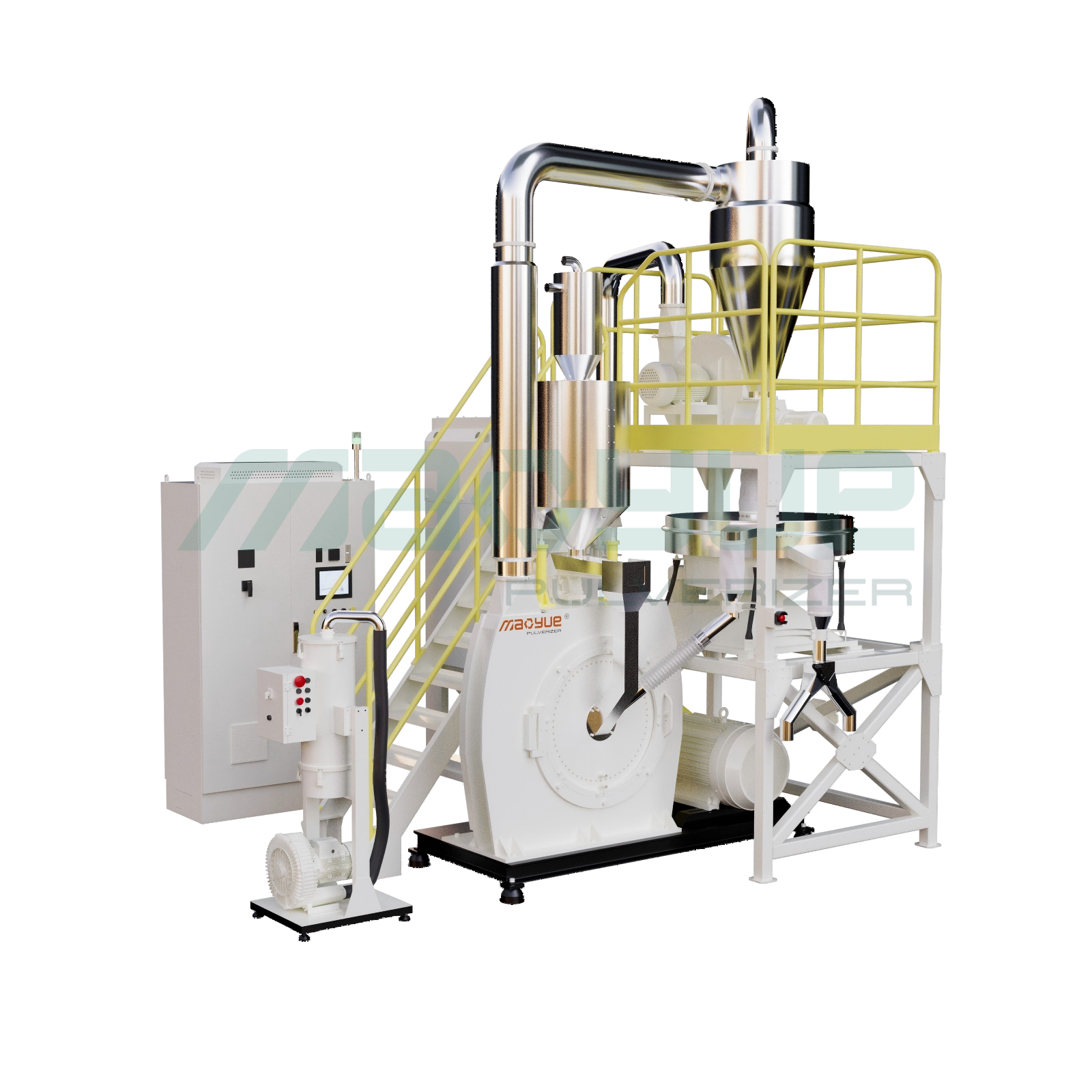
For high-output PE and PP powder production, the machine model and grinding disc size directly affect processing capacity.
Mao Yue’s 800 model plastic pulverizer uses an 800 mm grinding disc and can be equipped with the appropriate motor power and cooling system according to different raw materials and production requirements.
For customers targeting an output of around 800 kg/h, this capacity range provides sufficient production margin and allows the machine to avoid operating continuously at its maximum load.
Therefore, choosing the right machine model is not simply about pursuing a “higher output.” It is about matching the machine’s processing capacity, powder fineness, and operating stability with actual production requirements.

PVC pulverizing has different requirements for machine design and cooling methods, so PE or PP configurations cannot simply be applied to PVC.
For example, Mao Yue’s MF-850 PVC pulverizer uses a 660 mm grinding disc and a 90 kW motor, combined with water and air cooling to control the grinding temperature. It can meet the powder production requirements of materials such as PVC pipes and profiles.
This also shows that 800 kg/h is not a fixed machine configuration. A truly suitable solution needs to be matched according to the processing material, target output, and required powder fineness.

Stable pulverizing production starts with stable feeding.
Just like a steady flow of water, if the feeding rate constantly fluctuates, the load inside the grinding chamber will also change continuously, which can affect both output and powder quality.
Mao Yue uses a vibratory feeding system to ensure that materials enter the grinding chamber more evenly and continuously. An iron removal device can also be configured to reduce the impact of metal contaminants on the grinding discs and other core components.
Simply put, stable feeding keeps the pulverizer operating within its optimal working range.

Once the material enters the grinding chamber, the grinding disc becomes one of the key components determining powder fineness and production efficiency.
If the grinding gap is too small, the powder can become finer, but friction and heat generation may also increase. If the gap is too large, it may help increase output, but the resulting powder may be too coarse.
Therefore, Mao Yue uses an adjustable grinding gap design, allowing the gap to be adjusted according to different raw materials and powder requirements. This helps achieve a better balance between powder fineness, output, and grinding temperature.
In simple terms, the grinding gap may seem like a small parameter, but it can have a direct impact on the overall performance of the pulverizer.

In high-output continuous production, wear is one of the key factors affecting long-term stability.
Grinding discs and grinding teeth gradually wear during continuous operation. This can change the working gap and subsequently affect powder fineness and production efficiency. Therefore, in addition to having a well-designed grinding system, the core grinding components also need to provide good wear resistance.
Mao Yue manufactures core components such as rotors, fixed knives, and grinding discs in-house and selects suitable wear-resistant materials according to different materials and applications.
For example, the PE/PP 800 model plastic pulverizer uses DC53 grinding knives, helping maintain stable grinding performance over extended periods of operation.
A good grinding disc should not only produce fine powder—it should also maintain consistent performance after long hours of continuous production.

For thermoplastic materials, temperature control has a direct impact on pulverizing performance.
Heat is continuously generated during high-speed grinding. If the heat is not removed efficiently, the material may soften, which can affect powder fineness, output, and production stability.
Therefore, Mao Yue configures air cooling, water cooling, or combined cooling systems according to different materials and production requirements. For example, the 800 model PE/PP pulverizer can be equipped with a water-cooling system to help remove heat generated during the grinding process.
Cooling is not simply about making the machine “as cold as possible.” The goal is to keep the equipment within a suitable and stable operating temperature range, helping ensure continuous production and consistent powder quality.

The grinding process is not finished when the powder is produced. The powder must also be discharged from the grinding chamber quickly and smoothly.
Mao Yue uses airflow to carry qualified powder into the conveying pipeline and can configure cyclone separators, dust collection systems, and screening equipment according to production requirements. This enables continuous production from grinding and conveying to powder collection.
Proper airflow design not only helps remove powder efficiently but also reduces powder accumulation inside the system, helping the equipment maintain stable operation.
Simply put, the pulverizer produces the powder, while airflow helps the powder “move out” smoothly.

If the customer has specific requirements for powder particle size, the grinding process alone may not ensure that all particles fall within the target range.
Therefore, Mao Yue can configure a screen after the pulverizing system to screen the finished powder. Qualified powder is separated from coarser particles, further improving particle size consistency.
For applications with strict powder quality requirements, screening is not only the final processing step but also an important quality control stage.

High-output continuous production cannot rely solely on operator experience. It also requires a stable control system.
Maoyue equipment can be equipped with an electrical control cabinet and variable frequency drive (VFD) system, allowing feeding and operating parameters to be adjusted according to actual production conditions. For example, the published configuration of the PE/PP 800 model includes a VFD and control cabinet, making it easier for operators to adjust the equipment in real time.
This helps reduce unnecessary manual intervention and allows operating parameters to be adjusted according to the machine’s running condition, helping maintain more stable output, temperature, and powder quality.
Stable plastic powder production at 800 kg/h cannot be achieved by the pulverizer alone. Instead, it requires all components of the system to work together efficiently.
System | Main Function |
|---|---|
Feeding System | Uniformly conveys materials |
Iron Removal Device | Protects core components |
Main Pulverizer | Performs the core pulverizing process |
Cooling System | Controls grinding temperature |
Fan | Conveys the powder |
Cyclone Separator | Separates the powder |
Dust Collector | Collects fine dust |
Swing Screen | Controls particle size |
Control Cabinet | Monitors and adjusts the production process |
The specific configuration is not a fixed template. Instead, it is matched according to raw material characteristics, feed size, target powder fineness, and required output.
A truly stable 800 kg/h production capacity comes from the proper coordination of the entire system.
Plastic Raw Material → Feeding → Pulverizing → Cooling → Air Conveying → Cyclone Separation → Dust Collection → Screening → Finished Plastic Powder
From a process perspective, this workflow may not seem complicated. However, achieving stable production at 800 kg/h depends on how well each stage works together.
The feeding system keeps the load stable, the grinding discs refine the material into powder, the cooling system controls temperature, airflow handles powder conveying, and screening controls the final particle size.
Therefore, stable high-output production is more like a coordinated team effort than the performance of a single machine.

Consistent powder quality depends not only on the grinding discs but also on the coordinated control of the entire production process.
Uniform feeding helps reduce load fluctuations inside the grinding chamber, allowing the equipment to maintain a stable operating condition.

The grinding disc gap needs to be properly matched to the raw material and target powder fineness. Mao Yue uses an adjustable grinding system, making this critical parameter easier to control.
Continuous high-output pulverizing generates more heat. Proper air cooling, water cooling, or combined cooling helps control temperature and prevents temperature fluctuations from affecting powder quality.
The powder needs to be discharged quickly and smoothly. With properly designed airflow, cyclone separation, and dust collection systems, powder accumulation can be reduced, helping keep the entire production process continuous.

Although a grinding disc may appear to be just a metal component, its grinding tooth structure, disc surface accuracy, and machining consistency can all affect actual pulverizing performance.
Mao Yue specializes in the R&D and manufacturing of plastic pulverizers, grinding discs, and grinding knives. Through precision machining processes, Maoyue controls the manufacturing quality of core components, providing a solid foundation for stable equipment operation.

When the grinding disc rotates at high speed, dynamic balancing has a direct impact on equipment vibration and operating conditions.
Proper dynamic balancing can reduce vibration generated during high-speed rotation and minimize its impact on bearings and other mechanical components.
Therefore, a high-output plastic pulverizer requires more than sufficient motor power. Manufacturing precision and dynamic balancing are equally important foundations for achieving reliable, long-term operation.
High-output production does not necessarily mean high maintenance costs. The equipment’s structural design and the way wear parts are replaced are equally important.
Mao Yue focuses on wear-resistant components and convenient maintenance design, making core pulverizing components easier to inspect and replace. For example, the movable knives and fixed knives of PVC pulverizers can be replaced conveniently, helping reduce maintenance downtime.
For continuous production, reducing unnecessary downtime means lowering maintenance costs and improving production efficiency.
This is the most important point of the entire article.
800 kg/h is not achieved by the main pulverizer alone. It is the result of coordinated operation across the entire production system.
It depends on multiple stages, including raw materials, feeding, pulverizing, cooling, airflow, separation, screening, control, and maintenance. A bottleneck in any one of these areas can affect the final output.
That is why Mao Yue focuses on providing a complete plastic pulverizing solution. From raw material analysis and material testing to system design, equipment manufacturing, installation and commissioning, and operator training, Mao Yue helps customers build a pulverizing system that matches their actual production requirements.
The real 800 kg/h is not simply a number on the machine nameplate—it is the actual production capacity achieved through stable, continuous operation.

Rotomolding is one of the important applications for plastic powder, especially PE materials. Stable powder particle size and reliable powder production capacity can help maintain consistency in subsequent rotomolding processes.

Plastic powder is also widely used in masterbatch and modified plastic production. Mao Yue can provide suitable pulverizing solutions for different materials, including color masterbatch and filled masterbatch, to meet different powder fineness requirements.

PVC powder is mainly used in applications such as pipes, profiles, flooring, and wall panels. The publicly listed maximum capacity of Mao Yue’s MF-850 PVC pulverizer can reach up to 800 kg/h, making it suitable for production applications that require high output and consistent powder quality.
Whether for rotomolding, masterbatch production, or PVC processing, the core objectives remain the same: stable output, uniform powder, and reliable continuous production.
For high-output plastic pulverizing projects, choosing the right manufacturer is just as important as choosing the right equipment.
Mao Yue not only manufactures plastic pulverizers but also produces core components such as grinding discs, grinding knives, and rotors in-house. By controlling the core pulverizing components, Mao Yue can better manage equipment performance.
According to the Mao Yue website, the company has more than 28 years of industry experience, with products covering PE/PP pulverizers, PVC pulverizers, grinding discs, grinding knives, and crushing and pulverizing production lines.
More importantly, Mao Yue can provide comprehensive support from raw material testing and solution design to equipment manufacturing, installation, commissioning, and production testing.
For high-output projects that require long-term stable operation, the real value is not simply a single machine, but a complete pulverizing solution that has been properly matched to the actual production requirements.
Yes, it can, but the actual output depends on the raw material, target powder fineness, and equipment configuration.
Mao Yue plastic pulverizers can process materials such as PE, PP, HDPE, LDPE, LLDPE, and PVC. The equipment can be configured according to the characteristics of different materials.
The final powder fineness depends on the raw material and equipment configuration. Different Mao Yue models offer different adjustable ranges. For example, the PE/PP product page lists a typical range of 20–80 mesh.
Yes. According to the Mao Yue website, customized solutions can be provided based on the customer’s raw material, required output, and target powder fineness.
So, how does Mao Yue achieve stable plastic powder production at 800 kg/h?
The answer is not simply to “choose a larger pulverizer.”
The real answer is a complete system that has been properly matched to the production requirements.
The raw material determines the pulverizing strategy; the feeding system controls the material load entering the grinding chamber; the grinding discs determine the core pulverizing performance; the adjustable grinding gap helps control powder particle size; the cooling system manages temperature rise; airflow conveys the powder; the screening system controls the final product; and precision manufacturing and wear-resistant components provide the foundation for long-term operation.
The control system connects all these stages together.
This is the difference between a machine that “can reach 800 kg/h” and a system that is “designed around the goal of stable 800 kg/h production.”
For companies looking to increase output, maintain consistent powder quality, and obtain a customized plastic pulverizing solution, the first step is not to simply choose a model from a product catalog.
The first step is to understand your raw material.
Tell Mao Yue what type of plastic you need to process, your target powder fineness, and your required output. We can recommend a suitable plastic pulverizer configuration based on your actual production conditions.


