English


Views: 0 Author: Site Editor Publish Time: 2026-10-10 Origin: Site
After a PE pulverizer has been running for a period of time, the particle size of the resulting PE rotomolding powder may change, even if the machine speed, feeding method, and other operating parameters remain relatively stable.
Does this mean the pulverizer blades are worn?
For PE rotomolding powder production, the blades are important components that influence grinding performance. As the blades wear, their working geometry may change, affecting the grinding process and the final particle size distribution. However, blade wear does not necessarily lead to an increase in coarse particles, and operating hours alone cannot determine whether blade replacement is necessary.
To understand how pulverizer blade wear affects powder particle size, it is important to examine the wear mechanism and evaluate actual production data.
A plastic pulverizer disc uses the interaction between rotating and stationary grinding discs to apply shearing, impact, and grinding forces to plastic particles, gradually reducing them to the target particle size.
During long-term operation, blade edges may become dull, and the working surfaces may gradually wear. These changes can affect the material reduction process. However, disc designs and operating principles vary among pulverizer models, so a specific effect should not be assumed to occur in every machine.
When blade conditions change, the actual grinding process may differ from that of new blades, even if machine speed and other operating settings remain unchanged.
Therefore, determining whether blade wear is affecting production requires more than simply checking whether the blades appear dull. The key is to establish whether changes in blade condition have affected grinding performance.
Blade wear can affect particle size in different ways. The actual outcome depends on the degree of wear, blade design, grinding gap, and material characteristics.

When blade wear reduces the effectiveness of shearing and grinding, some material may not be sufficiently pulverized. As a result, the proportion of particles exceeding the target particle size range may increase in the finished powder.
For PE rotomolding powder that requires consistent particle size, this may affect powder flow, spreading inside the mold, and processing consistency.
However, an increase in coarse particles does not directly prove that the blades are worn. Feeding conditions, grinding gap settings, and screening performance can also contribute to similar problems.
Two batches of powder can have similar average particle sizes without having the same particle size distribution.
For example, two batches of PE powder may have comparable average particle sizes, while one contains a higher proportion of fine and coarse particles and the other has particles concentrated within a narrower size range.
If blade wear changes the grinding process, the proportions of particles in different size ranges may also change. Therefore, evaluating blade condition requires more than measuring average particle size. The overall particle size distribution and the proportion of particles outside the target range should also be examined.
If blade working conditions change over time, powder quality may vary between different production periods.
For rotomolding manufacturers operating continuously, this means that even when the pulverizer continues to run normally, it is important to monitor whether powder particle size consistently meets production requirements.
These changes are not inevitable consequences of blade wear. Their actual impact should be determined using production data.
When the particle size distribution of PE rotomolding powder changes, blade replacement should not be the immediate conclusion. A more reliable approach is to compare production data and inspect the blades and related operating conditions.
Four areas deserve particular attention.
Compare changes in particle size distribution.

Compare powder test results obtained with new blades or blades in good condition against current results. Examine average particle size, the proportion of coarse particles, and changes across different particle size ranges. If the distribution continues to deviate from its original condition, further inspection of the pulverizing system is necessary.
Inspect the blades and grinding gap.
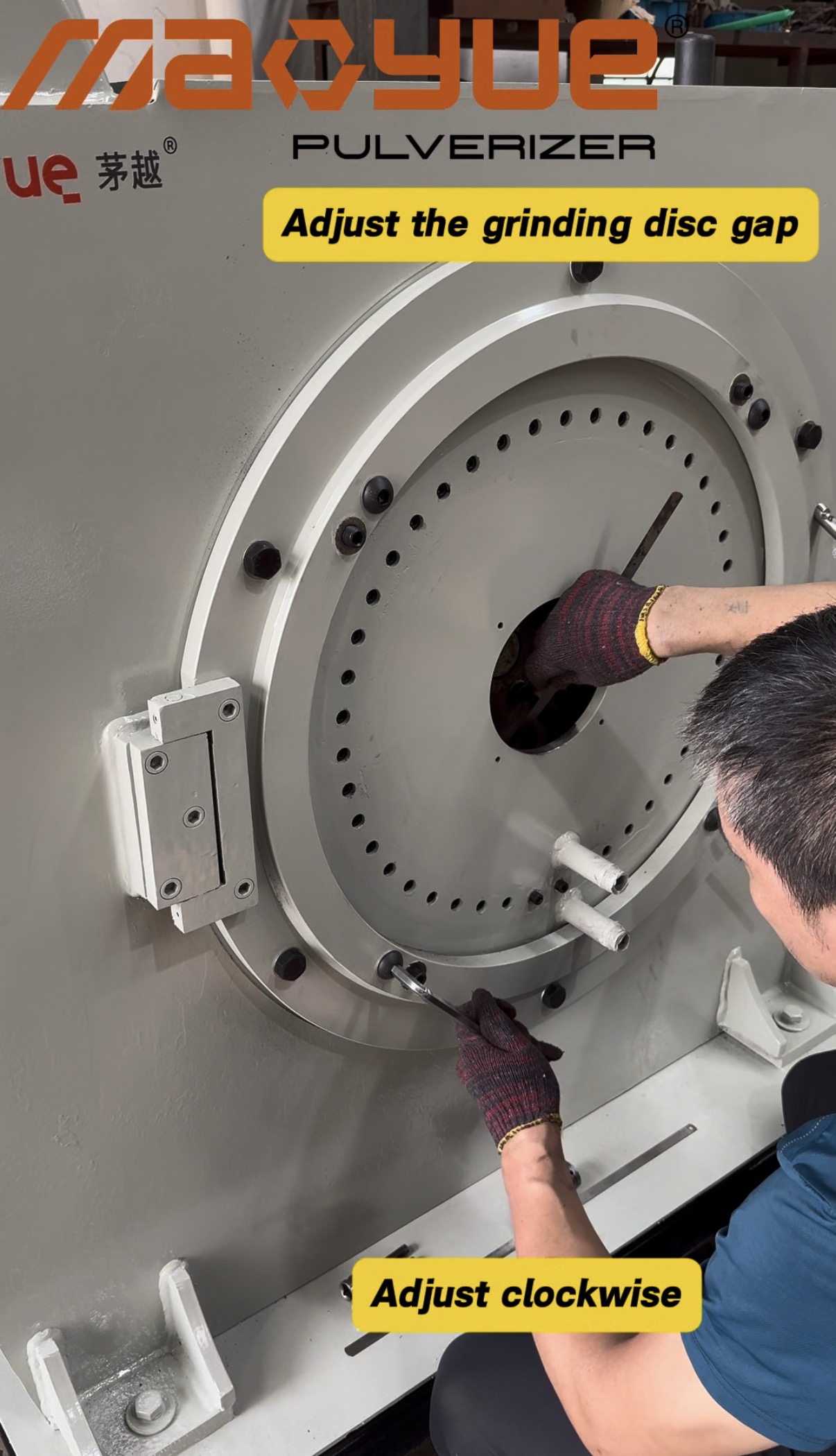
Check whether the blades show noticeable dulling, wear, or changes in working geometry. Also inspect the grinding gap and review its adjustment history. Since changes in the grinding gap can affect pulverizing performance, blade wear and gap-related issues should be evaluated together.
Compare throughput and operating performance.

When the raw material, target particle size, and operating conditions are reasonably consistent, compare throughput over the same operating period. If changes in particle size distribution occur alongside a decline in throughput, the blade condition and grinding settings should be investigated further.
Check the screening stage.

It is important to distinguish between coarse particles that were not sufficiently pulverized and particles that were not effectively separated during subsequent screening. If there is a noticeable difference between the material discharged from the pulverizer and the final screened product, screening performance should be investigated to avoid attributing every problem to blade wear.
When comparing these samples, keep sampling locations and testing methods consistent, and consider whether oversize material is returned to the pulverizing system.
By evaluating these factors together, manufacturers can more accurately determine whether blade wear is a primary cause of changes in particle size.
Blade wear does not automatically mean that replacement is immediately necessary. The appropriate action depends on the actual blade condition, machine design, and production requirements.
Adjust the grinding gap: If inspection identifies an unsuitable gap setting and the blades remain in a condition that permits adjustment, evaluate how changing the gap affects particle size and throughput.
Resharpen the blades: If the blade design allows resharpening and the required working geometry and machining accuracy can be restored, the feasibility of resharpening can be assessed.
Replace the blades or grinding discs: If wear has affected normal operation or the required particle size and production performance cannot be achieved after resharpening, replacement should be considered.
Gap adjustment cannot compensate for severe blade wear, and resharpening is not suitable for every blade design.
Blade maintenance should not rely solely on a fixed number of operating hours. It should take into account actual wear, particle size distribution, production efficiency, and machine requirements.
For PE rotomolding powder production, blade service life is not the only performance indicator. More importantly, the blades should maintain suitable working geometry during operation, and the pulverizing system should continue to meet the customer's particle size and throughput requirements.
As a direct plastic pulverizer manufacturer, Mao Yue focuses on in-house production of core components, blade materials and heat treatment, precision machining, and actual material testing. These capabilities help customers make more informed decisions during equipment selection and production application.


Mao Yue manufactures grinding discs and blades in-house and controls the machining dimensions of core components as well as blade resharpening quality.
The working geometry of the blades and grinding discs affects the actual grinding gap. Therefore, dimensional consistency and proper resharpening procedures are important for maintaining grinding performance.
By controlling the manufacturing and resharpening quality of core components, Mao Yue can better manage key factors affecting grinding performance rather than relying entirely on the specifications and quality of externally sourced components.

Blade wear resistance depends not only on steel hardness but also on material selection, heat treatment, blade geometry, and actual grinding conditions.
Mao Yue selects suitable materials and heat treatment processes according to blade application requirements. For PE rotomolding powder production, blade performance should not be evaluated solely by initial hardness or theoretical service life. Actual wear and its effects on powder particle size and machine throughput should also be considered.

Mao Yue uses precision machining and quality inspection to control the manufacturing quality of core components. Dynamic balancing is also used to control the effects of imbalance in rotating components.
These manufacturing and inspection measures help control dimensional variations and the rotational condition of key components, providing a foundation for stable machine operation. Actual performance must still be evaluated in combination with installation quality, bearing condition, maintenance practices, and specific production conditions.
Technical specifications for materials and components alone cannot fully represent actual production performance. For PE rotomolding powder production, equipment suitability must be evaluated against the customer's raw material, target particle size, and capacity requirements through actual material testing.
Mao Yue can conduct material trials based on the customer's PE material and production requirements, focusing on the following indicators:
Target particle size and particle size distribution: Evaluate powder fineness and the proportions of particles in different size ranges against the application requirements.
Coarse particle content: Assess whether the proportion of particles exceeding the target size range meets the customer's production requirements.
Actual processing capacity: Verify throughput under the specified target particle size conditions.
Continuous operating performance: Observe powder temperature and machine operating conditions during the test.
Through actual material testing, customers can better understand how well the equipment matches their raw materials and production requirements before purchasing. The results provide a reference for equipment selection and process planning.
If particle size changes occur during subsequent production, the cause can be further investigated by reviewing particle size test results, blade wear, grinding gap settings, and throughput records rather than deciding on blade replacement based solely on appearance or operating hours.
A machine that can continue operating does not necessarily continue producing powder of the same quality.
Mao Yue can evaluate equipment requirements and conduct material testing based on your actual PE material, target particle size, and capacity requirements, helping you select a pulverizing solution suited to your production conditions.
Yes, it can. Blade wear may change the working geometry and actual grinding conditions, potentially causing changes in particle size distribution during continuous production.
No. The outcome depends on factors such as pulverizer design, grinding gap, PE material properties, feeding conditions, and the screening system. The overall particle size distribution should therefore be evaluated.
Compare the material discharged from the pulverizer with the final screened product. If excessive coarse particles are already present at the pulverizer outlet, investigate the grinding process. If the pulverizer discharge is acceptable but the final powder contains too many coarse particles, focus on the screening system.
There is no fixed replacement interval that applies to every operating condition. A more reliable approach is to evaluate blade wear, operating hours, processed material volume, throughput, particle size distribution, and the actual geometry of the blades.
If you are evaluating a PE rotomolding pulverizer or experiencing particle size distribution or throughput problems in your existing production line, provide Mao Yue with your PE material type, target mesh size, required capacity, and current production issues.
We can evaluate your equipment requirements based on actual operating conditions and arrange material testing.
Contact Mao Yue to discuss your PE pulverizing requirements and request a material testing solution.


