Specializing in the production of Plastic Pulverizer Machines.

Views: 0 Author: Site Editor Publish Time: 2026-09-16 Origin: Site
Modified plastics have more complex processing characteristics than standard PE. Fillers, pigments, and other additives can affect material hardness, toughness, temperature behavior, and pulverizing performance. Therefore, producing high-quality modified PE powder is not simply a matter of reducing the material to a smaller size. It requires proper matching of feeding, disc gap, particle size, temperature control, airflow, and powder collection.
With more than 30 years of experience in plastic pulverizer manufacturing, Mao Yue provides customized PE pulverizing solutions based on customers’ actual materials and powder requirements, helping achieve stable powder quality and continuous production.
For plastic powders, particle size is only one factor used to evaluate quality. Particle size distribution, powder morphology, flowability, and bulk density can also affect subsequent feeding, mixing, and molding performance.
Especially in rotational molding, coating, and plastic reprocessing, finer powder is not always better. The powder needs to match the actual production process. Stable particle size, good flowability, and consistent powder characteristics are the key to producing high-quality modified PE powder.
Similar average particle sizes do not necessarily mean that powders have the same performance. A well-controlled particle size distribution and good flowability can help the powder remain more stable during feeding, mixing, and subsequent molding processes, while reducing accumulation and agglomeration.
Therefore, modified PE pulverizing should not focus only on “how fine the powder is.” Equipment parameters should be properly adjusted according to the material characteristics, target particle size, and final application to achieve stable and uniform powder quality.
Modified PE often contains calcium carbonate, pigments, mineral fillers, or other functional additives. These components can change the material’s hardness, toughness, and wear resistance, resulting in pulverizing performance that differs from standard PE.
For example, highly filled PE may increase wear on the pulverizing discs and knives, while some flexible formulations are more likely to cause adhesion and agglomeration when the material temperature rises. Therefore, modified PE should not simply use the same pulverizing parameters as standard PE. The equipment settings should be adjusted according to the material formulation, material characteristics, and target powder requirements.
High-speed pulverizing generates a certain amount of heat, and the temperature may gradually increase during continuous operation. For thermoplastic materials such as modified PE, PP, and PA, excessive temperatures can cause the material to soften, affecting powder formation, feeding stability, and particle size consistency, while also increasing the risk of adhesion and agglomeration.
Therefore, stable pulverizing is not simply about increasing motor power or pulverizing intensity. A proper balance between output, powder fineness, and temperature control is essential for achieving continuous and stable production.
A disc-type plastic pulverizer uses the high-speed relative motion between the discs to subject the material to friction, shearing, and impact forces, gradually processing it into plastic powder that meets the required specifications.
After entering the pulverizing chamber, the material is continuously refined within the working area of the discs. The feeding, cooling, and powder collection systems work together to support continuous production. For PE and modified PE, the proper matching of disc design, working gap, operating parameters, and material characteristics is critical to achieving the desired powder fineness and stable production.
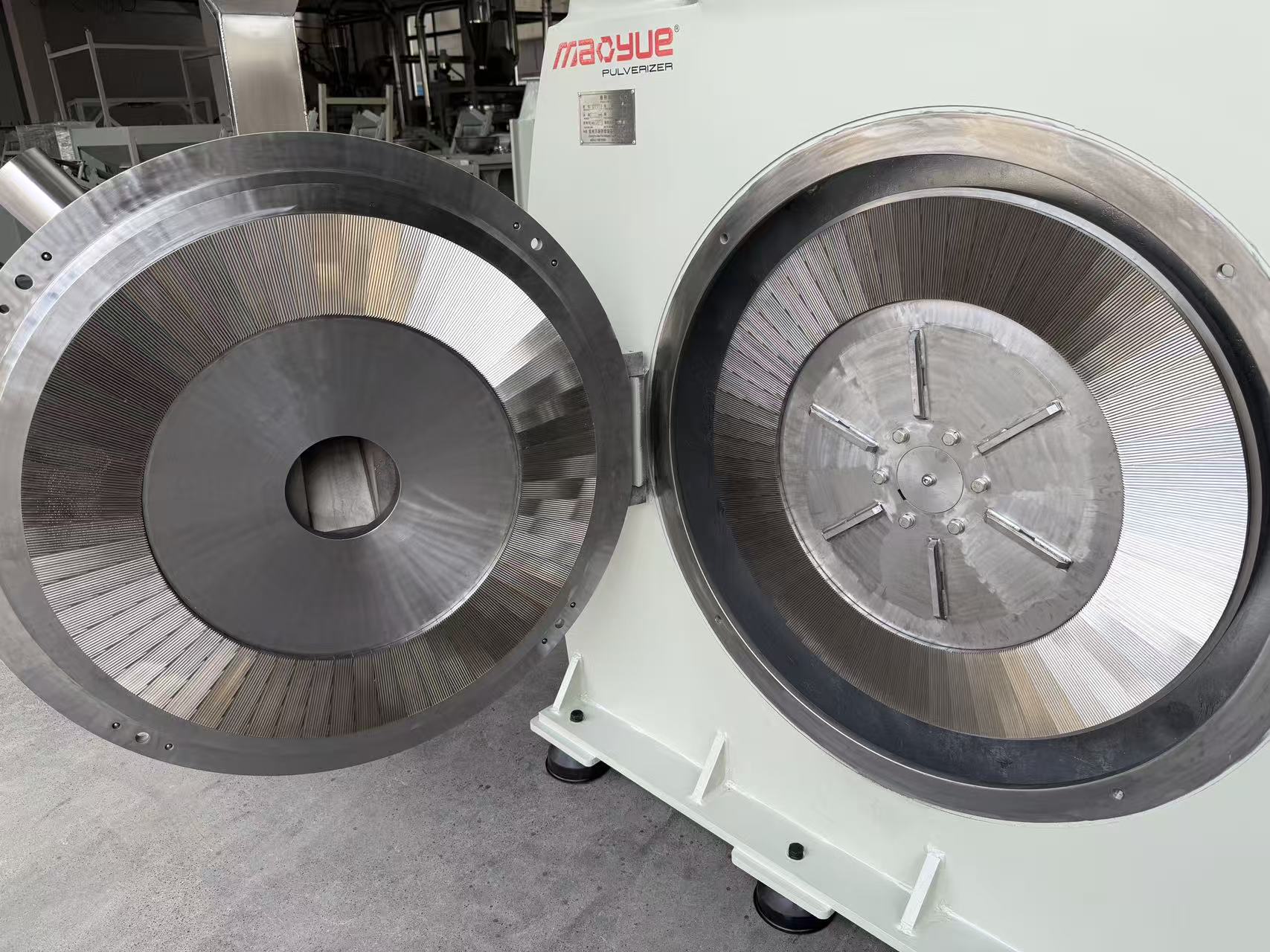
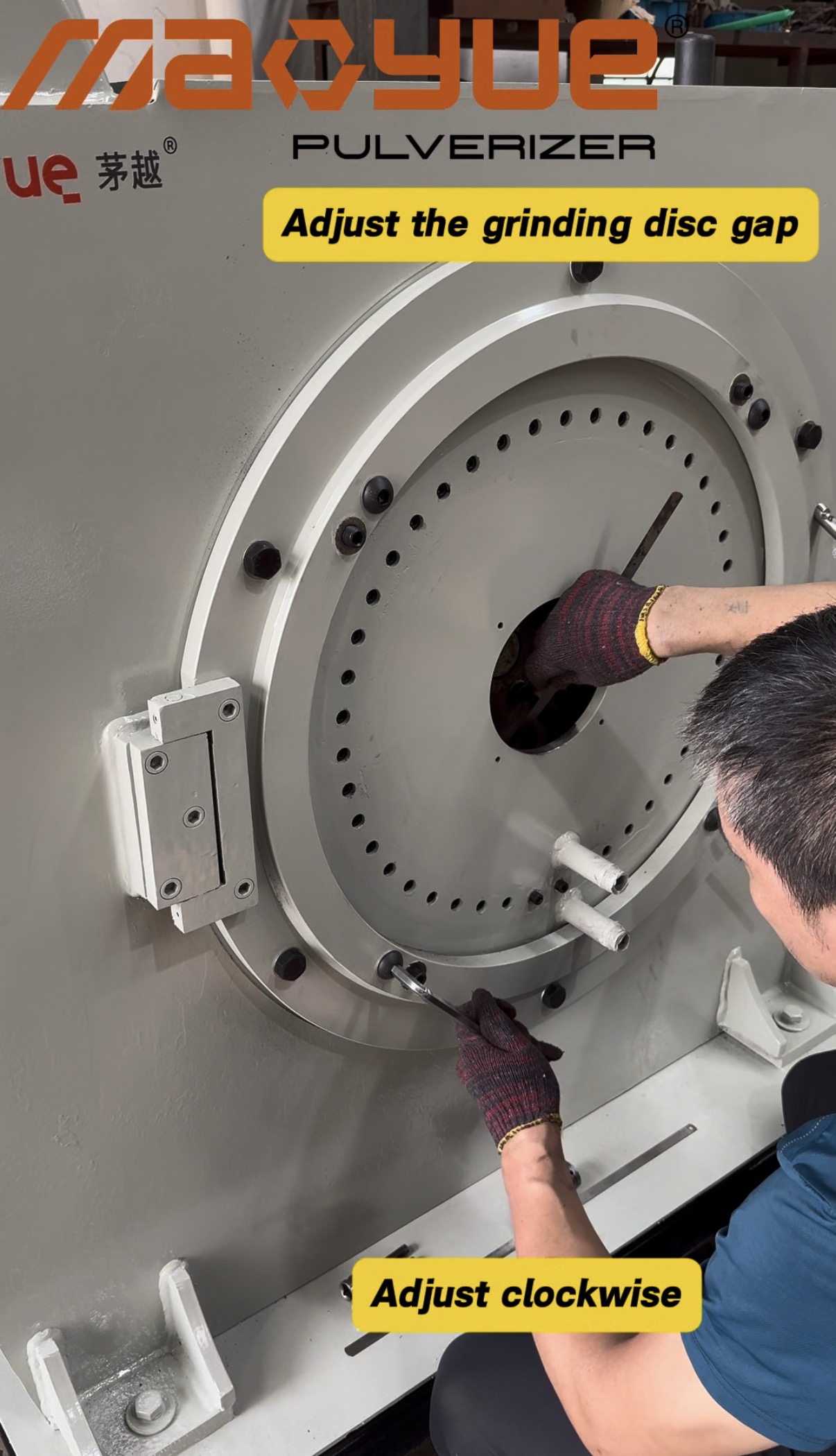
The working gap between the pulverizing discs is an important parameter that affects powder fineness and production stability. Generally, a smaller gap produces finer powder, while appropriately increasing the gap can help improve output and produce coarser powder.
However, a smaller gap is not always better. Different materials require different working gaps. An excessively small gap may increase friction and temperature rise, affecting pulverizing efficiency and powder quality. Therefore, during actual production, the gap should be adjusted according to the material characteristics, target particle size, and output requirements to achieve a proper balance between fineness, capacity, and temperature control.
Different formulations of modified PE, PP, and PA may vary in hardness, filler content, toughness, and processing characteristics, so no single set of parameters can be applied to all materials. Feed size, target particle size, and production capacity requirements can also directly affect pulverizing performance.
Therefore, professional equipment selection should not rely solely on theoretical specifications. Actual material testing is also important for determining the appropriate disc gap, feeding rate, and operating parameters, helping achieve a better balance between powder fineness, output, and temperature control.

Modified PE, PP, and PA are usually fed directly into a disc-type pulverizer in pellet form, so extensive pretreatment is generally not required. Before pulverizing, the feed material should have a relatively uniform particle size, and hard foreign materials such as metal should be removed as much as possible to prevent damage to the discs and other pulverizing components.
Stable and clean feeding is the foundation for producing uniform powder. It also helps the pulverizer operate consistently, creating suitable conditions for subsequent particle size control and continuous production.

Stable feeding is the foundation of continuous pulverizing. Excessive or fluctuating feed rates can cause changes in equipment load and temperature, which may affect production capacity and powder particle size consistency.
By properly controlling the feeding rate and ensuring that the material enters the disc-type pulverizer evenly, the equipment can maintain a stable load, resulting in more consistent output, more uniform powder, and smoother continuous production.

After entering the disc-type pulverizer, modified PE pellets are continuously subjected to impact, friction, and shearing forces between the high-speed rotating discs, gradually forming the required powder. The disc gap and operating parameters need to be adjusted according to the material characteristics, target particle size, and output requirements.
Depending on the material and application requirements, PE pulverizing systems can produce powder in a range of approximately 10–120 mesh. The actual powder fineness and output should still be confirmed through material testing to determine the most suitable pulverizing parameters.

Continuous pulverizing generates a certain amount of heat, so timely cooling is necessary to prevent temperature rise from affecting powder quality. Depending on the material characteristics and production requirements, air cooling, water cooling, or a combined cooling system can be used.
After pulverizing, the powder can also be processed through a screening system to control particle size and separate particles that do not meet the required specifications. This helps achieve more uniform particle size and more stable finished powder quality.

The finished powder is transported and collected through an airflow conveying and powder collection system, helping reduce powder loss and accumulation while keeping the production environment clean. Proper airflow design also helps ensure stable powder conveying.
Depending on the final application, the finished powder can be tested for particle size, appearance, flowability, and batch-to-batch consistency to ensure that the powder meets the requirements of subsequent production processes.

For modified plastic pulverizing, there is no single set of parameters that works for every material. Therefore, testing the customer’s actual material before equipment selection is very important.
Based on the test results, Maoyue evaluates the feeding condition, powder fineness, output, temperature changes, and finished powder quality, and then adjusts parameters such as the disc gap, feeding rate, and cooling. This allows the equipment configuration to better match the customer’s actual material and production requirements, rather than simply selecting a standard machine model.

The disc structure directly affects how the material is subjected to forces and the resulting powder quality. Different modified PE formulations and target particle sizes require suitable disc designs, working gaps, and pulverizing parameters.
Maoyue manufactures its core pulverizing components in-house and can configure them according to the actual material and application requirements. The goal is not simply to pursue higher rotational speeds, but to achieve a proper balance between pulverizing efficiency, powder fineness, and temperature control.
For continuous pulverizing of thermoplastic materials, temperature control directly affects powder quality and equipment stability. Maoyue can configure air cooling, water cooling, or combined cooling systems according to the material characteristics and equipment model, helping remove the heat generated during the pulverizing process in a timely manner.
Stable cooling helps reduce material softening, adhesion, and agglomeration, making the pulverizing process smoother while maintaining consistent powder fineness and stable production conditions.

Stable feeding is the foundation of continuous pulverizing, while a properly designed powder collection system determines whether the finished powder can be conveyed and collected smoothly. A mismatch in any part of the process may affect the overall line efficiency and powder quality.
Therefore, Maoyue designs feeding, pulverizing, cooling, airflow, separation, and powder collection as an integrated system. This allows all processes to work together for more stable and efficient continuous production.
Modified PE formulations and production requirements vary, so equipment parameters need to be adjusted accordingly. The following specifications can be used as a reference for common configurations. The actual equipment specifications should be determined based on material testing, target powder fineness, and output requirements.
Parameter | Common Configuration Considerations |
|---|---|
Materials | PE, modified PE, PP, PA, highly filled PE, recycled PE |
Powder Fineness | Approximately 10–120 mesh |
Disc Diameter | 500–800 mm and customized models |
Cooling Method | Air cooling / water cooling / combined cooling |
Feeding Method | Manual or automatic feeding |
Applications | Rotational molding, coating, compounding, recycling |
Output | Determined according to material, powder fineness, and equipment configuration |

Rotational molding is one of the important applications of PE powder. The powder needs to have good flowability and melting characteristics so that it can spread evenly inside the mold, helping achieve stable wall thickness and consistent product quality.
Properly pulverized modified PE powder can be used for tanks, containers, industrial products, playground equipment, and other rotational molding products according to different formulations and performance requirements, meeting the powder and material performance requirements of various applications.

Some coating processes have high requirements for the particle size uniformity, flowability, and dispersion of plastic powders. A properly designed pulverizing process can help produce more consistent powder, providing a suitable raw material for subsequent coating and surface treatment.
The specific powder specifications should be matched according to the coating material, process conditions, and final product requirements.
Modified PE powder can also be used as an intermediate material for blending, compounding, and further processing. Powder with uniform particle size and stable flowability is easier to convey, meter, and mix, helping maintain stable downstream processing and improve raw material utilization.
The specific powder specifications can be adjusted according to the formulation and downstream processing requirements.
Some production scraps and suitable plastic waste can be processed into plastic powder with a uniform particle size using a disc-type pulverizer and then reintroduced into appropriate production processes. This can help reduce material waste while improving plastic raw material utilization.
However, whether recycled materials are suitable for further pulverizing and reuse should be evaluated based on their material composition, level of contamination, and final application requirements to ensure that the recycled powder meets the needs of subsequent production.
When selecting a pulverizer for modified PE, it is important to first identify the actual material to be processed. Standard PE, modified PE, PP, PA, calcium carbonate-filled PE, and recycled PE may differ in hardness, toughness, and pulverizing characteristics.
Material properties determine the equipment configuration. Only after the raw material composition and processing condition are clearly understood can the appropriate disc design, working gap, cooling method, and feeding parameters be determined.
The target powder particle size should be determined according to the downstream production process and final product requirements. Different applications may have different requirements for powder fineness, particle size distribution, and flowability.
Once the target specifications are defined, the disc design, working gap, airflow, and screening method can be properly matched, allowing the equipment to achieve a better balance between powder quality and production efficiency.
Motor power alone cannot determine the actual output of a pulverizer. Material characteristics, target powder fineness, disc configuration, feeding stability, and cooling conditions can all affect the final production capacity.
Therefore, when selecting equipment, material properties, powder specifications, and target output should be evaluated together. Actual material testing provides a more reliable way to confirm the machine’s production performance rather than relying solely on motor power.
Thermoplastic materials generate a certain amount of heat during continuous pulverizing. Materials that are more prone to softening, adhesion, or agglomeration generally require greater attention to temperature control.
Therefore, when selecting a pulverizer, the cooling system should be properly configured according to the material characteristics, output, and equipment specifications. Air cooling, water cooling, or a combined cooling system can be used to maintain stable pulverizing temperatures and production conditions.
For factories operating multiple shifts or running equipment continuously for long periods, stable operation is more important than simply pursuing higher motor power. Bearing condition, temperature control, component wear, and the powder collection system can all affect long-term production performance.
Therefore, when selecting equipment, attention should be paid to the overall long-term stability of the system to ensure consistent powder quality and output under actual production conditions.

Mao Yue has specialized in plastic pulverizer manufacturing for more than 30 years, serving a wide range of plastic materials and applications. Instead of using a one-size-fits-all configuration, we match the equipment to the material characteristics, target powder specifications, and output requirements.
This long-term manufacturing experience enables Mao Yue to better handle the pulverizing requirements of different formulations, including modified PE, PP, PA, and highly filled plastics, providing solutions that are better suited to customers’ actual production needs.

Mao Yue manufactures core pulverizing components such as discs and grinding teeth in-house, allowing more direct control over machining precision and component dimensions while making it easier to adjust equipment configurations for different materials and powder requirements.
For modified PE pulverizing, this in-house manufacturing capability enables more flexible matching of material characteristics, target particle size, and production requirements, allowing the equipment configuration to better suit actual applications.

Before finalizing the equipment, testing the customer’s actual material provides a more direct way to verify pulverizing performance. Mao Yue focuses on evaluating powder fineness, output, temperature, feeding stability, and finished powder condition, and adjusts relevant parameters based on the test results.
This approach helps make equipment selection better suited to the customer’s actual production requirements and reduces the risks associated with relying solely on theoretical specifications.

The high-speed rotating components of a plastic pulverizer require high levels of machining precision and dynamic balancing. Good machining accuracy helps ensure more stable component alignment and operation, while precise dynamic balancing helps reduce vibration during high-speed operation and minimize its impact on bearings and other critical components.
Therefore, precision machining and dynamic balancing are not only important for smooth equipment operation, but also directly affect the service life and long-term production stability of the pulverizer.
To match the right modified PE pulverizer more accurately, customers can provide key information such as material characteristics, target powder specifications, and production requirements. The more complete the information, the easier it is to determine the appropriate disc design, motor power, cooling method, and overall system configuration.
Information | Example |
|---|---|
Material | Modified PE, PP, PA |
Material Form | Crushed flakes |
Feed Size | 10-20mm |
Target Powder Particle Size | 20-80目 |
Required Output | 500kg/h |
Application | Rotational molding |
Operating Time | 16-24 hours/day |
Cooling Requirement | Air cooling / water cooling |
Yes. A suitable PE pulverizer can process various types of modified PE, but the specific equipment configuration should be determined according to the actual material, filler content, target powder particle size, and output requirements.
The final powder particle size depends on the material characteristics, disc design, working gap, and operating conditions. PE pulverizing systems can commonly be configured to produce powder in a range of approximately 10–120 mesh, but actual performance should be confirmed through material testing.
Yes. However, filled PE may have different pulverizing characteristics from standard PE because fillers can increase material hardness and affect wear behavior. Therefore, the pulverizing components and operating parameters should be evaluated according to the actual formulation.
Temperature rise can be controlled through proper feeding, working gap adjustment, airflow, and cooling configuration. Depending on the material and equipment model, air cooling, water cooling, or a combined cooling system can be used.
Not necessarily. Actual output also depends on factors such as material characteristics, feed size, target powder fineness, disc configuration, feeding stability, and cooling conditions.
Yes. When the material formulation, powder specifications, or production requirements differ from standard applications, material testing is recommended. Through equipment trials, a more suitable pulverizer configuration can be evaluated before the final equipment selection.
Producing high-quality modified PE powder is not simply about reducing plastic to a finer size. It requires careful consideration of material characteristics, feeding, disc design, working gap, temperature control, cooling, screening, and powder collection.
A suitable modified PE pulverizing system should be matched to the actual material, target particle size, and output requirements, achieving a proper balance between powder fineness, flowability, temperature control, and production efficiency.
With more than 30 years of experience in plastic pulverizer manufacturing and in-house manufacturing capabilities for core pulverizing components, Mao Yue can conduct material testing based on customers’ actual materials. By evaluating test results such as powder particle size, output, and temperature, Maoyue can provide suitable PE pulverizer configurations for applications including rotational molding, coating, compounding, and recycling.
If you are looking for a modified PE pulverizing solution, you can provide the material type, feed size, target particle size, and required output. Maoyue will use actual material testing results to recommend a suitable equipment solution for your production requirements.


