Specializing in the production of Plastic Pulverizer Machines.

Views: 0 Author: Site Editor Publish Time: 2026-11-06 Origin: Site
In color masterbatch pulverizing, finer powder does not necessarily mean better pulverizing performance. Some fine color masterbatch powders may exhibit increased interparticle cohesion, leading to hopper bridging, slow discharge, or unstable feeding, which can affect downstream production continuity.
However, powder flowability depends not only on particle size but also on masterbatch formulation, particle shape, particle size distribution, and storage conditions.
For color masterbatch manufacturers, the key is to produce qualified powder that meets the target particle size requirements while maintaining stable discharge and suitability for downstream feeding.
This article explains the causes of poor fine color masterbatch powder flowability, on-site diagnostic methods, testing parameters, and the equipment performance factors buyers should consider when selecting a color masterbatch pulverizer.
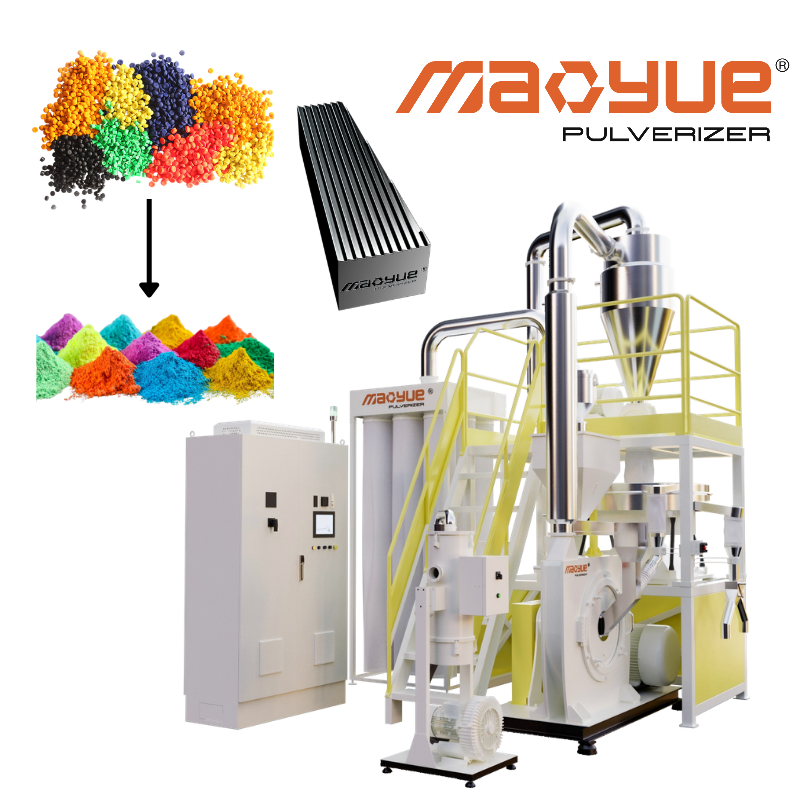
Powder flow behavior is influenced by particle weight, interparticle forces, and external stress conditions.
As color masterbatch particle size decreases, the total surface area per unit mass generally increases. Interparticle forces, including van der Waals forces, electrostatic interactions, and other adhesive forces, may become more significant relative to particle weight.
For some fine powders, these forces increase the tendency of particles to adhere to one another, making it difficult for the powder to move freely under gravity.
When interparticle forces are sufficient to resist the driving forces during discharge, the powder may form stable structures that obstruct normal flow.
Therefore, the flow behavior of fine color masterbatch powder depends on the relationship between interparticle forces and the stresses acting on the powder, rather than particle size alone.

Fines content generally refers to the proportion of particles smaller than a specified particle size threshold.
As the proportion of very fine particles increases, the powder's specific surface area and opportunities for particle contact may change, making interparticle forces more significant.
For masterbatch formulations prone to cohesion, a higher fines content may reduce the powder's ability to flow freely.
However, different formulations respond differently to fines content. Therefore, an appropriate fines content range should be established based on downstream processing requirements.
During evaluation, the particle size threshold, measurement basis, and testing method should be clearly defined to avoid directly comparing results obtained under different testing conditions.
Particle size distribution describes the proportions of particles of different sizes within a powder.
Even when two batches of color masterbatch powder have similar D50 values, their packing behavior may differ.
When smaller particles fill the spaces between larger particles, the powder's pore structure, bulk density, and consolidation behavior may change.
Under certain formulation and stress conditions, this particle arrangement may produce a more tightly packed powder structure, making it more difficult to restart discharge.
D10, D50, and D90 are commonly used to describe particle size distribution. D50 represents the median particle size rather than the arithmetic mean particle size.
A broader particle size distribution does not necessarily result in poorer flowability. Its actual effect depends on particle composition and powder properties.
The shape, surface roughness, and composition of color masterbatch particles influence friction and adhesion between particles.
Irregularly shaped particles may generate greater resistance to movement due to angular contact or mechanical interlocking.
Pigments, fillers, and additives can also alter particle surface properties, causing different masterbatch formulations to exhibit different flow characteristics.
In addition, some powders may accumulate electrostatic charges during friction or conveying, increasing adhesion between particles or between particles and equipment surfaces.
For heat-sensitive formulations, processing temperature increases may also affect the adhesive properties of particle surfaces.
Together, these factors influence powder flow behavior under actual operating conditions.
Some color masterbatch powders flow normally immediately after pulverizing but exhibit different flow behavior after storage.
When powder is subjected to the weight of material above it in a hopper, particle contact conditions and internal stresses may change.
For cohesive powders, longer storage periods or higher consolidation stresses may increase shear strength, making it more difficult to restart discharge.
Ambient temperature, humidity, and material properties may also influence powder behavior during storage.
Therefore, powder flow behavior under actual consolidation conditions should be considered when evaluating long-term storage applications.
Poor powder flowability mainly affects hopper discharge, material storage, and downstream metered feeding.
Common Problem | On-Site Symptoms | Production Impact |
|---|---|---|
Hopper Bridging | Powder forms a stable structure above the outlet | Discharge interruption |
Ratholing | A central flow channel forms while surrounding powder remains stagnant | Reduced effective discharge capacity |
Intermittent Discharge | Powder flow rate fluctuates | Unstable downstream feeding |
Powder Consolidation | Powder becomes difficult to discharge after standing or compression | Difficult discharge startup |
Unstable Metered Feeding | Material feed rate varies over time | Reduced downstream process continuity |
These problems may also be influenced by hopper outlet size, wall friction, hopper geometry, and feeding equipment.

When unstable powder discharge occurs, it is important to assess whether the powder exhibits strong cohesion and whether the existing feeding equipment is suitable for its properties.
Different flowability testing methods provide different types of information.
Testing Method | Main Evaluation Parameter | Practical Application |
|---|---|---|
Funnel Flow Test | Powder flow through a specified outlet | Comparing powders capable of free flow |
Angle of Repose Test | Powder pile formation characteristics | Preliminary comparison of similar powders |
Bulk and Tapped Density Test | Powder packing and consolidation behavior | Supporting evaluation of consolidation tendency |
Shear Testing | Powder yield behavior under different stress conditions | Evaluating cohesive powder behavior and hopper discharge risks |
Actual Discharge Test | Powder discharge behavior in a specified hopper or feeder | Verifying suitability for actual production |

For cohesive powders that cannot flow freely through a standard funnel, the flow time should not simply be recorded as zero, nor should the powder be classified as unsuitable based on this result alone.
Angle of repose testing is useful for preliminary comparisons between similar powders, but it cannot independently predict whether bridging will occur in an industrial hopper.
Bulk and tapped density measurements provide information about powder packing behavior, but they cannot replace shear testing when determining hopper design parameters.
For highly cohesive fine powders, shear testing provides information about powder yield behavior under different consolidation stresses. Combined with wall friction measurements and other relevant data, these results can support hopper design evaluations.
Actual discharge testing is used to verify the compatibility between the powder and the specific equipment.
A practical troubleshooting process involves three steps: identifying the problem location, comparing powder properties, and verifying the likely cause.
Begin by observing the operating conditions of the hopper and feeding equipment.
On-Site Symptoms | Priority Inspection Areas |
|---|---|
No discharge from the outlet | Powder bridging, outlet size, and cohesion |
Central discharge with stagnant material around it | Ratholing and hopper flow pattern |
Periodic discharge fluctuations | Feeding equipment, control parameters, and powder filling conditions |
Difficult discharge after storage | Storage time and consolidation conditions |
Problems after changing masterbatch formulation | Material composition, particle properties, and particle size changes |
This step helps identify which parts of the system require further investigation.
Collect samples under the same or comparable conditions and record the following parameters:
D10, D50, D90, and specified fines content.
Applicable powder flowability or shear test results.
Bulk density and tapped density.
Storage time, temperature, and environmental conditions.
Actual discharge rate and feeding fluctuations.
Sampling, storage, and testing procedures should be kept as consistent as possible to minimize differences caused by testing conditions.
Comparative Test Results | Recommended Investigation |
|---|---|
Fines content increases and shear testing indicates stronger cohesion | Evaluate fines content and particle surface properties |
Particle size distribution remains similar, but discharge deteriorates after storage | Examine consolidation stress, storage time, and environmental conditions |
Powder properties are similar, but bridging occurs only in a particular hopper | Evaluate outlet size, wall friction, and hopper design |
Powder discharges steadily, but metered feeding fluctuates | Check the feeder, control parameters, and material filling conditions |
These results help prioritize further investigation but cannot independently establish the root cause.
If necessary, compare the same powder under different feeding conditions or test different powder samples using the same equipment settings.
The findings should be verified using actual discharge rates, flow fluctuations, and continuous operation records.
Improvement measures should be selected according to the identified cause rather than assuming that increasing particle size will solve every flow problem.
Identified Problem | Recommended Improvement | Verification Parameters |
|---|---|---|
Fines content exceeds process requirements | Evaluate pulverizing parameters and screening conditions | Fines content, target particle size, and qualified powder output |
Particle size distribution is unsuitable for downstream feeding | Optimize particle size control and powder classification | Particle size distribution and discharge stability |
Powder becomes difficult to flow after consolidation | Evaluate storage conditions and hopper design | Flow behavior and discharge performance after storage |
Hopper bridging | Evaluate outlet size and hopper geometry based on powder cohesion | Continuous discharge stability |
Metered feeding fluctuations | Check compatibility between feeding equipment and powder properties | Feed rate and fluctuation range |
When changes in powder properties originate from the pulverizing process, grinding disc condition, grinding gap, feeding parameters, and screening conditions can be evaluated.
If the powder meets its target specifications but the problem mainly originates from hopper geometry or feeding equipment, improvements should focus on the relevant equipment.
After adjustments, the results should be verified under comparable conditions to ensure that improving discharge does not introduce unacceptable changes in powder quality.
For companies purchasing a color masterbatch pulverizer, the ability to produce finer powder is only one selection criterion.
More importantly, the equipment should consistently produce powder that meets the target particle size, flowability, and downstream processing requirements under actual operating conditions.
Buyers should therefore conduct trials using their actual materials and request comparable testing records from suppliers.
Trial Item | Recommended Evidence | Purchasing Consideration |
|---|---|---|
Actual Material | Polymer carrier, feed size, and relevant formulation information | Whether the tested material is representative |
Particle Size Distribution | D10, D50, D90, and specified fines content | Whether the powder meets target specifications |
Flowability | Applicable flowability test results or discharge records | Whether the powder meets downstream feeding requirements |
Temperature | Continuous operating temperature records and measurement locations | Whether thermal adhesion is a potential risk |
Qualified Powder Output | Actual mass of qualified powder and corresponding test duration | Whether the required production capacity is achieved |
Powder Recovery | Feed mass, collected powder mass, and material balance records | Whether significant material losses occur |
Continuous Operation | Operating duration, abnormalities, and shutdown records | Whether the equipment is suitable for continuous production |
Powder flowability can be verified using the customer's existing feeding equipment or appropriate laboratory tests. Pulverizer processing capacity should not be treated as equivalent to downstream hopper discharge performance.
Qualified Powder Output (kg/h) = Mass of Collected Powder Meeting the Agreed Quality Requirements (kg) ÷ Corresponding Test Duration (h)
For example, if a pulverizing trial produces 800 kg of qualified powder during an agreed two-hour test period, the qualified powder output is 400 kg/h.
These figures are provided for calculation purposes only and do not represent actual Mao Yue equipment test results.
If flowability is included in the customer's acceptance criteria, qualified powder must meet the agreed particle size, flowability, and other applicable quality requirements.
The test should also clearly define how recycled or returned material is accounted for, the test duration basis, and how abnormal shutdowns are handled to ensure meaningful comparisons between equipment.
Buyers can use these results to compare the actual production capabilities of different machines under the same material and agreed operating conditions.
As a manufacturer of plastic pulverizers and core grinding discs, Mao Yue provides technical support through in-house grinding disc manufacturing, temperature control, equipment configuration, and actual material testing.

Grinding disc tooth geometry, cutting edge condition, and grinding gap influence the pulverizing process and final particle size distribution.
Mao Yue manufactures grinding discs and cutting tools in-house, using tool steels such as DC53, supported by precision grinding and maintenance capabilities.
For different masterbatch formulations and target particle size requirements, Mao Yue can evaluate grinding disc structures, working gaps, and operating parameters.
By comparing particle size distribution, specified fines content, and qualified powder output during trials, customers can assess whether the selected configuration meets their production requirements.
When grinding disc wear causes changes in powder specifications, regrinding, replacement, and maintenance options can also be evaluated.
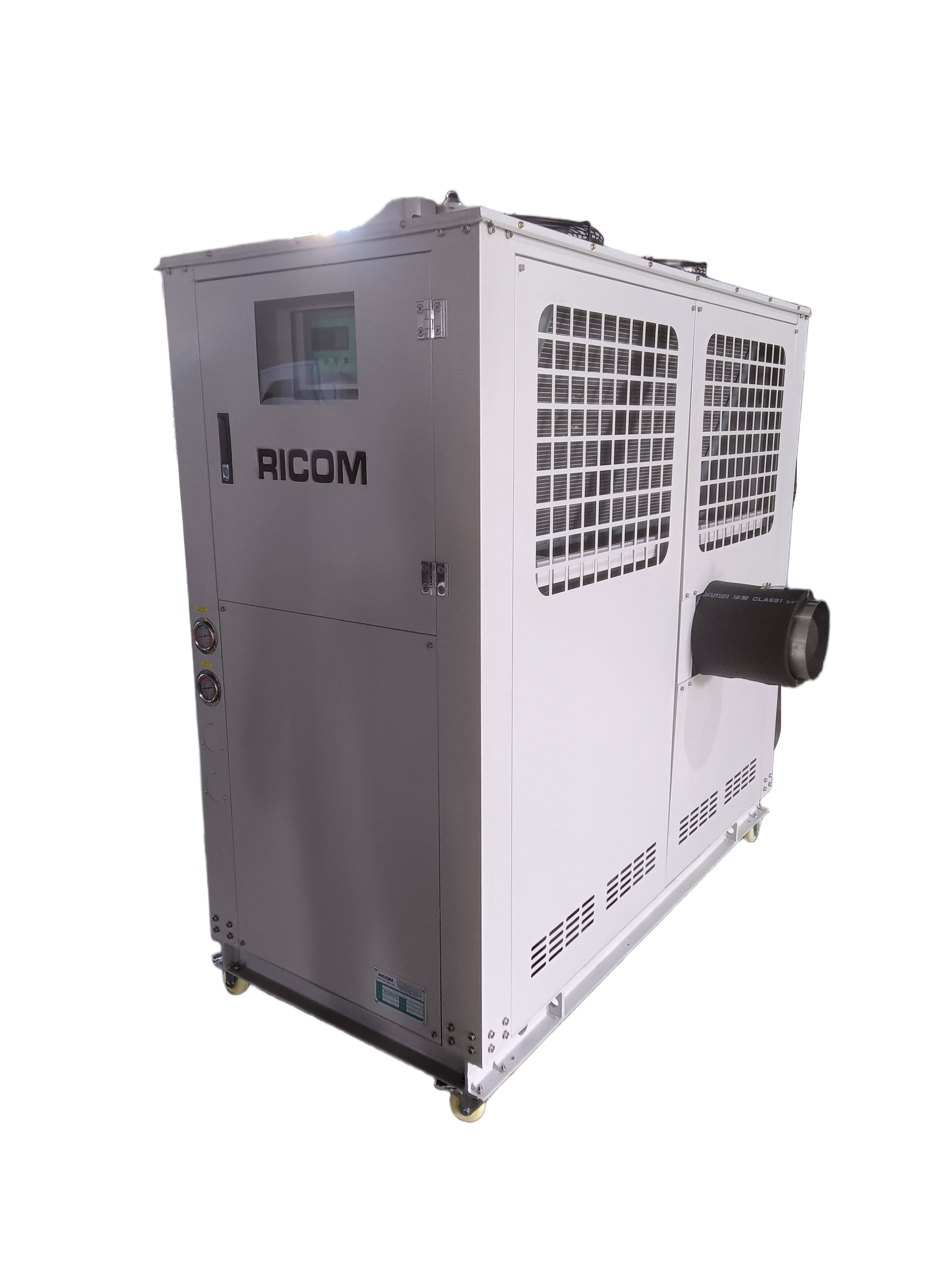
Some masterbatch formulations are sensitive to processing temperature.
When heat accumulates during pulverizing and the material approaches its softening or tackiness temperature range, particle surface adhesion and powder buildup inside the equipment may increase.
Depending on the equipment configuration, Mao Yue PE pulverizers can combine air and water cooling with controlled feeding and operating parameters.
Customers can evaluate cooling suitability for their materials by monitoring operating temperatures, powder conditions, and material buildup during continuous operation.
Cooling performance should be verified through tests conducted with the actual material under specified operating conditions.
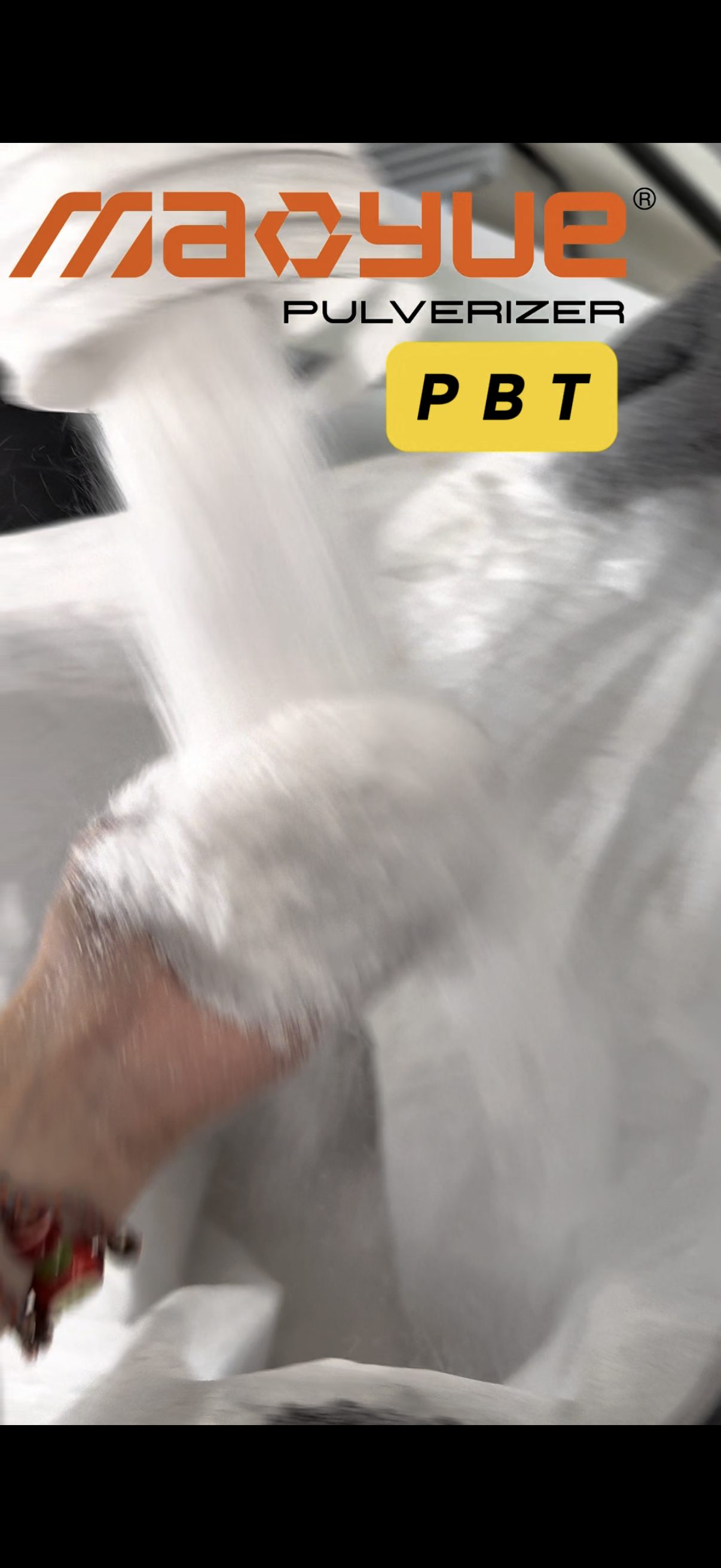
Mao Yue can conduct pulverizing trials using customer-supplied color masterbatch samples and use results such as particle size distribution, operating temperature, and qualified powder output to support grinding disc configuration and equipment selection.
For flowability measurements requiring specialized instruments, results from the customer or a third-party laboratory can be incorporated to further evaluate suitability for downstream applications.
When customers have defined hopper discharge or metered feeding requirements, Mao Yue can use actual material trial results to evaluate the relationship between target particle size, fines control, and pulverizer configuration.
If testing indicates that changes in powder properties contribute to discharge problems, adjustments to the pulverizing process can be assessed.
If the main problem originates from hopper outlets, wall friction, or feeding equipment, improvements should be developed using the relevant equipment design and testing data.
Mao Yue focuses on controlling and verifying powder properties that can be influenced by the pulverizing process rather than attributing all flowability problems to the pulverizer.
By clearly defining the relationship between equipment capabilities and downstream feeding requirements, customers can make more informed purchasing decisions.
No. Finer particles may exhibit stronger interparticle cohesion, but actual flowability also depends on particle shape, formulation, electrostatic effects, temperature, and environmental conditions. Testing is required to evaluate actual behavior.
There is no universal particle size threshold applicable to all masterbatch formulations. It should be determined based on downstream application requirements, target particle size distribution, and actual feeding performance.
Yes. However, airflow, pipeline configuration, separation equipment, and collection systems must be evaluated according to the powder's properties.
Buyers should conduct trials using their actual materials and compare target particle size, flowability, qualified powder output, and continuous operating performance.
The flowability of fine color masterbatch powder is influenced by interparticle forces, particle size composition, surface properties, and storage conditions.
For masterbatch manufacturers, controlling powder properties and matching them with downstream feeding requirements can help improve production continuity.
When selecting a pulverizer, actual material trials and agreed acceptance criteria should be used to verify whether the equipment meets production requirements.
If you are evaluating color masterbatch pulverizing equipment or looking to improve fines content, particle size distribution, and qualified powder output, contact Mao Yue to discuss an actual material pulverizing trial.
Please provide the following information:
Actual Masterbatch Samples: Polymer carrier, material size, and relevant formulation information.
Target Powder Specifications: Required particle size, acceptable fines content, and applicable quality requirements.
Capacity Requirements: Target qualified powder output and continuous operating conditions.
Downstream Application: Hopper configuration, metered feeding method, and existing flowability problems.
With in-house grinding disc manufacturing, cooling configurations, and actual material testing capabilities, Mao Yue can help evaluate suitable pulverizing processes and equipment solutions.
Contact Mao Yue to discuss your color masterbatch pulverizing trial and receive equipment configuration and testing recommendations based on your actual material.


