Specializing in the production of Plastic Pulverizer Machines.

Views: 0 Author: Site Editor Publish Time: 2026-09-26 Origin: Site
Color masterbatch is typically produced and supplied in granular form, making it easy to store, transport, and dose. However, in some downstream processing applications, color masterbatch needs to be further processed into powder.
In this case, the key question is not simply whether the material can be pulverized, but whether the process can produce powder with stable particle size, good flowability, controlled temperature rise, and consistent batch quality, while also maintaining stable feeding and efficient powder collection.
Therefore, high-quality color masterbatch powder is not simply about achieving a finer particle size. It requires a reasonable balance between particle size distribution, flowability, temperature control, color consistency, and contamination control.
This article examines these factors from the perspective of powder quality, explains how they affect color masterbatch powder production, and further introduces how a color masterbatch pulverizing system can be configured according to the actual material characteristics and production requirements.
Turning color masterbatch into powder may seem like a simple process of reducing particle size, but it actually involves multiple stages, including mechanical grinding, friction-induced heat generation, material conveying, and powder collection.
Therefore, achieving a sufficiently fine powder does not necessarily mean that the powder meets the required quality standards. Even if two batches of powder reach the same target mesh size, they may still differ in particle size distribution, flowability, and feeding performance, which can affect the stability of downstream processing.
For this reason, evaluating color masterbatch powder should not focus on particle size alone. The overall condition of the powder and its consistent performance in actual production also need to be considered.
Color masterbatch powder is typically a powder material produced by mechanically pulverizing color masterbatch pellets. Its final characteristics depend not only on the pulverizing process but also closely on the formulation and material properties of the color masterbatch itself.
Depending on the formulation, color masterbatch typically contains:
Polymer carrier
Pigments
Dispersing agents
Stabilizers
Other functional additives
These components can affect the material’s hardness, thermal properties, pulverizing behavior, and the final powder characteristics.
Therefore, even color masterbatches with the same color may show significant differences in feeding, temperature rise, particle size, and powder flowability during pulverizing if their carrier resins or formulations are different. This is why color masterbatch pulverizing requires parameter design and testing based on the actual material.

A typical color masterbatch pulverizing process includes feeding, disc pulverizing, cooling, screening, and powder collection.
First, the color masterbatch pellets are steadily fed into the pulverizing chamber through the feeding system. The high-speed grinding disc applies mechanical force to the material, gradually reducing the particles to the target size.
During pulverizing, a certain amount of heat is generated. Depending on the material characteristics and production conditions, air cooling, water cooling, or a combination of both may be used to maintain stable processing conditions.
The powder then enters the screening and powder collection system for separation and collection, producing color masterbatch powder that meets the requirements of downstream processing.
A disc-type color masterbatch pulverizer can be used to process color masterbatch pellets into powder. The specific machine configuration depends on the feed particle size, material properties, required output, and cooling requirements.
Good color masterbatch powder does not simply mean smaller particles. Instead, the powder needs to meet the requirements of the final application in terms of powder characteristics and production stability.
Powder Characteristic | Main Function | Production Factors to Consider |
|---|---|---|
Particle Size Distribution | Affects powder handling and use | Disc gap, pulverizing conditions |
Flowability | Affects conveying and stable feeding | Fine powder ratio, particle characteristics |
Temperature Stability | Affects material condition | Cooling method, operating conditions |
Color Consistency | Affects the appearance of final products | Process stability, contamination control |
Particle Morphology | Affects packing and flowability | Pulverizing parameters |
Contamination Control | Affects color and material purity | Cleaning and component condition |
Powder Collection Performance | Supports continuous production | Cyclone, dust collector, and airflow |
Batch-to-Batch Repeatability | Affects production consistency | Feeding, monitoring, and process control |
When evaluating color masterbatch powder, the focus should not be on achieving a single performance indicator, but on matching the powder characteristics to the actual application, production conditions, and downstream processing requirements.

Particle size is an important characteristic of color masterbatch powder, but a single “mesh size” cannot fully describe the powder condition. For example, even when two batches both reach 40 mesh, their proportions of fine particles and larger particles may still differ.
For this reason, particle size distribution and its stability are more important than a single mesh size. A suitable and consistent particle size distribution can help improve powder consistency during conveying, feeding, mixing, and downstream processing.
The goal is not simply to produce finer powder, but to determine a suitable particle size range based on the final application and maintain stable, repeatable production within that range.

Finer powder does not necessarily mean better flowability. As the proportion of fine particles increases, contact and interaction between particles may become stronger. Static electricity, moisture, and temperature changes can also further affect powder conveying behavior.
In addition to meeting the target particle size, color masterbatch powder should maintain stable flowability, such as:
Smooth discharge from the hopper
Stable conveying and feeding
Reduced bridging and powder accumulation in pipelines
These characteristics ultimately need to be verified through actual production. A suitable particle size distribution and good flowability need to meet both the requirements of the final application and those of continuous production.
High-speed disc pulverizing generates frictional heat. If the temperature continues to rise, some color masterbatch materials may soften, stick to the grinding components, or agglomerate, which can affect powder characteristics, output, and continuous operating stability.
Temperature control is not about maintaining one fixed temperature value. Instead, the temperature rise should be properly controlled based on the material characteristics, target particle size, feed rate, and operating time, with an appropriate cooling method selected accordingly.
A stable temperature condition helps maintain a continuous pulverizing process and consistent powder quality.
Color consistency primarily depends on the carrier resin, pigments, and formulation of the color masterbatch. However, the stability of the pulverizing process can also affect how the powder performs during subsequent conveying, dosing, and mixing.
If particle size distribution, temperature conditions, or powder collection conditions vary significantly between batches, they may introduce additional instability into downstream processing. The purpose of pulverizing is not to change the original color system, but to maintain stable powder characteristics and consistent production conditions.
In actual production, it is important to monitor:
Whether particle size distribution remains stable between batches
Whether temperature and feeding conditions remain stable
Whether the powder can be continuously and completely collected
Whether significant material residue remains during material changeover
It is important to note that the pulverizer does not directly determine the final color of the color masterbatch. Its main function is to maintain stable material conditions and reduce fluctuations caused by the pulverizing process, providing more consistent powder for downstream processing.
For color masterbatch powder production, cross-contamination is an important factor affecting powder purity and color consistency.
When the same pulverizing system is used to process color masterbatches with different colors or formulations, material from the previous batch may remain in the pulverizing chamber, grinding discs, conveying pipelines, cyclone separator, dust collection system, or powder collection system. After a material changeover, these residues may enter the next batch of powder. This can be particularly significant when switching between black or dark-colored masterbatches and light-colored or white masterbatches, as even a small amount of residue may have an impact.
Reducing the risk of cross-contamination requires control throughout the entire production system, including:
Cleaning the pulverizing chamber, grinding discs, and key components
Controlling residual material in conveying pipelines, cyclones, and powder collection systems
Arranging a suitable production sequence for different colors and formulations
Cleaning and inspecting the equipment after material changeover
Regular maintenance of areas prone to powder accumulation
For production lines that frequently switch between different colors or formulations, equipment design should consider not only pulverizing capacity and output, but also ease of cleaning, residue control, and material changeover efficiency.
It is important to distinguish between the two: color consistency focuses on the stability of powder quality between batches, while cross-contamination focuses on the risk of residual material from one material entering another. The two are related, but they represent different production control issues.

A complete color masterbatch pulverizing system is more than just a single pulverizer. It consists of several stages, including feeding, pulverizing, cooling, screening, and powder collection. Each stage works together to affect the final powder’s particle size, temperature, and collection efficiency.
The basic process is:
Feeding → Pulverizing → Cooling → Screening → Collection
The feeding system ensures a stable supply of material into the pulverizing chamber. The pulverizing stage processes the color masterbatch to the target particle size. The cooling stage controls temperature rise during processing, while the screening and powder collection systems separate, convey, and collect the finished powder.
The stability of color masterbatch pulverizing therefore depends not only on the pulverizer itself, but also on how well the different stages of the entire system are matched.

Stable feeding is the foundation of continuous pulverizing. Significant fluctuations in the material feed rate can directly affect the pulverizing load, output, and temperature rise, which in turn can affect the powder condition.
An automatic feeding system can maintain a stable feed rate according to production requirements, reducing fluctuations caused by manual operation and making the pulverizing process more continuous and stable.
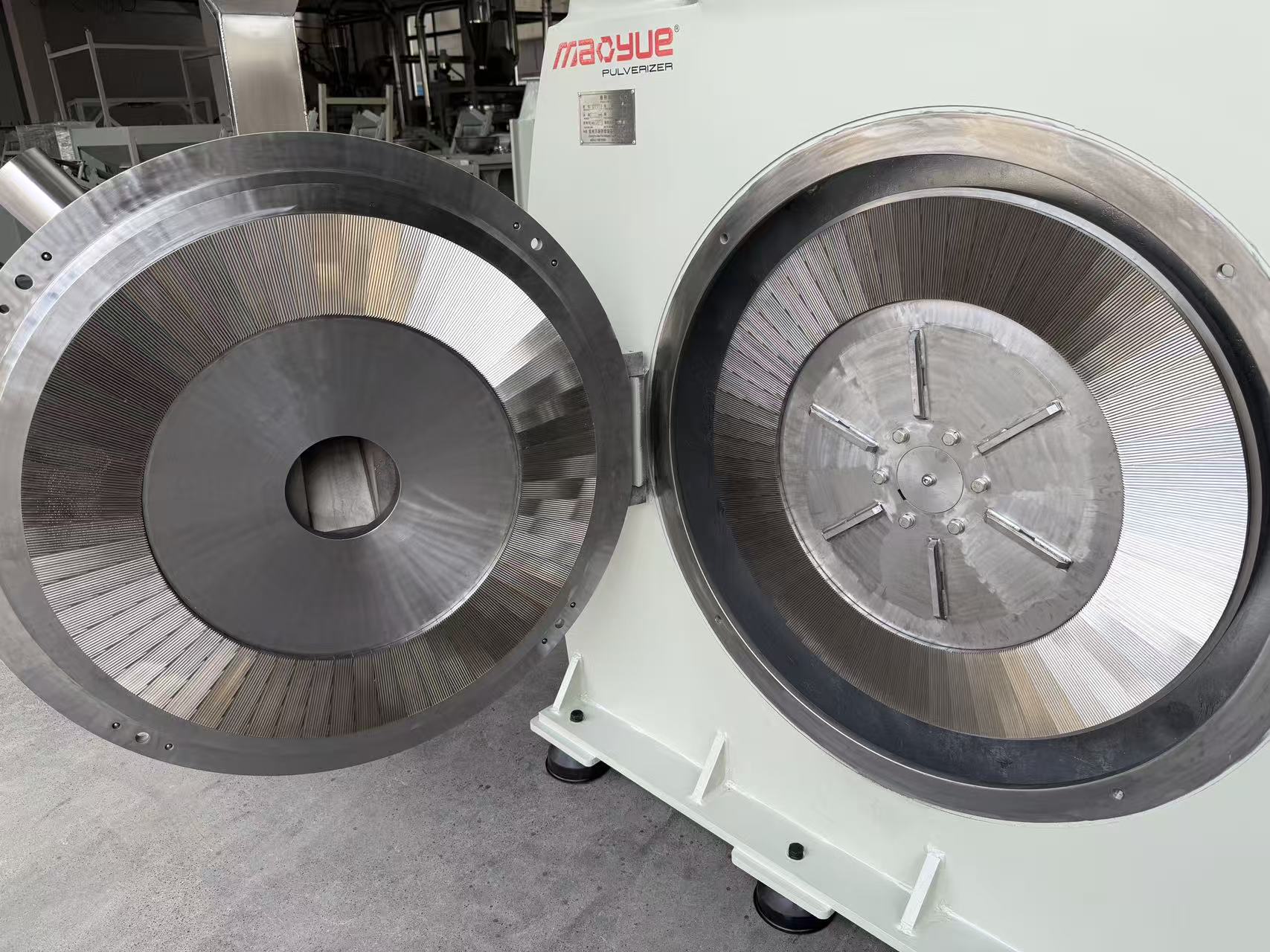
Disc pulverizing uses the mechanical action generated by high-speed rotating grinding discs to gradually reduce the particle size of color masterbatch and achieve the target powder condition.
The working gap between the grinding discs is an important parameter affecting powder fineness and processing performance. A smaller gap generally produces stronger mechanical action, but this does not mean that every material is suitable for the smallest possible gap.
Actual pulverizing parameters need to be adjusted according to the target particle size, output, material characteristics, temperature, and continuous operating time, achieving a reasonable balance between powder fineness, output, and operating stability.
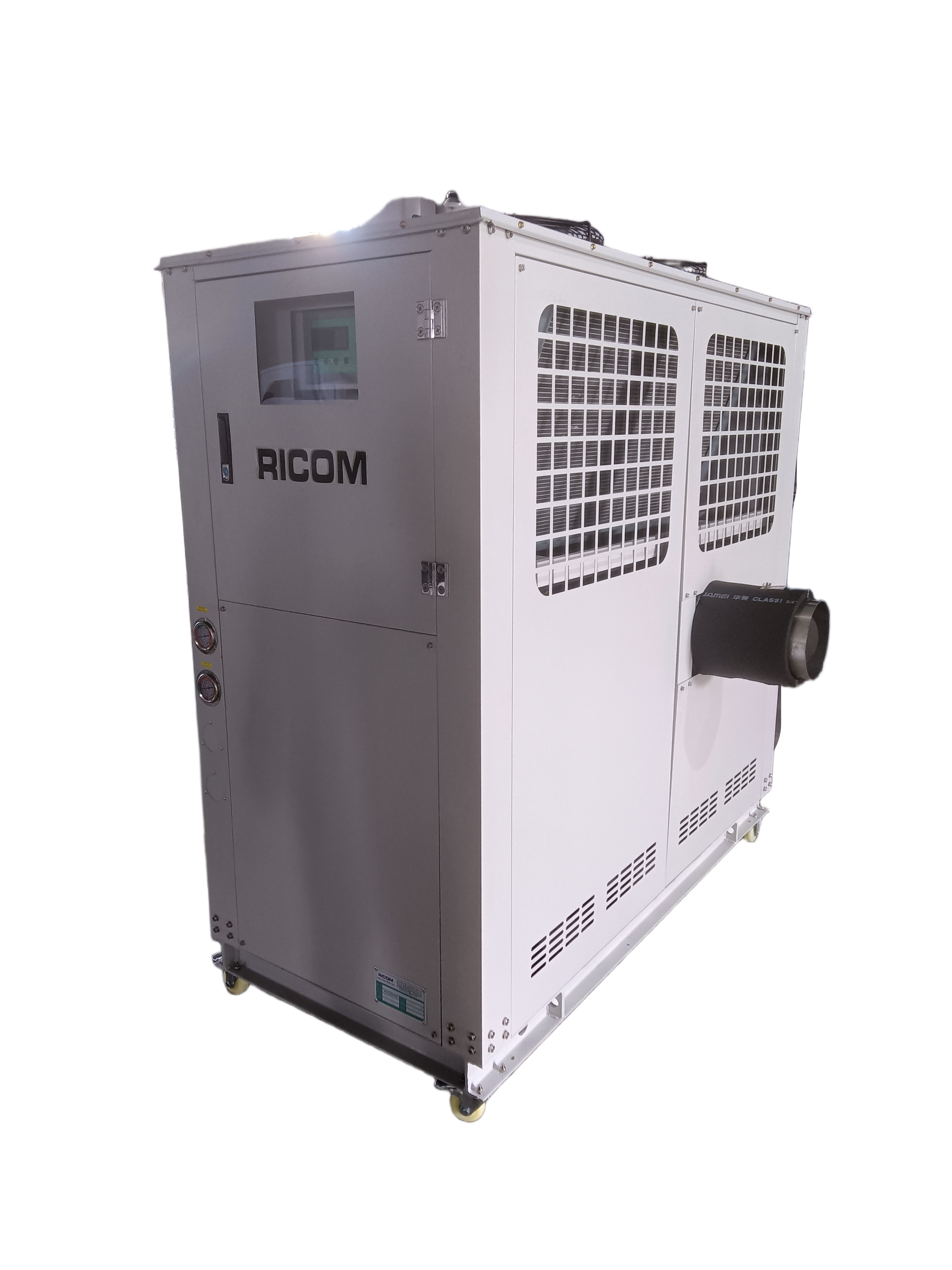
High-speed pulverizing generates frictional heat, and controlling temperature rise in a timely manner is important for maintaining continuous production and stable powder conditions.
Depending on the material characteristics and equipment design, common cooling methods include:
Air Cooling: Uses airflow to remove heat generated during processing.
Water Cooling: Provides stronger temperature control.
Air + Water Cooling: Combines both methods and is suitable for applications with higher temperature control requirements.
The cooling method should not be treated as a fixed configuration. It should be selected according to the material characteristics, target particle size, required output, and continuous operating conditions.

After pulverizing, the powder needs to leave the processing system smoothly and consistently. Depending on production requirements, screening, cyclone separation, and dust collection can be configured to separate, convey, and collect the powder.
A properly designed powder collection system not only affects powder recovery and finished powder quality, but also plays an important role in system airflow, dust control, and continuous operating stability.
When choosing a color masterbatch pulverizer, it is better to start with the actual material and final powder requirements rather than selecting a machine model first. Different color masterbatches have different formulations, particle sizes, and thermal properties. Even when the target particle size is the same, they may require different pulverizing and cooling configurations.
A more practical selection sequence is:
Material → Powder Target → Output → Working Hours → Final Application → Equipment Configuration
Following this sequence helps determine the appropriate grinding disc size, feeding method, cooling system, screening, and powder collection configuration more accurately, while reducing the deviations that can result from selecting a machine based only on its model.

When selecting a color masterbatch pulverizer, the first step is to understand the actual formulation and condition of the material.
The main factors to consider include:
Polymer carrier
Original particle size
Hardness and thermal properties
Pigment and additive content
These factors directly affect material feeding, pulverizing, temperature rise, and the final powder characteristics.
Simply knowing that the material is “PE masterbatch” or “PP masterbatch” is usually not enough. Equipment parameters still need to be determined based on the actual material characteristics and production requirements.

Target particle size and output need to be considered together. Finer powder typically requires corresponding adjustments to the pulverizing conditions. If high output is also required, the grinding disc gap, feed rate, cooling capacity, and powder collection capacity need to be properly balanced.
When selecting equipment, greater attention should be paid to:
The actual output that the equipment can achieve consistently over the long term at the target powder specification.
Compared with simply focusing on the theoretical maximum output of the equipment, stable actual production capacity provides a more useful reference.
Equipment operating hours directly affect system configuration and long-term operating requirements. Running the equipment for 1–2 hours per day is different from operating continuously for 8 or even 24 hours in terms of cooling, wear-resistant components, maintenance, and operational stability.
When selecting equipment, the daily working hours and continuous production requirements should be defined in advance. This helps ensure the proper configuration of the cooling system, key components, and maintenance plan for long-term stable operation.
The final application determines the required particle size, flowability, and production conditions of the powder. In addition to the target particle size, particle size distribution, feeding performance, temperature conditions, and powder collection efficiency should also be considered.
Equipment configuration should be determined based on the final application and powder requirements, and then matched with the actual material to select suitable pulverizing, cooling, and powder collection systems. Equipment should not be selected solely based on the material name.
Before selecting equipment, it is important to conduct a material test using the actual color masterbatch. Even when different formulations use the same base resin and similar colors, differences in pigments, additives, and material conditions can result in variations in feeding, pulverizing, temperature rise, and powder performance.
Testing the actual material can provide data on target particle size, actual output, temperature rise, feeding performance, and powder collection efficiency. This allows equipment selection to be based on actual test results rather than theoretical specifications alone.
A color masterbatch material trial is not only about confirming whether the material can be pulverized into powder. More importantly, it verifies powder quality, equipment stability under actual operating conditions, and production capacity.
Test Item | Main Purpose |
|---|---|
Raw Material Condition | Confirm the actual feeding conditions |
Powder Particle Size | Determine whether the target specification is achieved |
Particle Size Distribution | Evaluate powder consistency |
Actual Output | Confirm production capacity at the target specification |
Temperature Rise | Evaluate continuous operating conditions |
Feeding Performance | Determine whether feeding remains stable |
Powder Collection Performance | Confirm whether the powder can be collected consistently |
Final Application | Determine whether the powder meets actual processing requirements |
Color / Contamination Performance | Check powder condition between batches or after material changeover |
These data help determine the appropriate configuration of the pulverizing, feeding, cooling, screening, and powder collection systems, providing a practical basis for final equipment selection.
For color masterbatch powder production, equipment configuration should be determined based on the actual material and production requirements rather than using a fixed set of parameters.
Mao Yue uses a disc-type plastic pulverizing system and can configure the feeding, pulverizing, cooling, screening, and powder collection systems according to the material characteristics, target particle size, required output, and operating conditions of the color masterbatch.
The key is not to use the same parameters for all color masterbatches, but to verify particle size, output, temperature rise, and powder collection performance through actual material testing before determining the appropriate production conditions.

Different color masterbatches require different pulverizing conditions. An adjustable grinding disc gap allows the pulverizing intensity to be adjusted according to the actual material and target particle size, helping achieve a suitable balance between powder fineness, output, and temperature rise.

An automatic feeding system can reduce fluctuations caused by manual feeding and maintain a stable, continuous material supply, improving the repeatability of the pulverizing process.
For color masterbatch powder production lines operating continuously for extended periods, stable feeding is an important foundation for maintaining consistent output, temperature rise, and powder characteristics.

Depending on the actual material, target particle size, and production conditions, air cooling, water cooling, or a combination of air and water cooling can be selected.
The cooling system should be configured based on actual temperature rise, output, and continuous operating requirements. The goal is to maintain stable system operation while providing adequate temperature control, rather than simply adding more cooling equipment.

After pulverizing, the powder needs to be conveyed and collected promptly and consistently. The cyclone separation and dust collection systems can work together with the pulverizing equipment to separate, convey, and collect the powder, reducing powder retention and maintaining stable airflow and continuous production.

Depending on the equipment configuration, the system can integrate PLC/HMI to monitor key parameters such as current, temperature, feeding, and equipment operating status.
For long-term continuous production, process data can help identify changes in operating conditions in a timely manner. Parameters can then be adjusted according to the material characteristics and production requirements, improving process stability and repeatability.
Powder is not necessarily better simply because it is finer. An excessive proportion of fine particles may reduce flowability and increase the risk of bridging, powder accumulation, or unstable feeding.
The goal of pulverizing should not be to achieve the smallest possible particle size. Instead, an appropriate and stable particle size distribution should be established according to the final application, balancing powder fineness, flowability, and production stability.
If the temperature rises too much during pulverizing, some plastics may soften, stick to the grinding components, or agglomerate, affecting powder characteristics and continuous production.
The grinding disc gap, feeding rate, and cooling method should be properly matched to the actual material to control temperature rise and maintain stable processing conditions.
Significant fluctuations in the amount of material entering the pulverizing chamber can cause changes in equipment load, temperature rise, and output, affecting the stability of continuous production.
Stable feeding is therefore not simply an auxiliary process, but an important part of maintaining stable operation throughout the pulverizing system.
When producing color masterbatch powders in different colors, residual material from the previous batch may enter the next batch, affecting the color and purity of the powder.
In addition to arranging a suitable production sequence and properly cleaning the equipment during material changeover, the ease of equipment cleaning and residue control are also important.
Mao Yue’s color masterbatch pulverizing system focuses on easy-to-clean equipment design, reducing areas where powder can accumulate and making color changeovers, cleaning, and routine maintenance easier. This helps reduce the risk of material residue between different colors.
For production lines that require frequent color changes, this design can simplify cleaning and maintenance procedures and improve material changeover efficiency.
Yes. Color masterbatch pellets can be further processed into powder using a disc-type plastic pulverizing system. However, the target particle size, output, and equipment configuration need to be determined based on the actual material.
There is no single particle size suitable for all color masterbatches. The target particle size should be determined according to the final application, feeding method, and downstream processing requirements.
Not necessarily. An excessive proportion of fine particles may affect flowability, feeding, and powder collection. More importantly, the powder should have a particle size distribution that meets the application requirements and can be produced consistently.
Air cooling, water cooling, or a combination of both can be configured according to the actual material and production conditions. The feeding rate and pulverizing parameters should also be adjusted appropriately.
It is recommended to start with the actual color masterbatch, target particle size, required output, working hours, and final application. The grinding disc size, motor power, feeding system, cooling system, and powder collection configuration can then be determined based on material test results.
The actual color masterbatch, original particle size, target powder particle size, required output, working hours, and final application should be provided.
Good color masterbatch powder starts with the actual material, clear powder requirements, and verified production conditions.
If you plan to process color masterbatch into powder, you can provide Maoyue with:
Actual color masterbatch samples
Original particle size
Target powder particle size
Required output
Daily working hours
Final application
Mao Yue can conduct material trials based on your actual material and evaluate particle size, particle size distribution, actual output, temperature rise, feeding performance, and powder collection performance. Based on the test results, we can then discuss a suitable pulverizer configuration.
Do not select a masterbatch pulverizer based on the machine model alone. Test the actual material first, confirm the powder requirements, and then determine the equipment configuration. Send your color masterbatch samples and production requirements to Mao Yue for testing.


