Specializing in the production of Plastic Pulverizer Machines.

Views: 0 Author: Site Editor Publish Time: 2026-07-16 Origin: Site
When selecting or operating a plastic pulverizer, most people focus first on factors such as motor power, grinding disc diameter, production capacity, and energy consumption. While these are all important indicators of machine performance, one critical parameter that directly determines the grinding result is often overlooked—grinding disc clearance.
Although the clearance between the grinding discs is typically only a fraction of a millimeter, it plays a vital role in the entire pulverizing process. It directly affects how plastic particles are subjected to shearing, compression, friction, and impact inside the grinding chamber, ultimately influencing powder fineness, particle size distribution, production efficiency, energy consumption, grinding disc service life, and the long-term stability of the machine. Even a slight change in disc clearance can lead to noticeable differences in powder quality and may significantly affect downstream processes such as PVC extrusion, rotational molding, plastic compounding, dip coating, and powder coating.
Think of a plastic pulverizer as a pair of precision scissors. The grinding disc clearance is like the distance between the two blades. If the blades are too close together, excessive friction is generated, causing higher temperatures, increased power consumption, accelerated disc wear, and even material softening or disc clogging. On the other hand, if the blades are too far apart, the plastic particles cannot be adequately sheared, resulting in coarser powder, wider particle size distribution, and lower production efficiency. Only by maintaining the grinding disc clearance within the optimal range can manufacturers achieve the ideal balance between powder quality, production capacity, energy efficiency, and equipment longevity.
For professional plastic pulverizer manufacturers, grinding disc clearance is far more than a simple assembly dimension. It reflects the overall engineering capability, manufacturing precision, and process expertise behind the machine. From the machining accuracy of the grinding discs and the concentricity of the main shaft to dynamic balancing, assembly tolerances, and cooling system design, every detail contributes to maintaining a stable and precise grinding disc clearance during long-term operation.
With more than 30 years of experience in the research, development, and manufacturing of plastic pulverizing equipment, MaoYue Intelligent Equipment has always been committed to precision engineering and continuous technological innovation. By combining high-precision CNC machining, professional dynamic balancing, an adjustable grinding disc system, and an advanced hybrid cooling system, MaoYue ensures consistent grinding disc clearance throughout continuous production. This enables customers to produce plastic powders with uniform particle size, excellent flowability, and consistent quality, while achieving higher productivity, lower energy consumption, and longer equipment service life.
In this article, we will explore why grinding disc clearance is so important, how it affects every stage of the plastic pulverizing process, and how proper clearance adjustment—combined with a high-quality plastic pulverizer—can significantly improve powder quality, production efficiency, and your company's long-term competitiveness.
Grinding disc clearance refers to the small gap between the rotating grinding disc and the stationary grinding disc inside a plastic pulverizer. After plastic particles enter the grinding chamber, they pass through this narrow clearance, where they are continuously subjected to compression, shearing, friction, and impact until they are reduced into fine plastic powder.
Although this clearance is typically only a fraction of a millimeter, it is one of the most critical parameters in the entire pulverizing system. In many ways, it serves as the heart of the plastic pulverizer, determining how efficiently and consistently the material is processed.
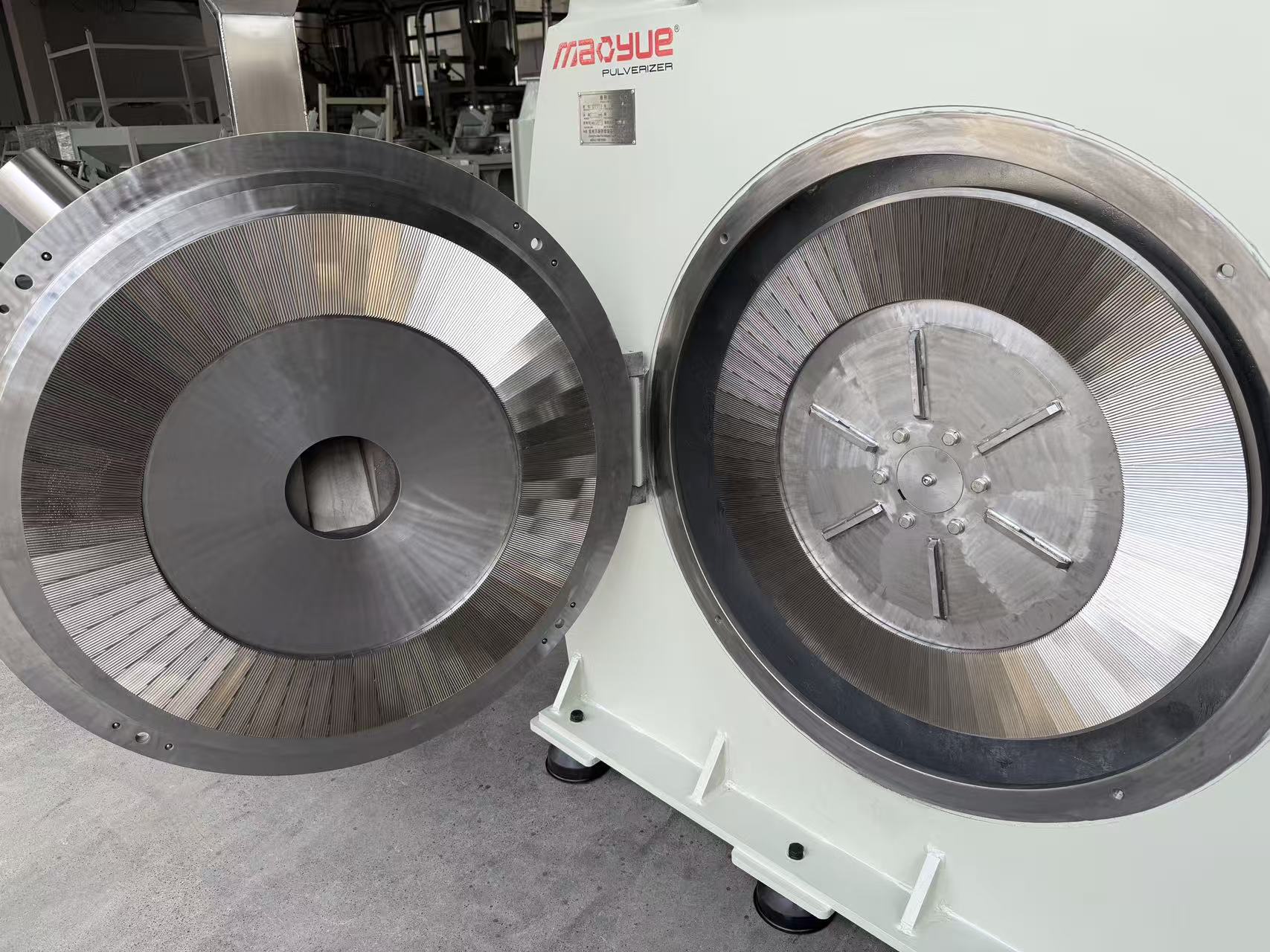
Inside a disc-type plastic pulverizer, the grinding system consists of a high-speed rotating grinding disc and a stationary grinding disc. Together, these two discs form a narrow grinding passage known as the grinding disc clearance.
As plastic particles enter this passage, they are exposed to thousands of high-speed shearing actions every second while being compressed, rubbed, and impacted between the two grinding discs. This is the primary grinding zone where the plastic is gradually reduced to the desired particle size.
The uniformity, stability, and precision of the grinding disc clearance directly determine several key performance indicators of the pulverizer, including powder fineness, particle size distribution, production efficiency, grinding temperature, energy consumption, and grinding disc service life. Even a slight variation in the clearance can significantly affect powder quality and the overall stability of the pulverizing process.
The most important function of grinding disc clearance is to control the fineness and particle size of the plastic powder. In general, a properly reduced grinding disc clearance allows plastic particles to remain in the grinding zone for a longer period, where they undergo more intensive shearing, compression, and grinding. As a result, the pulverizer produces finer, more uniform plastic powder with a narrower particle size distribution, improving product consistency and downstream processing performance.
In contrast, if the grinding disc clearance is too large, plastic particles may pass through the grinding zone before they have been fully pulverized. This results in coarser powder, a higher percentage of oversized particles, and a wider particle size distribution. Such inconsistencies not only affect the appearance and flowability of the powder but also increase the screening workload and may require additional regrinding, ultimately reducing production efficiency while increasing energy consumption.
For industries such as rotational molding, masterbatch production, and PVC processing, even small variations in powder particle size can have a significant impact on the quality of the final product. Uniform particle size is essential for ensuring stable feeding, consistent melting behavior, improved material dispersion, and superior finished product performance.

Many people assume that the smaller the grinding disc clearance, the better the pulverizing performance. In reality, this is a common misconception. If the clearance is too small, the material flow rate decreases while friction increases significantly. This not only accelerates grinding disc wear but also causes heat to build up inside the grinding chamber. As the temperature rises, some thermoplastic materials may begin to soften or adhere to the grinding discs, disrupting continuous production and ultimately reducing actual output.
When the grinding disc clearance is properly adjusted, plastic particles can pass smoothly through the grinding chamber while still receiving sufficient shearing and grinding to achieve the desired particle size. This creates the ideal balance between high production capacity, excellent powder quality, and maximum operating efficiency.
Professional plastic pulverizer manufacturers, such as MaoYue, optimize the grinding disc clearance according to the characteristics of different plastic materials. This allows customers to achieve both higher productivity and consistent, high-quality plastic powder without compromising machine stability or energy efficiency.
In plastic pulverizing, temperature control is one of the most critical factors affecting both powder quality and machine stability. Whether processing PE, PP, PVC, or other thermoplastics, heat is continuously generated during high-speed grinding, and grinding disc clearance plays a vital role in determining how much heat is produced and accumulated.
Every collision, shearing action, and frictional contact between the plastic particles and the grinding discs converts mechanical energy into heat. If the grinding disc clearance is too small, friction increases dramatically, causing the temperature inside the grinding chamber to rise rapidly. Excessive heat may soften or even partially melt thermoplastic materials such as PE, PP, EVA, and TPU. Once the material becomes sticky, it can adhere to the grinding discs or clog the grinding chamber, reducing production efficiency and interrupting continuous operation.
By contrast, a properly adjusted grinding disc clearance allows plastic particles to move smoothly through the grinding chamber while minimizing unnecessary friction and heat generation. When combined with an efficient cooling system, the pulverizer can maintain a stable grinding temperature even during long periods of continuous operation. This helps prevent material degradation, improves powder consistency, and ensures reliable, high-efficiency production.

Today, energy efficiency has become a top priority for modern plastic processing companies. One often-overlooked factor that has a direct impact on power consumption is grinding disc clearance. When the clearance is adjusted too small, the motor must overcome greater resistance during the pulverizing process. As a result, motor load and operating current increase, leading to higher electricity consumption.
In contrast, when the grinding disc clearance is properly optimized, plastic materials can be pulverized efficiently without creating excessive resistance. This allows the motor to operate within its optimal load range, reducing energy consumption while maintaining stable production capacity and consistent powder quality.
For manufacturers that operate 24 hours a day producing plastic powder, even a small reduction in hourly power consumption can translate into substantial cost savings over time. Lower energy usage not only reduces operating expenses but also improves the overall efficiency and competitiveness of the production line.
Therefore, precisely controlling the grinding disc clearance is essential not only for achieving superior powder quality and high production efficiency, but also for reducing energy consumption, lowering operating costs, and maximizing long-term economic benefits. It is one of the key factors in building a highly efficient, reliable, and cost-effective plastic pulverizing system.
Many people believe that the smaller the grinding disc clearance, the finer the powder and the better the pulverizing performance. However, this is a common misconception. A smaller clearance does not necessarily produce better results. In fact, if the grinding disc clearance is set too small, the disadvantages often outweigh the benefits.
For a plastic pulverizer, the goal is not simply to minimize the clearance. Instead, the key is to determine the optimal grinding disc clearance based on the specific plastic material being processed and the desired powder particle size. Only by finding this balance can the machine deliver high-quality powder, stable production efficiency, lower energy consumption, and longer equipment service life.
An excessively small grinding disc clearance may improve particle fineness to some extent, but it also increases friction, heat generation, motor load, and grinding disc wear. These issues can lead to material softening, disc clogging, reduced production capacity, and higher operating costs. Therefore, proper clearance adjustment is essential for achieving the best overall pulverizing performance.
When the rotating grinding disc is positioned too close to the stationary grinding disc, plastic particles are subjected to much greater compression, shearing, and friction. While this may improve powder fineness to some extent, it also significantly increases the friction between the plastic material and the grinding discs.
A simple way to understand this is to imagine rubbing your hands together. The faster and harder you rub them, the more heat they generate. The same principle applies to a plastic pulverizer. When the grinding disc clearance is too small, the grinding discs must not only cut the plastic but also withstand much greater frictional forces, continuously generating excessive heat inside the grinding chamber.
As a result, the machine operates under higher mechanical stress, reducing overall efficiency and placing additional strain on key components.

In plastic pulverizing, temperature control is often even more important than increasing cutting force. If the grinding disc clearance is too small, the continuous friction between the plastic particles and the grinding discs generates excessive heat. When this heat cannot be dissipated efficiently, the temperature inside the grinding chamber rises rapidly, directly affecting the properties of the plastic material.
Once the material exceeds its softening temperature, it begins to stick to the grinding disc surface instead of being cleanly cut. This can lead to unstable powder quality, clogged screens, reduced airflow, lower production efficiency, and in severe cases, complete machine shutdown.
This problem is particularly common when processing LDPE, LLDPE, PE, PP, EVA, and TPU. Because these thermoplastics have relatively low softening temperatures and are highly sensitive to heat, they rely heavily on proper grinding disc clearance and an efficient cooling system to maintain a stable grinding temperature throughout continuous production.
An excessively small grinding disc clearance also accelerates grinding disc wear. As plastic particles are exposed to greater compression and friction, the grinding teeth must withstand higher mechanical and thermal stresses. Over time, the cutting edges gradually become rounded or dull, and localized wear or damage may occur, reducing the grinding discs' cutting efficiency.
As the grinding discs continue to wear, the effective grinding disc clearance also changes. This causes powder particle size to become less consistent and requires more frequent machine adjustments and recalibration, ultimately reducing production efficiency and increasing maintenance requirements.
In addition, frequent grinding disc replacement involves much more than the cost of new wear parts. It also results in increased machine downtime, higher maintenance labor costs, production interruptions, and scheduling delays. For manufacturers operating continuous plastic powder production lines, these hidden costs often exceed the actual cost of the grinding discs themselves.
For this reason, maintaining the optimal grinding disc clearance is essential not only for producing high-quality plastic powder but also for extending grinding disc life, reducing maintenance costs, and ensuring long-term, reliable operation.
If an excessively small grinding disc clearance leads to increased friction and higher grinding temperatures, an excessively large clearance creates a different set of problems. Although a larger gap reduces friction between the grinding discs, it also weakens the shearing, compression, and grinding action applied to the plastic particles, resulting in significantly lower pulverizing efficiency.
For a plastic pulverizer, an overly large grinding disc clearance affects much more than powder fineness. It can reduce production efficiency, increase energy consumption, generate more rework, and lead to unnecessary material waste, ultimately raising the overall cost of production.

When the distance between the rotating grinding disc and the stationary grinding disc is too large, plastic particles spend much less time in the grinding zone. As a result, they receive insufficient shearing, compression, and friction before passing through the grinding chamber.
Many particles leave the grinding zone before they are fully pulverized, producing coarser plastic powder, a higher percentage of oversized particles, and a broader particle size distribution. In addition to reducing powder uniformity, inconsistent particle sizes can negatively affect powder flowability, dispersion, and downstream processing performance.
For applications such as PVC extrusion, rotational molding, and powder coating, consistent particle size is essential for maintaining stable processing conditions and producing high-quality finished products. Even small variations in powder size can influence melting behavior, surface finish, dimensional stability, and overall product performance.
Although a larger grinding disc clearance allows material to pass through the grinding chamber more easily, it does not necessarily improve overall productivity.
Because many plastic particles are not fully pulverized during their first pass, a significant amount of oversized material must be returned to the pulverizing system for secondary or even multiple grinding cycles. While the machine may appear to process more material, the percentage of qualified finished powder actually decreases, reducing the effective production output.
Repeated grinding also means the pulverizer must handle more material, causing the motor to run longer and the cooling system to operate continuously. This increases electricity consumption, places additional stress on the equipment, and extends the overall production cycle.
For manufacturers focused on maximizing productivity, qualified output is far more important than simply increasing material throughput. Maintaining the optimal grinding disc clearance is therefore one of the most effective ways to improve production efficiency while ensuring consistent powder quality.
Plastic powder that is too coarse or fails to meet the required particle size specification often cannot be used directly in production. Manufacturers are forced to either regrind the material or, in some cases, discard it altogether. Both options increase production costs and lead to unnecessary material waste.
This issue becomes even more significant when processing high-value engineering plastics such as PA, PET, PBT, and TPU. Every additional grinding cycle increases manufacturing costs, while repeated exposure to heat may gradually degrade the material's physical properties, reducing its processing performance and the quality of the final product.
In addition to higher material costs, frequent rework also disrupts production schedules, lowers equipment utilization, and delays product delivery. For manufacturers operating continuous production lines, these hidden costs can have a substantial impact on overall profitability.
For this reason, selecting the proper grinding disc clearance is essential for minimizing rework, reducing material waste, improving qualified output, and achieving a more efficient and cost-effective plastic pulverizing process.

For a plastic pulverizer, there is no universal standard grinding disc clearance that works for every plastic material or production condition. The optimal clearance is not a fixed value. Instead, it must be carefully optimized based on several factors, including the type of plastic, target powder particle size, production capacity, grinding disc speed, feed rate, and grinding temperature.
Professional plastic pulverizer manufacturers understand that precision adjustment is not simply about making the clearance smaller or larger. The real objective is to achieve the ideal balance between powder fineness, particle size consistency, production efficiency, energy consumption, grinding disc wear, and long-term machine stability.
Think of it like tuning a musical instrument. Even the smallest adjustment can have a significant impact on the final performance. The same principle applies to grinding disc clearance—even a variation of a fraction of a millimeter can noticeably affect powder quality and overall pulverizing performance.
Every plastic material has its own hardness, toughness, melting point, heat sensitivity, elasticity, and friction characteristics, which means each one behaves differently during the pulverizing process. As a result, the optimal grinding disc clearance varies from one material to another.
For example:
PVC is relatively brittle, allowing it to be processed efficiently with a smaller grinding disc clearance to produce finer and more uniform powder.
PE (Polyethylene) is softer and generates more frictional heat during grinding, requiring a carefully optimized clearance to prevent overheating and material buildup.
PP (Polypropylene) has higher toughness and requires a balance between sufficient shearing force and effective cooling to achieve stable pulverizing performance.
EVA and TPU are highly heat-sensitive and can soften easily during processing, making precise grinding disc clearance and efficient temperature control especially important.
For this reason, experienced engineers never rely on a single fixed machine setting. Instead, they evaluate multiple factors—including material characteristics, target mesh size, production capacity, grinding temperature, and cooling efficiency—before optimizing the grinding disc clearance for each specific application.
By tailoring the clearance to the material being processed, manufacturers can maximize machine performance while achieving consistent powder quality, high production efficiency, lower energy consumption, extended grinding disc life, and long-term operational stability.

Different applications have different requirements for powder particle size and particle size distribution. As a result, the grinding disc clearance must be adjusted according to the target mesh size rather than using a single standard setting for every application.
For example:
Rotational molding requires plastic powder with uniform particle size and excellent flowability to ensure even melting, consistent wall thickness, and smooth surface finishes on molded products.
PVC extrusion places greater emphasis on stable material feeding and consistent melting behavior. A uniform particle size helps improve extrusion efficiency while minimizing dimensional variations in the final products.
The masterbatch industry demands excellent powder dispersion. Fine and evenly distributed plastic powder allows pigments and additives to mix more uniformly, resulting in better color consistency and more stable processing performance.
Dip coating applications require not only a narrow particle size distribution but also excellent powder flowability and uniformity to produce smooth, dense, and evenly coated surfaces with consistent coating thickness.
Therefore, the target mesh size determines much more than the fineness of the finished powder. It directly influences product performance, processing efficiency, and the quality of the final product. For professional plastic pulverizer manufacturers, grinding disc clearance should always be optimized according to the customer's specific application requirements rather than simply pursuing finer or coarser powder. By matching the clearance to the desired mesh size and processing application, manufacturers can achieve the optimal balance between powder quality, production efficiency, and overall machine performance.
For a plastic pulverizer, grinding disc clearance is not a parameter that remains permanently unchanged after a single adjustment. During long-term continuous operation, the actual clearance can gradually change due to factors such as machine operating conditions, component wear, temperature fluctuations, and manufacturing precision.
To maintain consistent powder quality, production efficiency, and machine stability, the grinding disc clearance should be inspected and adjusted regularly as part of routine equipment maintenance.
As a plastic pulverizer processes large volumes of material, the grinding discs gradually wear over time. The grinding teeth become less sharp, reducing their cutting efficiency and altering the effective grinding disc clearance.
As the discs wear, powder particle size may become less consistent, production efficiency can decline, and energy consumption may increase. For this reason, it is recommended to inspect the condition of the grinding discs regularly based on the type of material being processed, operating hours, and the degree of wear.
When excessive wear is detected, the grinding discs should be reconditioned, replaced, or the grinding disc clearance should be recalibrated to restore optimal grinding performance. Regular maintenance not only helps maintain consistent powder quality but also extends equipment life and minimizes unexpected downtime.

Heat is inevitably generated during the pulverizing process, and all metal components expand slightly as their temperature increases. Although this dimensional change is usually only a fraction of a millimeter, it is significant enough to affect the grinding performance of a high-precision plastic pulverizer.
During extended continuous operation, if the generated heat is not dissipated efficiently, critical components such as the grinding discs and main shaft may expand slightly. These small dimensional changes can alter the actual grinding disc clearance, causing it to deviate from the optimal setting and affecting powder particle size, production efficiency, and process stability.
This is one of the primary reasons why modern plastic pulverizers are equipped with high-efficiency cooling systems. By effectively controlling the grinding temperature, the cooling system minimizes thermal expansion, maintains a stable grinding disc clearance, and ensures consistent pulverizing performance even during long production runs.
Even if the operator adjusts the grinding disc clearance to the ideal setting, the actual clearance can still fluctuate during operation if the machine itself suffers from machining inaccuracies, assembly errors, or main shaft runout. These seemingly minor deviations can cause unstable grinding performance, inconsistent powder quality, increased machine vibration, and accelerated wear of key components.
For this reason, maintaining a precise grinding disc clearance depends not only on proper adjustment but also on the overall manufacturing quality and assembly precision of the plastic pulverizer. A high-performance machine should be built with the following features:
High-precision CNC machining to ensure accurate grinding disc dimensions, tooth profiles, and machining tolerances.
A high-concentricity main shaft system to keep the rotating grinding disc running smoothly and accurately at high speeds.
A premium bearing system to minimize radial and axial runout, improving rotational accuracy and overall machine stability.
Professional dynamic balancing of the grinding discs to reduce vibration during high-speed operation and ensure uniform load distribution across the grinding surfaces.
Strict assembly tolerance control to guarantee precise alignment and fit between all critical machine components.
Without these fundamental engineering and manufacturing standards, it is extremely difficult to maintain a stable and accurate grinding disc clearance over long periods of continuous operation. This is why high-quality plastic pulverizers consistently deliver more uniform powder particle size, higher production efficiency, lower energy consumption, and longer service life, while lower-precision machines often struggle with inconsistent performance and frequent maintenance.
For a high-performance plastic pulverizer, maintaining a precise grinding disc clearance depends on much more than the adjustment mechanism alone. It is the result of the machine's overall engineering design, manufacturing precision, and quality control throughout the production process. If the grinding discs are not machined accurately, the main shaft has excessive runout, or the machine experiences excessive vibration during operation, the grinding disc clearance can quickly deviate from its original setting—even if it was perfectly adjusted before leaving the factory.
With more than 30 years of experience in the research, development, and manufacturing of plastic pulverizing equipment, Mao Yue Intelligent Equipment is committed to precision engineering at every stage of production. From grinding disc design and precision component machining to machine assembly, dynamic balancing, and final performance testing, every process is carried out under strict quality control standards.
This comprehensive manufacturing approach ensures that every MaoYue plastic pulverizer maintains a stable and precise grinding disc clearance throughout long-term continuous operation. As a result, customers can consistently produce high-quality plastic powder with uniform particle size, excellent flowability, and reliable product consistency, while benefiting from higher production efficiency, lower energy consumption, and extended equipment service life.

The grinding disc is the core component that determines the performance of a plastic pulverizer, and its machining accuracy directly affects the stability of the grinding disc clearance.
At MaoYue, every grinding disc is manufactured using advanced high-precision CNC machining centers. Critical parameters—including disc flatness, concentricity, tooth profile geometry, dimensional accuracy, and machining tolerances—are strictly controlled throughout the manufacturing process to ensure exceptional consistency and precision.
Compared with grinding discs produced using lower-precision machining methods, MaoYue's precision-engineered grinding discs maintain more uniform contact between the rotating and stationary discs. This provides a solid foundation for accurate grinding disc clearance adjustment and stable pulverizing performance.
This level of manufacturing precision not only produces more uniform particle size distribution and higher-quality plastic powder but also minimizes localized wear and abnormal vibration. As a result, the pulverizer maintains stable grinding performance, higher production efficiency, and longer service life even during extended continuous operation.

Grinding discs typically rotate at several thousand revolutions per minute. At these high operating speeds, even a slight mass imbalance can be greatly amplified, generating excessive vibration, increasing mechanical stress, and affecting the stability of the grinding disc clearance.
To eliminate these issues, MaoYue performs professional dynamic balancing on every high-speed grinding disc before assembly. This ensures smooth and stable rotation at high speeds while effectively minimizing vibration and rotational runout throughout the pulverizing process.
Accurate dynamic balancing offers multiple benefits. It reduces the load on the main shaft and bearing system, extends the service life of critical components, and helps maintain the precise relative position between the rotating and stationary grinding discs. As a result, the grinding disc clearance remains highly stable throughout long-term continuous production, enabling the machine to consistently produce plastic powder with uniform particle size, excellent consistency, and reliable quality.

Different plastic materials have unique processing characteristics, which means there is no single grinding disc clearance suitable for every application.
To address this, MaoYue has developed an adjustable pulverizing system that allows operators to quickly and accurately fine-tune the grinding disc clearance according to the hardness, toughness, thermal properties, and target particle size of different materials, including PVC, PE, PP, EVA, TPU, ABS, and PA. This ensures that the plastic pulverizer consistently operates under optimal grinding conditions for every application.
The flexible adjustment system not only reduces material changeover and machine setup time but also minimizes trial runs and significantly improves the likelihood of achieving the desired particle size on the first attempt. Whether customers require 20, 30, 40, 60, 80, or 100 mesh plastic powder, MaoYue can optimize the grinding disc clearance to match the target specification, helping customers achieve the ideal balance between powder quality, production efficiency, and machine stability.

A precise grinding disc clearance can only be maintained under stable temperature conditions. If the heat generated during the pulverizing process is not removed efficiently, thermal expansion of the metal components can alter the actual grinding disc clearance, even when the initial adjustment is perfectly calibrated. These small dimensional changes can affect particle size consistency, powder quality, and the overall stability of the machine.
To ensure consistent performance, MaoYue combines air cooling, water cooling, and low-temperature air cooling technologies into an optimized hybrid cooling system. The cooling configuration can be tailored to different plastic materials and production conditions, providing a more efficient heat management solution for a wide range of applications.
By rapidly dissipating the heat generated during grinding, the hybrid cooling system effectively suppresses temperature rise and minimizes the effects of thermal expansion on the grinding disc clearance.
When processing heat-sensitive materials such as PE, PP, LLDPE, EVA, and TPU, the system significantly reduces the risk of material softening, sticking to the grinding discs, and clogging inside the grinding chamber. This enables the plastic pulverizer to maintain a stable grinding disc clearance, consistent powder quality, and outstanding pulverizing performance even during extended periods of continuous operation.
Even the most advanced plastic pulverizer cannot deliver consistent long-term performance without proper maintenance. Regular inspection and adjustment of the grinding disc clearance are essential not only for maintaining consistent powder quality, but also for minimizing downtime, improving production efficiency, and extending the service life of critical machine components.
A well-planned maintenance program helps ensure that the pulverizer continues to operate at peak performance while reducing operating costs and preventing unexpected equipment failures.

The grinding discs are the most critical working components of a plastic pulverizer and the primary factor affecting changes in grinding disc clearance over time. During continuous production, the grinding teeth gradually wear, reducing cutting efficiency and altering the effective clearance between the rotating and stationary discs.
It is recommended to inspect the grinding discs regularly based on operating hours, processed materials, and wear conditions. Pay close attention to the wear pattern of the disc surface, the condition of the grinding teeth, disc flatness, and the contact condition between the two grinding discs. If excessive wear or damage is detected, the discs should be repaired or replaced before powder quality begins to deteriorate.
Routine inspection not only helps maintain consistent particle size but also extends grinding disc life and improves overall machine reliability.
Grinding temperature is one of the most important indicators of machine operating conditions and a key reference for determining whether the grinding disc clearance remains properly adjusted.
An abnormal increase in grinding temperature often indicates that the grinding disc clearance should be readjusted or that the cooling system requires maintenance. Ignoring excessive temperature can lead to unstable powder quality, reduced production efficiency, and accelerated wear of machine components.
Installing a temperature monitoring system allows operators to continuously monitor the temperature of the grinding chamber, bearing system, and other critical components. Real-time temperature monitoring helps identify potential problems at an early stage, allowing corrective actions to be taken before production is affected.
The long-term stability of the main shaft system directly determines whether the grinding disc clearance can remain consistent, and the bearing system is one of its most critical components.
As bearings wear or become damaged, they can cause shaft vibration, radial runout, or axial movement, all of which directly affect the actual grinding disc clearance during operation. Even minor bearing wear can lead to inconsistent particle size, increased vibration, and reduced grinding performance.
Keeping the main shaft running smoothly not only helps maintain a stable grinding disc clearance but also extends the service life of the main shaft, grinding discs, transmission system, and other key mechanical components, reducing maintenance costs and improving machine reliability.
A stable grinding disc clearance depends on maintaining a stable grinding temperature, and an efficient cooling system is essential for effective temperature control.
Whether the plastic pulverizer uses air cooling, water cooling, or a hybrid air-and-water cooling system, the cooling system should always be maintained in optimal operating condition. Efficient heat dissipation minimizes thermal expansion of metal components, helping to maintain a consistent grinding disc clearance throughout continuous production.
As part of routine maintenance, operators should regularly clean cooling air passages and heat dissipation channels, inspect the water circulation system for proper flow, verify that the water pump, cooling pipelines, and cooling fans are functioning correctly, and remove scale, dust, or other blockages that may reduce cooling efficiency.
By keeping the cooling system operating at peak performance, manufacturers can effectively prevent excessive temperature rise, maintain consistent powder quality, improve machine stability, and extend the overall service life of the plastic pulverizer.
No. An excessively small grinding disc clearance can increase friction, generate excessive heat, accelerate grinding disc wear, and even reduce production capacity. The optimal clearance is one that achieves the best balance between powder fineness, production efficiency, energy consumption, and machine stability.
The adjustment frequency depends on several factors, including the type of plastic being processed, operating hours, and the wear condition of the grinding discs.
For continuous industrial production, it is recommended to inspect the pulverizing system regularly. If you notice changes in powder quality, particle size, production efficiency, or grinding temperature, the grinding disc clearance should be checked and readjusted promptly to maintain optimal performance.
Heat-sensitive materials such as PE, EVA, TPU, and certain modified plastics require particularly precise grinding disc clearance because they are more susceptible to frictional heat during the pulverizing process.
In addition, engineering plastics and other high-value materials also require accurate clearance adjustment to ensure consistent particle size distribution, stable powder quality, and maximum material utilization.
Absolutely. An improperly adjusted grinding disc clearance can increase motor load, raise power consumption, and reduce overall production efficiency.
By optimizing the grinding disc clearance, manufacturers can lower operating costs, improve energy efficiency, extend the service life of key machine components, and maximize the overall performance of the plastic pulverizer.
Although the grinding disc clearance is typically only a fraction of a millimeter, it is one of the most critical factors affecting the performance of a plastic pulverizer. It directly influences powder particle size, particle size distribution, production efficiency, grinding temperature, energy consumption, grinding disc service life, and the long-term operating stability of the entire machine.
The ideal grinding disc clearance is neither simply smaller nor larger. Instead, it should be carefully optimized according to the plastic material, target mesh size, and production requirements to achieve the best balance between powder quality, production efficiency, energy efficiency, and equipment durability.
With more than 30 years of experience in the research, development, and manufacturing of plastic pulverizing equipment, MaoYue Intelligent Equipment is committed to delivering reliable and high-performance pulverizing solutions through precision manufacturing, strict quality control, advanced cooling technology, adjustable pulverizing systems, and continuously optimized grinding disc designs.
Whether you are processing PVC, PE, PP, EVA, TPU, ABS, PET, PA, or other engineering plastics, MaoYue can provide professional machine selection, customized grinding disc clearance optimization, and tailored pulverizing solutions based on your specific material characteristics and application requirements.
By choosing the right plastic pulverizer and maintaining the optimal grinding disc clearance, you can consistently produce high-quality plastic powder with uniform particle size and stable performance, while improving production efficiency, reducing operating costs, and maximizing your long-term return on investment.


