Specializing in the production of Plastic Pulverizer Machines.

Views: 0 Author: Site Editor Publish Time: 2026-07-18 Origin: Site
If you've ever used a plastic pulverizer, you may have asked yourself a simple question: Why can two machines with the same motor power have production capacities that differ by hundreds of kilograms per hour?
In reality, the output of a plastic pulverizer is not determined by a single factor. Instead, it is the result of multiple interacting elements, including raw material properties, grinding disc design, disc gap, cooling efficiency, feeding stability, machine configuration, and routine maintenance.
In other words, a plastic pulverizer is more like a complete system than a collection of individual components. Only when every part works together efficiently can the machine consistently deliver high output, stable operation, and uniform powder quality. If any part of the system underperforms—such as unstable feeding, excessive grinding disc wear, insufficient cooling, or poor airflow design—the result can be reduced capacity, higher energy consumption, and inconsistent particle size.
You can think of a plastic pulverizer as an orchestra. Every component must perform in perfect harmony. If even one section falls out of sync, the efficiency and performance of the entire system will suffer.
For plastic processing companies, output is not just a production figure; it is also a key indicator of production efficiency, operating costs, and profitability. A plastic pulverizer with high output and stable operation can not only reduce the unit production cost but also help companies respond to market demands faster and improve overall competitiveness.
Every additional kilogram of qualified plastic powder produced represents higher production efficiency, lower unit costs, and stronger market advantages. However, a truly outstanding pulverizer does not simply pursue maximum output. Instead, it achieves the best balance between high productivity, powder quality, energy consumption control, and equipment reliability.
Higher output means:
Lower production costs
Faster delivery times
Higher equipment utilization
Better return on investment
However, blindly pursuing higher output while ignoring the operating condition of the machine can create new problems. Although production capacity may increase in the short term, it can easily lead to higher operating temperatures, inconsistent powder particle size, accelerated grinding disc wear, increased maintenance costs, and even a shorter machine service life.
Therefore, in the plastic pulverizing industry, the real goal is not the “highest output”, but rather “continuously stable high output.”

The output of a plastic pulverizer usually refers to the amount of qualified plastic powder produced per hour, which is commonly measured in kilograms per hour (kg/h).
The processing capacity of a machine is a theoretical value, while the output represents the actual performance of the equipment under real production conditions.
Therefore, even if two plastic pulverizers have exactly the same model and rated specifications, their actual production output may still vary significantly depending on factors such as factory conditions, operating environment, raw materials, machine settings, and maintenance practices.
Higher output is certainly important, but it is not the only standard for evaluating the performance of a plastic pulverizer. If the particle size becomes inconsistent or high temperatures cause material degradation, simply pursuing higher production capacity has little value.
A truly excellent plastic pulverizer does not focus only on achieving “high output”. Instead, it aims to achieve the best balance between production capacity, powder quality, energy efficiency, and long-term stable operation.
This is also the core principle behind the continuous system optimization of Mao Yue Intelligent Equipment. Through ongoing improvements in grinding disc structure, cooling systems, airflow design, and overall machine integration, Mao Yue helps customers achieve stable and efficient production while maintaining high-quality powder performance.

When many companies try to increase pulverizer production capacity, their first thought is often to replace the machine or increase motor power. However, they frequently overlook one of the most important factors—the raw material itself.
In reality, even the most advanced plastic pulverizer cannot consistently achieve its best performance if the condition of the raw material is not ideal. Factors such as plastic type, particle size, shape, moisture content, bulk density, and the material’s thermal properties directly affect grinding efficiency, energy consumption, powder quality, and final output.
In other words, the raw material determines whether it is easy or difficult to grind, while the pulverizer determines how fast and how well it can be processed. Only when the material and the machine are properly matched can truly efficient and stable production be achieved.
Different plastics have completely different physical and thermal properties, resulting in significant differences in their performance during the pulverizing process.
For example:
PVC has relatively high brittleness, making it easier to pulverize and suitable for continuous high-output production.
PE tends to soften when exposed to heat, so an efficient cooling system is required to prevent material melting and sticking to the grinding discs.
PP generates more frictional heat during pulverizing, requiring better airflow cooling and more precise temperature control.
TPU has high elasticity and is more difficult to cut, requiring specially designed grinding discs to improve pulverizing efficiency.
PA, PC, PBT, and other engineering plastics usually require lower grinding temperatures and more precise machine parameters to prevent changes in material properties.
Therefore, there is no single machine or set of operating parameters that can be applied to all types of plastics. Material characteristics directly influence the output performance of a plastic pulverizer.
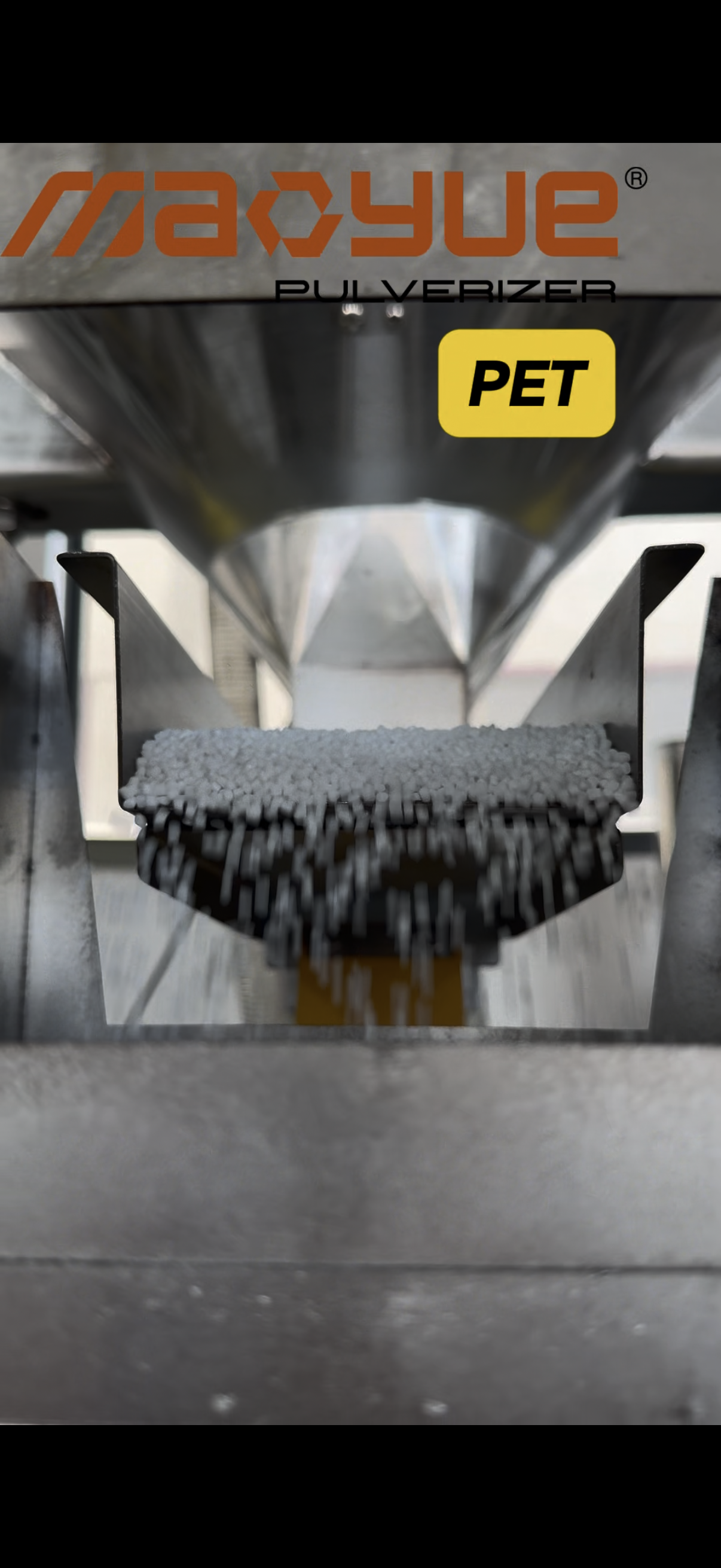
The size and shape of raw materials also have a significant impact on pulverizing efficiency.
Plastic fragments with uniform sizes and regular shapes can enter the grinding chamber more smoothly, ensuring more stable feeding and more even force distribution on the grinding discs. As a result, the overall production efficiency can be improved.
In contrast, if the raw material size is too large, it not only requires a longer grinding time but also increases the load on the machine. In some cases, it may even cause unstable feeding or temporary material blockage. Irregularly shaped plastic scraps can also affect airflow conveying, making the entire pulverizing process less stable.
Therefore, before entering the pulverizer, it is usually recommended to use a crusher or granulator to process the raw materials into uniformly sized pieces. This helps achieve higher and more stable pulverizing output.
Moisture content is another critical factor affecting plastic pulverizing efficiency.
If the plastic raw material contains excessive moisture, the heat generated during the grinding process may cause the material to become sticky. This can result in powder buildup on the grinding discs, grinding chamber, and conveying pipelines, reducing airflow conveying efficiency and increasing the frequency of equipment cleaning.
At the same time, moisture increases grinding resistance, causing higher operating temperatures, increased energy consumption, and unstable powder particle size distribution, which can negatively affect the quality of subsequent processing.
For plastics with high moisture absorption or strong sensitivity to water, it is recommended to perform sufficient drying treatment before pulverizing. This not only improves machine output but also enhances powder quality and ensures long-term stable operation of the equipment.
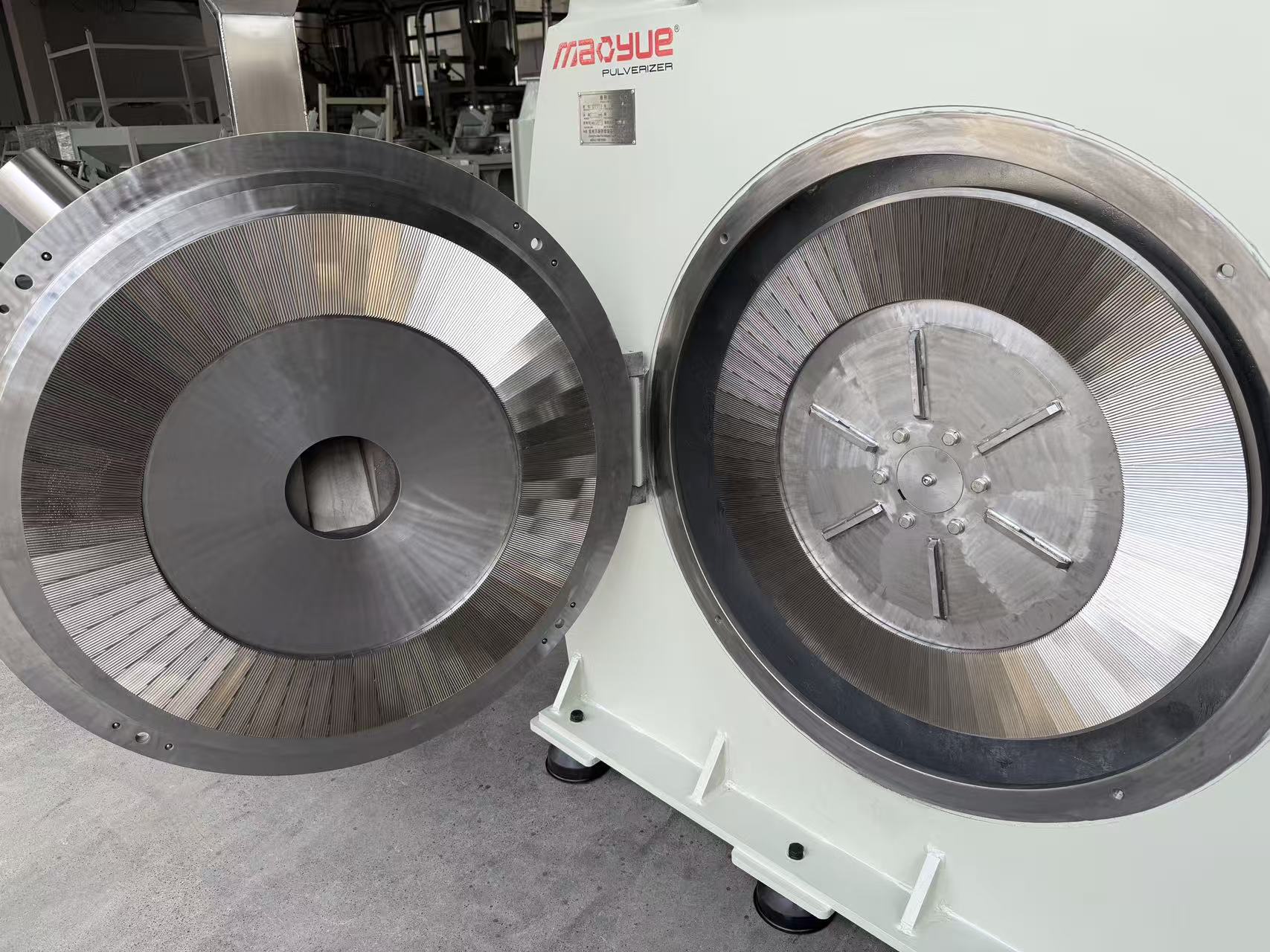
The grinding disc is often considered the “heart” of a plastic pulverizer. No matter how powerful the motor is or how advanced the feeding system may be, the final efficiency of plastic cutting and grinding is always determined by the grinding disc itself.
The grinding disc diameter directly determines the effective grinding area of the machine. A larger disc provides a longer cutting path, allowing plastic particles to come into contact with the grinding surface more frequently. As a result, more raw material can be processed within the same period of time, improving the production capacity per hour.
However, it is important to note that a larger grinding disc does not always mean higher output. If the disc diameter is not properly matched with the motor power, main shaft speed, airflow system, and cooling capacity, it may not deliver its expected advantages. Instead, it could increase energy consumption and reduce grinding efficiency.

The tooth profile structure is one of the most important factors determining grinding disc performance. The tooth design directly affects cutting efficiency. An optimized grinding disc design can reduce friction and improve powder uniformity.
A well-designed grinding disc tooth profile can:
Improve plastic cutting efficiency;
Reduce unnecessary friction;
Lower heat generation during the grinding process;
Improve powder particle size uniformity;
Reduce energy consumption per unit of production;
Extend grinding disc service life.
On the other hand, if the tooth profile design is unreasonable, plastic materials will experience more friction rather than cutting between the discs. This not only wastes significant energy but also accelerates grinding disc wear, causing the machine output to continuously decline over time.
The grinding gap between the rotating disc and the fixed disc is one of the most critical parameters throughout the pulverizing process.
Although this gap is usually only a fraction of a millimeter, it directly determines the cutting efficiency, grinding temperature, and final powder particle size.
A proper grinding disc gap must achieve the best balance between cutting performance and frictional heat generation.
If the grinding gap is too small, the cutting effect becomes stronger, but friction also increases significantly, causing the machine temperature to rise rapidly. For thermoplastic materials such as PE and PP, excessive heat may cause the plastic to soften or even partially melt. This not only reduces output but also affects powder quality and accelerates grinding disc wear.
If the grinding gap is too large, plastic particles cannot be fully cut and ground. Many particles may pass through the grinding zone without sufficient processing, resulting in larger powder particle sizes, reduced output, and the need for repeated grinding, which increases overall energy consumption.
Therefore, the optimal grinding disc gap is not simply the smallest possible or the largest possible. Instead, it should be precisely adjusted according to the material type, target particle size, and machine structure.
Only by maintaining the correct grinding disc gap can a plastic pulverizer achieve the ideal combination of high output, low energy consumption, and stable powder quality.
The motor is the power core of a plastic pulverizer, continuously providing driving force for the high-speed rotating grinding discs. However, a higher motor power does not necessarily mean higher pulverizer output.
The key factor affecting production capacity is whether the motor power, main shaft speed, grinding disc design, cooling capacity, and material characteristics are properly matched. Only when the entire system operates in coordination can the machine achieve maximum production capacity while maintaining high-quality powder performance.
Therefore, a truly excellent plastic pulverizer is not simply a machine equipped with the most powerful motor. Instead, it is a system that achieves the best balance between power transmission, grinding disc design, cooling system, and airflow structure, enabling continuous and stable production of high-quality plastic powder.

No matter how advanced a plastic pulverizer is, it is difficult to achieve continuous and efficient production without a stable feeding system. Therefore, for continuous production processes, stable feeding is just as important as grinding disc design and motor configuration.
A proper feeding rate is an essential foundation for achieving high output.
Feeding too quickly can easily cause material accumulation or blockage, while insufficient feeding wastes the processing capacity of the equipment.
Therefore, the optimal feeding speed is not simply the fastest possible speed. Instead, it should maintain a balanced supply of material inside the grinding chamber, allowing the machine to continuously operate within its highest efficiency range.

With the development of automated production, more and more plastic pulverizers are adopting intelligent automatic feeding systems to further improve production efficiency and reduce manual intervention.
Compared with traditional manual feeding, automatic feeding systems offer significant advantages:
Maintain more stable machine output;
Reduce labor intensity;
Lower the risk of material blockage;
Improve powder particle size consistency;
Reduce energy consumption per unit of production;
Enhance long-term operating stability of the entire machine.
As the plastic processing industry continues moving toward smart manufacturing, automatic feeding has become an essential component of modern high-performance plastic pulverizers.
High temperature is one of the biggest challenges in the plastic pulverizing process. During operation, plastic particles continuously undergo cutting, compression, and friction between the high-speed rotating grinding disc and the fixed grinding disc. A large amount of mechanical energy is converted into heat energy.
If this heat cannot be removed in time, it will not only reduce pulverizing efficiency but also affect powder quality and the long-term stable operation of the equipment.

Air cooling is the most common and fundamental cooling method used in modern plastic pulverizers.
A high-speed blower continuously supplies air into the grinding chamber, quickly removing most of the heat generated during the pulverizing process and maintaining stable machine operation.
In addition to heat dissipation, the air cooling system also plays an important role in powder conveying. High-speed airflow can quickly transport powder that has already reached the required particle size away from the grinding zone, preventing the powder from remaining between the grinding discs and undergoing unnecessary friction.
This further reduces heat generation and improves overall pulverizing efficiency.
For some plastics that generate a higher amount of heat during processing, an air cooling system alone may not be sufficient for continuous production. In such cases, a water cooling system becomes an important supplement for improving pulverizing efficiency.
A water cooling system typically uses circulating cooling water to continuously reduce the temperature of key areas such as the grinding chamber, bearing housing, and machine body components. By quickly removing heat generated during operation, it effectively prevents continuous temperature rise during long-term production.
This ensures more stable equipment performance and helps maintain consistent powder quality even under demanding processing conditions.
No matter how wear-resistant the grinding disc material is, continuous long-term operation will eventually cause gradual wear.
A sharp grinding disc improves cutting efficiency, while a worn grinding disc increases friction and reduces production capacity. Therefore, it is necessary to regularly inspect the wear condition of the grinding discs and perform maintenance or replacement when required.

Powder fineness is one of the important factors affecting the output of a plastic pulverizer.
In general, the finer the required powder particle size, the lower the machine output will be. This is because plastic particles need to remain in the grinding chamber for a longer period and undergo more cutting and grinding cycles to achieve a smaller particle size. At the same time, finer powder production also requires higher energy consumption.
However, for industries such as rotomolding, masterbatch production, plastic modification, and powder coating, finer and more uniform powder can provide better processing performance.
Therefore, in actual production, the best balance should be achieved between output and powder fineness according to specific product requirements, rather than simply pursuing only one performance indicator.
Experienced operators can adjust key operating parameters in a timely manner according to the processing characteristics of different plastic materials and the running condition of the equipment, ensuring that the pulverizer always operates within the optimal working range.
For example, skilled operators can:
Adjust the feeding speed according to machine load to prevent material blockage or idle operation;
Monitor grinding temperature in real time to prevent overheating from affecting powder quality;
Precisely adjust the grinding disc gap to balance output and powder fineness;
Identify potential equipment problems in advance by observing machine vibration, noise, motor load, and other operating conditions;
Optimize machine parameters according to different materials such as PVC, PE, PP, TPU, and engineering plastics.
These timely and accurate adjustments can not only improve machine output but also reduce energy consumption, minimize component wear, and maintain consistent powder particle size and quality.
In other words, an experienced operator can fully unlock the performance potential of a plastic pulverizer and achieve continuous, stable, and efficient production.
Regular maintenance is essential to ensure stable production and extend the service life of a plastic pulverizer.
The main maintenance tasks include:
Bearing lubrication
Grinding disc inspection
Belt adjustment
Cleaning of the dust collection system
Proper maintenance can help prevent unexpected downtime, maintain consistent machine output, reduce component wear, and ensure stable powder quality during long-term operation.

As discussed above, the output of a plastic pulverizer is never determined by a single component. Instead, it depends on the overall coordination and efficiency of the entire pulverizing system.
A larger motor, larger grinding disc, or faster feeding speed may improve performance in certain areas, but if the entire machine system is not properly matched, it is still difficult to achieve continuous and stable high output.
At Mao Yue Intelligent Equipment, we always follow one core principle: true high output comes from system optimization, not simply upgrading individual components.
With more than 30 years of experience in the research, development, and manufacturing of plastic pulverizing equipment, Mao Yue continuously optimizes every detail of the pulverizing system. We help customers increase production capacity while reducing energy consumption and achieving more stable powder quality.
Mao Yue does not focus on improving only one component. Instead, we design and optimize the entire pulverizing system from a complete machine perspective, including:
High-precision grinding discs to improve cutting efficiency and extend service life;
Optimized tooth profile design to reduce friction and improve powder particle size uniformity;
Precise grinding disc gap adjustment to achieve the best balance between high output and fine powder production;
Efficient air cooling combined with optional water cooling systems to continuously control grinding temperature and prevent material overheating;
Optimized airflow design to quickly remove heat and improve powder conveying efficiency;
Stable automatic feeding systems to ensure the machine always operates under optimal load conditions;
High-precision dynamic balancing technology to reduce vibration, improve machine stability, and extend the service life of bearings and key components;
Precision manufacturing processes and strict quality control to ensure long-term stable and efficient operation.

Mao Yue does not simply pursue leadership in a single specification or parameter. Instead, we focus on creating a highly coordinated system where the grinding discs, motor, cooling system, airflow system, feeding system, and control system work together as an integrated whole.
Only when every part is optimally matched can the equipment truly achieve:
Higher production capacity;
Lower energy consumption;
More uniform powder quality;
Longer service life.
This systematic design philosophy enables Mao Yue plastic pulverizers to stably process PVC, PE, PP, EVA, TPU, PA, PET, and various engineering plastics, helping customers worldwide improve production efficiency, reduce overall operating costs, and achieve higher return on investment.
This optimization not only enhances equipment performance but also provides customers with stable, reliable, and sustainable production value throughout long-term operation.
Increasing the output of a plastic pulverizer does not always mean replacing it with a larger machine. In many cases, simply optimizing daily operation, equipment maintenance, and raw material management can significantly improve production efficiency while reducing energy consumption and operating costs.
The following practical recommendations can help companies maintain the best operating condition of their plastic pulverizers over the long term:
Use dry and clean raw materials.
Maintain a proper grinding disc gap.
Replace worn grinding discs in time.
Ensure stable and consistent feeding.
Regularly inspect bearings and the cooling system.
The output of a plastic pulverizer is determined by a combination of raw material characteristics, equipment design, operating conditions, and maintenance practices.
Optimizing only one factor has limited results. Only through comprehensive optimization of the entire pulverizing system can companies truly achieve high output, high-quality powder, and stable production.
Whether processing PVC, PE, PP, TPU, or other engineering plastics, selecting a properly designed pulverizer and operating it correctly can significantly improve production efficiency and economic benefits.
Through its systematic design philosophy, Mao Yue helps customers worldwide achieve stable production capacity, lower operating costs, and more reliable powder quality.
The three most critical factors affecting output are grinding disc design, raw material characteristics, and cooling efficiency.
No. The entire pulverizing system needs to be properly matched and optimized in order to truly improve production capacity.
High temperatures can cause plastic materials to soften and increase friction, which reduces pulverizing efficiency and affects overall production performance.
The inspection frequency depends on the type of material being processed and the operating conditions. However, regular inspections are recommended to ensure that the equipment always maintains optimal performance.
Optimizing raw material pre-treatment, feeding stability, grinding disc gap adjustment, cooling efficiency, and daily maintenance are all effective methods.
Using a plastic pulverizer with a systematic optimized design, such as Mao Yue’s equipment, allows companies to achieve higher production capacity while maintaining more stable and consistent powder quality.


