Specializing in the production of Plastic Pulverizer Machines.

Views: 0 Author: Site Editor Publish Time: 2026-09-18 Origin: Site
Why does polypropylene powder often become uneven, warm, or clumped during grinding?
Producing consistent powder requires more than breaking granules into smaller pieces.
A PP Pulverizer Machine must control particle size, heat, feeding, screening, and powder collection.
In this article, you’ll learn how disc settings, cooling, stable feeding, and regrinding improve PP powder uniformity.
You’ll also see how Maoyue Pulverizer supports PP, PE, EVA, PET, and other thermoplastic grinding applications.
A PP Pulverizer Machine does more than reduce polypropylene granules into smaller pieces. It must create controlled shearing, stable heat removal, and reliable particle classification. Each stage affects powder fineness, flowability, and consistency during continuous production.
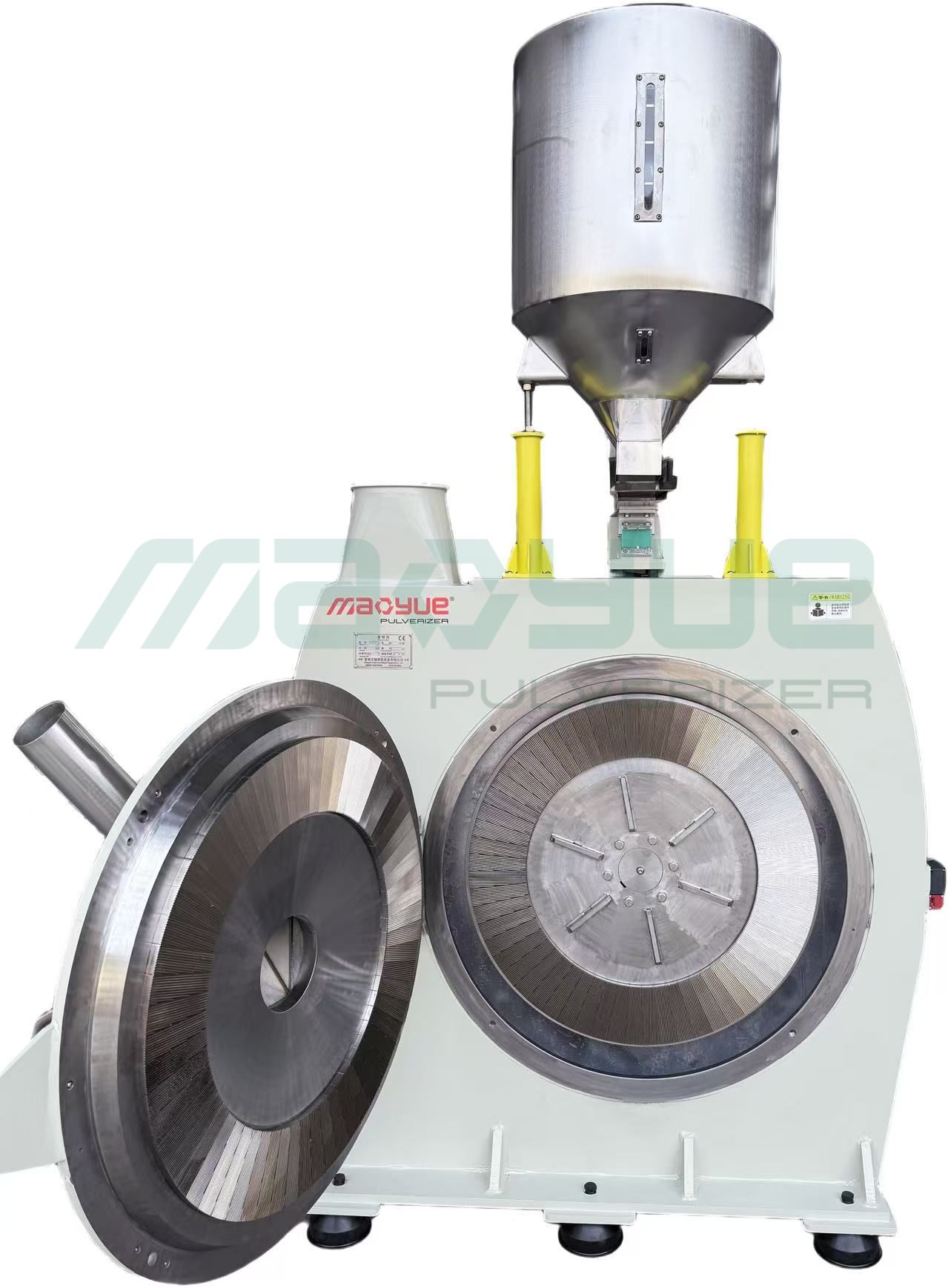
A disc pulverizer uses one rotating grinding disc and one stationary disc. PP granules enter the narrow space between them. The rotating disc then pulls, cuts, and presses each particle across the grinding teeth.
Clean shearing produces particles through controlled cutting. It creates fewer melted edges and fewer irregular flakes. Uncontrolled frictional tearing behaves differently because it rubs the material for too long.
Excessive rubbing raises the chamber temperature quickly. The PP may soften, smear, or stick together. Once this happens, the screen can block and powder uniformity drops.
Several operating factors influence this grinding action:
Disc clearance: A smaller gap generally produces finer powder. However, an extremely tight gap increases friction and heat. Operators need to balance fineness, capacity, and chamber temperature.
Disc condition: Sharp teeth cut PP granules more cleanly. Worn teeth create more rubbing and unstable particle shapes. Regular inspection helps maintain predictable powder quality.
Material flow: Steady feeding keeps the grinding load stable. Sudden feeding changes can overload the chamber. They also increase coarse particles and unwanted fines.
Maoyue Pulverizer uses a DC53 double-tooth grinding disc for controlled PP processing. Its tooth structure divides the grinding process into two main stages. The first stage reduces larger granules through stronger shearing.
The second stage refines those smaller pieces through controlled friction grinding. This sequence reduces the chance of untreated granules leaving the chamber. It also prevents fine particles from remaining inside too long.
The double-tooth layout provides a larger active grinding area than a basic single-tooth design. More material contacts the cutting surface during each rotation. As a result, the machine processes PP more evenly across the disc face.
This design can improve three important results:
1. Fewer coarse residual particles: Larger granules receive repeated cutting before discharge. They become easier to classify during screening. Less material needs unnecessary manual reprocessing.
2. Reduced over-grinding: Fine particles leave the grinding zone faster. They experience less repeated friction. This helps limit heat buildup and excessive powder fines.
3. More stable particle distribution: Each granule follows a similar grinding path. The final powder becomes more consistent. Downstream mixing and processing also become easier.
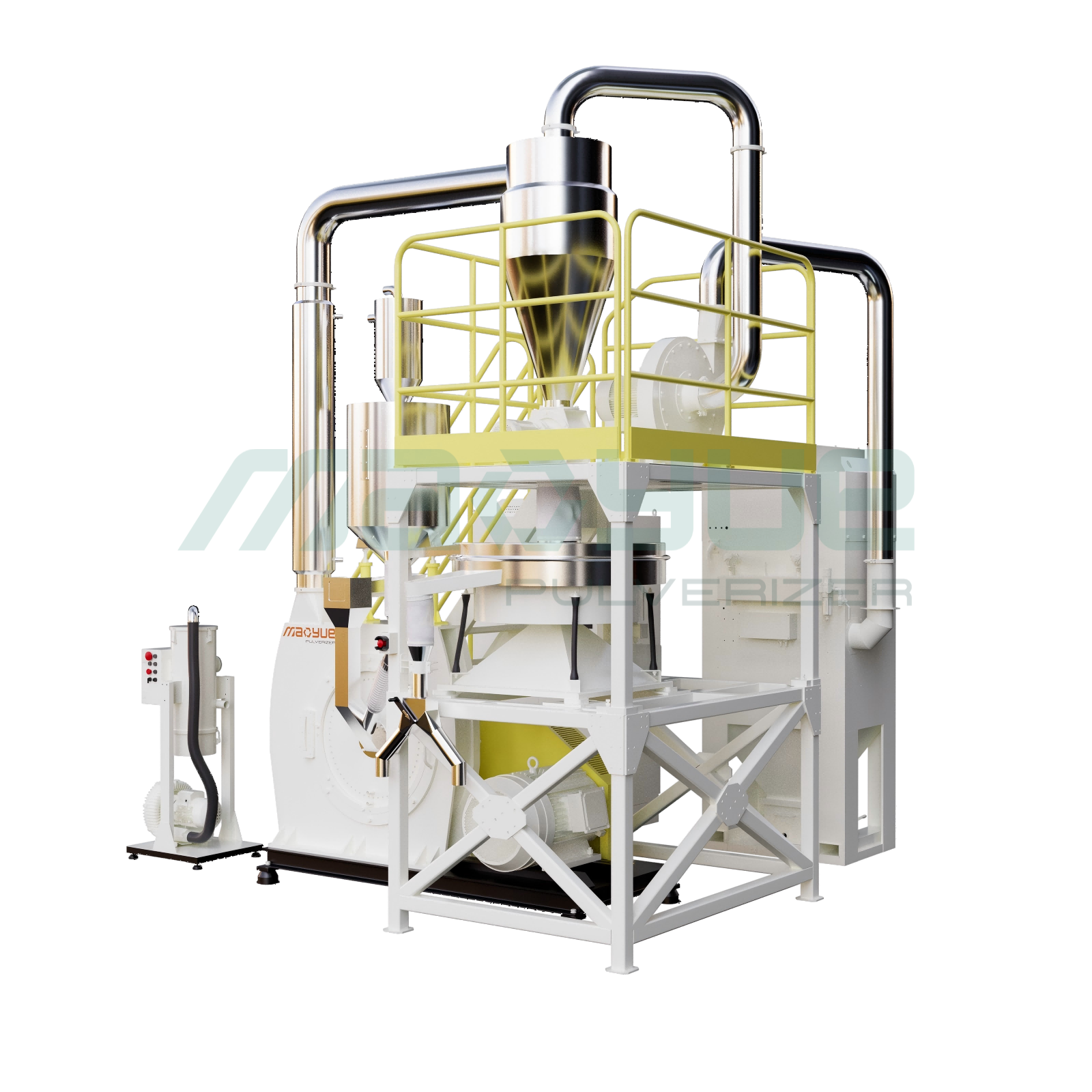
Uniform powder depends on the full system, not only the grinding discs. Each component controls one part of material movement or powder quality. They need to work as one balanced production line.
Component | Main Function | Effect on PP Powder Quality |
Main motor | Drives the rotating grinding disc | Maintains stable speed and cutting force |
Grinding disc set | Shears and refines PP granules | Controls fineness and particle distribution |
Feeding system | Delivers material at a steady rate | Prevents overload and uneven grinding |
Cooling pipeline | Removes heat from the chamber | Reduces melting, smearing, and agglomeration |
Negative-pressure system | Moves powder through sealed pipelines | Removes heat and prevents powder buildup |
Vibrating screen | Separates qualified and oversized particles | Keeps the finished mesh range more consistent |
Dust collection unit | Recovers airborne fine powder | Reduces product loss and improves cleanliness |
The feeding system controls how much material enters each grinding cycle. Vacuum or screw feeders provide a more even flow than manual feeding. Stable input also keeps motor load and chamber temperature easier to manage.
The cooling pipeline removes frictional heat during longer production runs. Meanwhile, negative pressure pulls finished powder away from the grinding area. This reduces local heat pockets and limits repeated grinding.
After grinding, the vibrating screen separates qualified powder from coarse particles. Oversized material can return for another grinding pass. The dust collector captures fine powder, supports cleaner operation, and protects final product yield.
Uniform powder rarely comes from one perfect machine setting. It comes from several settings working together during every production run. A PP Pulverizer Machine must balance fineness, output, temperature, and material flow.
The gap between the rotary disc and stationary disc directly affects particle size. A narrower gap usually creates finer powder, but it also increases friction. More friction raises temperature and may reduce hourly capacity. A wider gap allows faster material flow through the grinding chamber. However, it may leave more coarse particles in the finished powder. The correct setting should match the target mesh and application. Operators should never estimate disc clearance by sight. Even a small difference can change powder quality across the production batch. Precision tools provide a safer and more repeatable setting.
Use feeler gauges: They help operators measure the actual clearance between both discs. The reading remains more reliable than visual inspection. It also makes future setup easier to repeat.
Check several disc positions: A single measurement may hide uneven installation or disc wear. Measure multiple points around the grinding surface. Similar readings indicate better alignment.
Record successful settings: Keep the gap, feed rate, motor current, and powder mesh in one production log. This helps teams repeat stable results. It also reduces setup time for future orders.
Constant feeding keeps motor load and grinding pressure stable. When PP granules enter too quickly, the chamber becomes crowded. Heat rises, cutting quality falls, and coarse particles may pass through. Gravity feeding is simple and suitable for steady, free-flowing granules. However, it depends heavily on hopper design and material behavior. Bridging or sudden material drops may disturb the grinding load. Vacuum feeders and screw feeders provide better control during continuous production. They deliver material at a more predictable rate. Frequency control can also match feeding speed to motor load.
Feeding Method | Main Advantage | Possible Limitation |
Gravity feeding | Simple operation and low equipment cost | Flow may change when granules bridge |
Vacuum feeding | Stable transfer and cleaner material handling | Requires correct suction and pipeline settings |
Screw feeding | Precise and adjustable feed control | Screw speed must match material behavior |
Manual feeding | Flexible for testing small batches | High risk of uneven loading |
Grinding discs slowly lose their cutting shape during operation. Worn teeth rub PP instead of cutting it cleanly. This creates more heat, irregular particles, and unstable output. Damaged or incorrectly installed discs cause similar problems. They may create uneven clearance around the disc surface. Vibration and abnormal noise often appear before powder quality drops. A practical maintenance routine should include:
Regular inspection: Check teeth, edges, mounting surfaces, and fasteners after planned production cycles. Look for cracks, chips, or uneven wear. Early inspection prevents larger machine damage.
Sharpening and alignment: Restore the cutting profile before wear becomes severe. Confirm both discs remain parallel after installation. Poor alignment causes one side to grind harder.
Dynamic balance checks: An unbalanced rotating disc creates vibration at operating speed. It affects clearance stability and bearing condition. Balance should be checked after repair or replacement. Replacement intervals depend on PP quality, throughput, contamination, and target mesh. Clean virgin granules usually create less wear than mixed recycled material. Production records help determine the most economical replacement point.
The vibrating screen controls which particles enter the finished collection system. Smaller apertures produce finer powder, but they also reduce screening speed. They may block faster when material becomes warm or sticky. A PP Pulverizer Machine commonly works across ranges such as 20–80 mesh. Coarser powder may suit recycling or general reprocessing. Finer powder is often preferred for masterbatch, modification, or applications requiring better dispersion. Screen choice should follow the final process rather than a fixed machine habit. Rotomolding may need balanced flow and melting behavior. Masterbatch production may require finer particles for more even mixing. Operators should also monitor the amount of oversized material returning for regrinding. A high return rate may indicate an incorrect disc gap, worn teeth, or excessive feeding. It may also mean the selected screen is too fine for the current capacity.
Temperature control directly affects powder quality, production speed, and machine stability. PP softens easily when grinding friction rises. A PP Pulverizer Machine must remove heat before particles begin sticking together.
Grinding discs create heat while cutting and rubbing PP granules. Stable heat removal keeps the material firm enough for clean shearing. Poor temperature control changes cutting into smearing and uncontrolled friction. Once PP begins softening, several problems can appear:
Grinding efficiency falls: Soft particles absorb force instead of breaking cleanly. They remain inside the grinding chamber longer. This extra contact creates even more frictional heat.
Screens begin blocking: Warm particles can stick across small screen openings. Finished powder then leaves the machine more slowly. Oversized material also returns at a higher rate.
Agglomerates enter the powder: Melted edges can connect nearby particles. These clumps widen the particle size distribution. They also reduce powder flow during storage and feeding. Stable temperature creates more repeatable grinding conditions. Disc clearance, cutting pressure, and material flow remain easier to control. The resulting PP powder has fewer coarse pieces and fewer excessive fines.
Forced airflow moves through the grinding chamber during operation. It carries away frictional heat and transports powder toward the screening system. Fast discharge also reduces unnecessary contact between finished powder and grinding discs. Air cooling usually suits standard PP materials and moderate production loads. It can also support short production cycles or coarser mesh targets. The system remains simple because no separate water chiller is required. Operators still need to watch several working conditions:
Keep air inlets and pipelines clear. Restricted airflow reduces both cooling and powder movement. Fine material may then collect inside hot areas.
Match feeding speed to airflow capacity. Excessive feeding produces heat faster than the fan removes it. Motor current and discharge temperature may rise together.
Check powder texture during production. Warm, soft, or sticky powder signals weak cooling. Feed rate or disc settings may need adjustment.
Closed-loop water cooling provides stronger temperature stability during long production shifts. Cooling water circulates around key grinding areas. It absorbs heat before returning through the cooling system. Maoyue Pulverizer can match closed water cooling, temperature sensors, and PLC control. Sensors track temperature changes during production. The PLC can reduce feeding or strengthen cooling when heat begins rising.
Cooling Control | Suitable Production Condition | Main Powder Quality Benefit |
Forced air cooling | Moderate output and standard PP grinding | Removes heat and moves powder quickly |
Closed water cooling | Continuous or higher-load production | Keeps chamber temperature more stable |
Air and water cooling | Fine powder or changing production loads | Reduces melting and particle agglomeration |
PLC temperature control | Automated continuous production | Adjusts operation before quality changes |
A sealed negative-pressure system pulls ground powder away from the discs. It moves the material toward the vibrating screen and collection unit. This shortens powder residence time inside the hottest machine area. Negative pressure also reduces local heat pockets. Air moves through areas where loose powder could otherwise gather. Cleaner internal surfaces help the PP Pulverizer Machine maintain steady airflow. The enclosed pipeline provides another practical benefit. It limits fine powder leakage around discharge points. More usable powder reaches the collection system instead of escaping into the workshop. Some difficult polypropylene grades may still require cryogenic grinding. Liquid nitrogen makes tough material more brittle before size reduction. However, it adds equipment, operating cost, and process complexity. Optimized ambient pulverizing is often more practical for standard PP applications. Stable feeding, efficient cooling, sharp discs, and rapid powder discharge work together. They can reduce liquid nitrogen demand during many production runs.
Uniform PP powder depends on more than the grinding machine itself.
Disc clearance, steady feeding, temperature control, screening, recirculation, and sealed collection all shape final quality.
A properly configured PP Pulverizer Machine can deliver consistent powder for rotomolding, masterbatch, polymer modification, and recycling.
For machine selection, material testing, or a customized process, consult Maoyue Pulverizer for practical production support.
A: It grinds polypropylene granules or scraps into fine, reusable PP powder.
A: Common output is 20–80 mesh. Some models reach finer ranges.
A: High friction, overfeeding, weak cooling, dull discs, or poor discharge raises heat.
A: Stabilize feeding, adjust disc gaps, sharpen discs, cool effectively, screen, and regrind oversized particles.
A: It suits moderate loads. Continuous production may require water cooling.


