Specializing in the production of Plastic Pulverizer Machines.

Views: 0 Author: Site Editor Publish Time: 2026-10-03 Origin: Site
LDPE may look easy to process because it feels soft. Inside a pulverizer, that softness becomes the problem.
Instead of breaking cleanly, warm LDPE can bend, smear, stick, and block screens. Output then falls while particle size becomes less consistent.
This guide explains why it happens. You will learn how an LDPE pulverizer machine controls heat, feeding, disc clearance, airflow, and cooling.
LDPE means low-density polyethylene. Its highly branched molecular structure creates lower crystallinity than HDPE. It is therefore flexible, ductile, and resistant to brittle fracture at room temperature. Those traits suit films, liners, squeeze bottles, coatings, and flexible molded parts. They also make low-density polyethylene grinding unusually demanding.
A disc pulverizer normally reduces prepared granules between one rotating disc and one stationary disc. Repeated cutting, impact, shear, and friction create smaller particles. Harder plastics tend to fracture under those forces. LDPE often absorbs part of the energy through elastic or plastic deformation.
The result is a process problem:
The feed bends instead of cracking. Flexible pieces may flatten along the disc face. They need more contacts before reaching the required size.
More contact creates more heat. Longer residence time raises the thermal load inside the chamber.
Warm surfaces become tacky. Particles can smear across metal, join into agglomerates, or attach to other powder.
Fine targets intensify the cycle. A smaller disc gap and repeated classification usually increase energy input per kilogram.
Published data commonly places LDPE’s melting range near 105–115°C. The MOL Group LDPE catalogue also describes it as ductile and flexible. Yet operators should not use melting point as the only limit. Grinding can deteriorate far below full melting because particle surfaces soften first.
Feed form matters just as much as resin name. Thin film, fluffy trim, dense granules, filled compounds, and cross-contaminated regrind behave differently. Film can wrap or bridge before it reaches the grinding zone. Dirty regrind adds abrasive material, while moisture can disturb powder flow and screening.
An LDPE grinding machine converts motor power into size reduction, airflow, vibration, noise, and heat. Friction at the disc faces is a major heat source. Bearings, recirculated oversize, warm feed, and restricted airflow can add more.
The failure sequence often develops gradually:
Process change | What operators may observe | Likely production effect |
Grinding zone warms | Motor load or outlet temperature rises | Less efficient fracture |
LDPE begins softening | Disc surfaces develop a waxy coating | Reduced cutting action |
Powder starts sticking | Small lumps appear in finished material | Wider particle distribution |
Screen openings blind | Oversize circulation increases | Lower throughput and more heat |
Flow becomes unstable | Hopper bridging or discharge surging appears | Inconsistent output |
This cycle can feed itself. A blocked screen holds material longer. Longer residence creates additional friction. More heat produces greater sticking, which blocks even more screen area.
Several operating choices can trigger the cycle. An aggressive feed rate overloads the cooling capacity. A very tight disc gap adds contact and may increase temperature. Dull or unsuitable grinding surfaces rub more than they cut. Poor air movement leaves heat and fine powder inside the circuit.
Stopping only the visible blockage rarely solves the cause. Cleaning the screen may restore flow briefly, but the problem returns if the heat balance remains unchanged. Operators should record feed rate, inlet and outlet temperatures, motor current, cooling-water conditions, and screen differential pressure where available.
Changzhou Maoyue Intelligent Equipment Co., Ltd. describes configurable PE/PP pulverizing systems using feeding, grinding, screening, cooling, and dust collection equipment. This system view matters because an LDPE powder making machine cannot remain stable when surrounding equipment restricts flow.
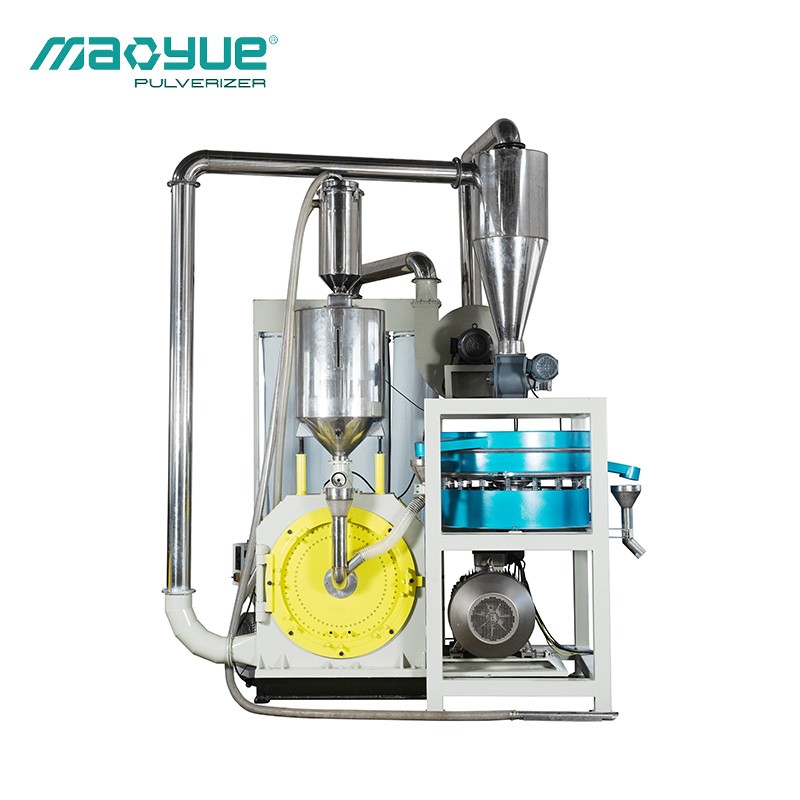
Cooling should remove heat at least as quickly as grinding creates it. The suitable method depends on resin grade, throughput, target mesh, room conditions, and acceptable operating cost.
Process air carries powder and heat away from the mill. Adequate airflow also helps prevent warm fines from remaining near the discs. However, airflow must match the classifier, cyclone, filters, and fan. Simply increasing fan speed may upset separation or overload dust collection.
Air cooling is attractive because it is simple. Its performance changes as room temperature and filter resistance change. Plants in hot climates may therefore see stable morning production but rising afternoon temperatures.
Water jackets or cooled disc structures remove heat from critical machine surfaces. Stable flow, clean passages, and a dependable inlet temperature are essential. Warm plant water may circulate correctly yet provide insufficient heat transfer.
A chiller gives tighter control when seasonal water temperature varies. It can also support continuous production at demanding mesh targets. Buyers should compare chiller capacity against the complete heat load rather than selecting it from motor power alone.
Maoyue offers configurable accessories, including chillers, for its plastic pulverizer machine systems. A practical configuration may combine air movement and water cooling instead of asking one circuit to handle every thermal problem.
Some LDPE grades remain too flexible for economical ambient grinding. Low-temperature pulverizing cools the feed enough to reduce ductility and encourage fracture. Liquid nitrogen, dry ice, or another engineered refrigeration system may supply the cold source.
Cryogenic Preparation of Sample Materials explains how cooling can embrittle elastic materials before size reduction. This principle helps when extremely fine powder or a difficult flexible feed resists conventional milling.
Cryogenic grinding is not a free upgrade. It adds refrigerant cost, insulation requirements, condensation control, ventilation, and safety procedures. Liquid nitrogen can displace oxygen. A qualified system design, oxygen monitoring, training, and suitable protective equipment are essential.
Cooling hardware cannot compensate for an uncontrolled process. Stable production usually comes from several modest adjustments working together.
Pre-granulate LDPE into a controlled size suitable for the mill. Remove metal before it reaches the discs. Separate paper, sand, PVC, and other contamination whenever the finished powder specification requires it.
Film deserves special attention. Loose film has low bulk density and unpredictable flow. Densifying or agglomerating it may improve metering, although the added thermal history and particle form must suit the final application.
Begin with a conservative feed rate. Increase it only after motor load, powder temperature, and screening remain stable. A variable-speed feeder helps maintain an even bed instead of sending slugs into the chamber.
Disc clearance affects particle size and energy demand. A tighter setting is not automatically better. If it creates extra rubbing and recirculation, the process may deliver less acceptable powder per hour.
Use this adjustment order during trials:
1. Confirm clean, uniform feed and unrestricted discharge.
2. Establish stable cooling-water flow and process airflow.
3. Set a moderate disc gap for the first target range.
4. Raise feed gradually while monitoring temperature and current.
5. Inspect powder for smearing, lumps, and excess oversize.
6. Change only one major variable before collecting another sample.
Sharp, material-appropriate grinding surfaces reduce unnecessary rubbing. Maintenance teams should inspect disc wear, alignment, bearing condition, cooling passages, screens, hoses, and filters. Trending these checks often reveals deterioration before a full blockage occurs.
The screen must remove acceptable powder without holding excessive material. A finer screen may improve the nominal specification, yet it can increase oversize return and heat exposure. Particle-size analysis should therefore measure the full distribution, not one mesh value.
Powder handling also matters after the mill. Warm LDPE fines can compact inside cyclones, ducts, and collection bins. Smooth transitions, controlled airflow, grounded equipment, and suitable dust collection help maintain flow and reduce risk.
Equipment buyers often ask for capacity first. A reliable supplier needs more context because “LDPE” covers many grades and feed conditions.
Prepare a process brief containing:
Resin grade, melt index, additives, fillers, and recycled content
Feed form, maximum size, bulk density, moisture, and contamination
Required particle distribution, not only a single mesh number
Expected hourly output and operating hours
Ambient temperature and available cooling-water data
Final use, such as recycling, compounding, or rotomolding
Dust, noise, electrical, and local safety requirements
Material trials provide stronger evidence than catalogue capacity. Send enough representative feed for steady testing. Include the hardest expected batch, not only clean virgin pellets. During the trial, record throughput, energy use, temperatures, screen behavior, powder distribution, and cleaning frequency.
A useful acceptance test defines measurable boundaries. It may specify kilograms per hour at an agreed particle distribution, using named feedstock and defined cooling conditions. It should also state how oversize, startup material, and downtime are counted.
Maoyue Machinery offers material testing before production scale-up. For an industrial LDPE pulverizer machine, this step helps match disc design, cooling capacity, feeding, screening, and collection to the actual material rather than a generic resin label.
LDPE is difficult to pulverize because it deforms, warms, and sticks before it fractures efficiently. Stable output needs controlled feed, suitable discs, balanced screening, and dependable heat removal.
Air and water cooling suit many applications. Chillers improve consistency, while cryogenic grinding serves harder cases.
Test the actual resin before purchasing. A measured trial protects powder quality, throughput, and operating cost.
A: Friction raises the surface temperature while flexible LDPE resists brittle fracture. The material can soften, smear, and coat the discs. Excessive feed, a tight gap, worn surfaces, or weak cooling makes sticking worse.
A: Some systems can handle prepared film, but loose film may bridge, wrap, and feed unevenly. Pre-cutting, densifying, or agglomerating may create a more stable feed. Confirm the preferred preparation through a material trial.
A: It can be enough for suitable grades and moderate targets. Performance depends on water temperature, flow, heat-transfer area, throughput, and mesh. Hot or variable plant water may require a properly sized chiller.
A: Consider it when ambient grinding causes persistent deformation, sticking, or poor fine-powder yield despite optimized feeding and cooling. Compare improved output against refrigerant, safety, ventilation, and maintenance costs.
A: Control grinding temperature, keep feed steady, maintain airflow, and avoid an unnecessarily tight disc gap. Inspect screen condition and oversize recirculation. Clean contamination and monitor powder for early agglomeration.
A: Provide the exact resin, additives, feed shape, bulk density, target particle distribution, capacity, cooling conditions, and final application. Representative testing gives the most dependable equipment configuration and output estimate.


