
Views: 0 Author: Site Editor Publish Time: 2026-07-27 Origin: Site
Are you grinding PE granules and still seeing rough tank interiors? A wrong powder setup can hurt wall thickness, surface finish, and production speed.
In rotomolding, tanks rely on plastic powder, not pellets. The key question is whether a PE Pulverizer Machine can turn PE into stable rotomolding powder every run.
In this post, you’ll learn the targets for mesh and micron fineness, how to improve particle size consistency, and why cooling performance matters. You’ll also see how to handle dust control, plan capacity, and keep process stability steady.

A PE Pulverizer Machine is basically the bridge between rough plastic input and the fine powder rotomolding needs. Tanks don’t melt pellets the same way. They want powder that flows, coats the mold evenly, and fuses in a consistent pattern.
That’s why the job is more than “grinding.” It’s granule-to-powder processing that protects quality from start to finish, even when the feed is virgin material or recycled regrind.
Think of granule-to-powder processing as controlled transformation. It takes PE granules—virgin pellets or prepared scrap—and turns them into rotomolding-grade powder. When it’s done well, heating and coating become more even inside the mold.
Here’s how the “powder conversion” shows up in real tank outcomes:
More even heating and coating: finer, more uniform powder spreads better during the melt cycle.
Fewer issues from coarse particles: larger fragments can heat unevenly and disturb the melt layer.
Better repeatability between runs: stable processing reduces random shifts in powder behavior.
Rotomolding operators feel this when they compare batches: the line runs smoother, and quality checks look more predictable.
A practical [PE Pulverizer Machine] setup can handle multiple PE feed sources. That flexibility matters for tank plants using both virgin resin and internal recycled regrind from scrap.
Common inputs include:
Input Type | What It Looks Like | Why It’s Used |
Virgin PE pellets | clean, uniform granules | stable baseline quality |
Recycled PE / regrind | reprocessed tank scrap | lowers cost and waste |
Production scraps | often pre-crushed fragments, a few mm range | speeds up in-house recycling |
Material families also matter. Most setups target HDPE / LDPE / LLDPE, and some configurations may support options like EVA depending on the design and powder targets.
Inside the [PE Pulverizer Machine], the process is a chain. Each step supports the next one, so powder fineness stays controlled and the system keeps running.
Here’s the mechanical flow you’ll usually see in a rotomolding-focused design:
Feeding: an automatic vibrating dosing channel keeps feed rate steady.
stable feeding helps grinding consistency stay stable
Precision grinding stage: a grinding chamber uses a disc-type milling concept.
material gets driven between grinding surfaces to form powder
Cooling / temperature management: friction generates strong heat, so temperature must be controlled.
if PE softens too much, they risk sticking and quality drift
Sifting + classification: a vibrating sieve checks particle size.
only correctly sized powder moves forward
Airflow separation + cyclone concept: a blower sends powder to a cyclone separator.
oversized particles route back to the grinding chamber
Collection bins: final powder lands in bins as rotomolding-grade output.
this keeps handling cleaner and batching easier
When these parts work together, the machine can produce powder that supports consistent dosing for water tank molds.
When you’re making rotomolded water tanks, powder quality is not a “nice-to-have.” It’s what helps PE melt evenly, coat the mold interior, and end up with the wall thickness and surface finish your QC team expects. A PE Pulverizer Machine is the upstream step that sets that quality baseline.
The tricky part? Two powders can both be “fine,” yet behave differently in the molding cycle. That’s why buyers pay attention to fineness targets, particle size distribution, flowability, and heat control together, not one item alone.
Fineness is the first check people mention because it connects directly to melting uniformity and surface quality. Finer powder usually distributes better during heating, so the inside coating looks smoother and more consistent.
For rotomolding-focused setups, your target range often lands around:
Powder Target | Typical Guidance | Why It Matters |
Mesh range | 30–50 mesh | Helps consistent melting and mold coverage |
Micron range | ~300–500 microns | Supports stable flow and smoother surface behavior |
Even with those reference numbers, your “exact target” still shifts. Mold size, formulation, and line setup change the best fineness point. A strong [PE Pulverizer Machine] should be capable of producing powder within the configured range for your specific production plan.
“Average mesh” is a weak promise. What matters is particle size distribution—how tight the sizes are across the batch. When the distribution is narrow, they melt more uniformly and dose more consistently.
Here’s what inconsistent distribution can trigger:
Uneven melting: some particles heat and melt sooner, others lag behind, so the coating layer becomes uneven.
Uneven deposition: that uneven layer translates into surface texture and thickness variability.
Risks to uniform wall thickness and surface finish: corners and deep sections of tanks are where defects tend to show.
In practice, teams notice it during routine runs. One day looks fine, the next day they see patchy deposition or subtle roughness. That’s often a powder consistency issue before it becomes a molding problem.
Rotomolding needs free-flowing fine powder so it can feed into the mold reliably. If powder clumps or doesn’t flow, dosing becomes inconsistent, and that inconsistency travels into the tank results.
Flowability also links back to temperature. Grinding creates friction heat, so the PE Pulverizer Machine can’t just chase fineness. It must protect powder behavior during production.
A key warning from real-world experience: PE can become soft/sticky if grinding temperature rises too high. When PE gets too warm, it may agglomerate, change particle shape, and make classification harder.
That’s why cooling is a core selection criterion. A PE Pulverizer Machine with solid cooling performance helps keep powder stable across long operating windows, reduces stickiness risk, and supports repeatable fineness and distribution.
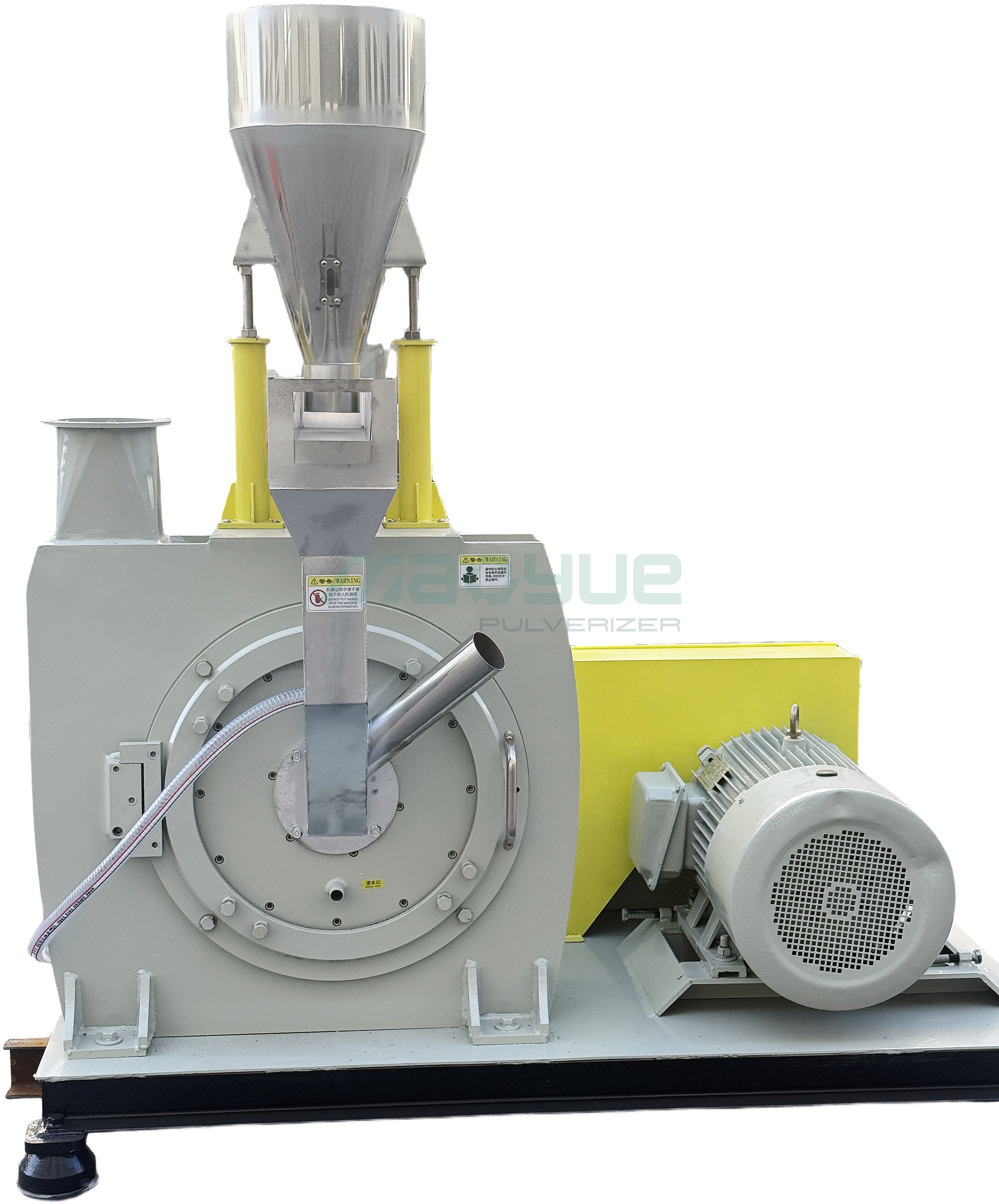
If your PE Pulverizer Machine runs warm, the whole line pays for it later. Grinding creates friction heat, and PE doesn’t forgive heat spikes. You may start the shift with good powder, then end up with sticky behavior, unstable sizing, and slower throughput.
What good cooling does is simple: it keeps grinding consistent. When the machine stays on temperature, powder stays predictable, and operators see fewer surprises.
Most people only think about fineness. Real production teams care about stability during long runs. Cooling is what protects the grinding zone so PE keeps its grinding-friendly behavior.
Here’s how heat shows up as practical problems:
Sticking / agglomeration: warm PE can clump, coat internal surfaces, and disrupt powder discharge.
Unstable particle size: classification becomes messy, and the PSD drifts between batches.
Reduced capacity during continuous operation: stuck material forces slower feed or more stops for clearing.
To make it clear, consider this comparison:
Cooling Condition | What You’ll Notice | Likely Impact on Powder |
Stable temperature | steady grinding sound, consistent discharge | stable fineness and PSD |
Temperature creep | build-up spots, irregular output | wider distribution, more rejects |
Cooling design is not one-size-fits-all. Teams choose a system that matches their operating schedule, resin sensitivity, and target powder range.
Common approaches in PE pulverizing include:
1. Water cooling system concept
Many setups use a water cooling loop to pull heat away from the grinding area.
It suits continuous work because heat removal stays strong even as conditions change.
2. Air cooling concept (where applicable)
Some designs rely on airflow to reduce temperature rise.
It tends to work best when loads are controlled and heat generation stays moderate.
3. Active monitoring / temperature maintenance mindset
Operators should treat temperature like a KPI, not a background detail.
Sensors, control logic, and routine checks help keep the grinding zone within a stable window.
A PE Pulverizer Machine with “set it and forget it” cooling usually means they planned for long-running rotomolding schedules.
On paper, cooling sounds great. In practice, you validate it by watching quality and downtime over hours, not minutes. That’s where the buying decision gets real.
Focus on these checks during continuous operation:
Temperature stability across hours of continuous operation
track whether temperatures drift mid-shift, not just at start-up
look for signs of internal build-up as the run continues
Whether the system keeps powder fineness stable over time
compare early-run and late-run mesh/micron results
check whether classification returns consistent output
Whether operators experience fewer stoppages due to sticking / overheating
note how often they clean, adjust, or slow the feed
count production interruptions tied to sticky material behavior
When you see these points align, you know the PE Pulverizer Machine isn’t just producing powder—it’s producing repeatable rotomolding-grade powder through the whole shift.
A: Common targets are 30–50 mesh, about 300–500 microns, based on rotomolding needs.
A: Yes. Many setups handle recycled PE/regrind and PE scrap, supporting in-house closed-loop recycling.
A: Use cooling and temperature control. PE can soften/stick if grinding temperature rises too high.
A: Fine PE dust affects cleanliness, safety, and material recovery. A closed design with dust collection helps.
A: Match continuous line demand. Typical reference ranges include 150–250 kg/hr depending on setup.
A: No. Particle size consistency, flowability, and stable cooling also drive uniform wall thickness and smooth surfaces.
A good PE Pulverizer Machine controls powder consistency for rotomolded tanks.
That consistency shapes melting behavior, wall thickness, and surface quality.Focus on fineness + PSD consistency, not mesh alone.
Use strong cooling to prevent PE from softening or sticking during grinding.Choose dust control + closed handling for cleaner, safer operation.
Match capacity planning to your line, so output stays stable in continuous runs.


