Specializing in the production of Plastic Pulverizer Machines.

Views: 0 Author: Site Editor Publish Time: 2026-08-03 Origin: Site
Ever grind plastic and still get mixed results? That “grind is not enough” moment is real.
Grinding breaks material down, but it won’t guarantee uniform powder.
That’s where after grinding screening changes everything.
In this post, we’ll explain how a Plastic Pulverizer with vibrating screen turns mixed output into consistent specs.
You’ll learn why a sealed, closed-loop classification step matters after pulverizing.You’ll also see what to check for stable fineness, cleaner operation, and smoother downstream processing.
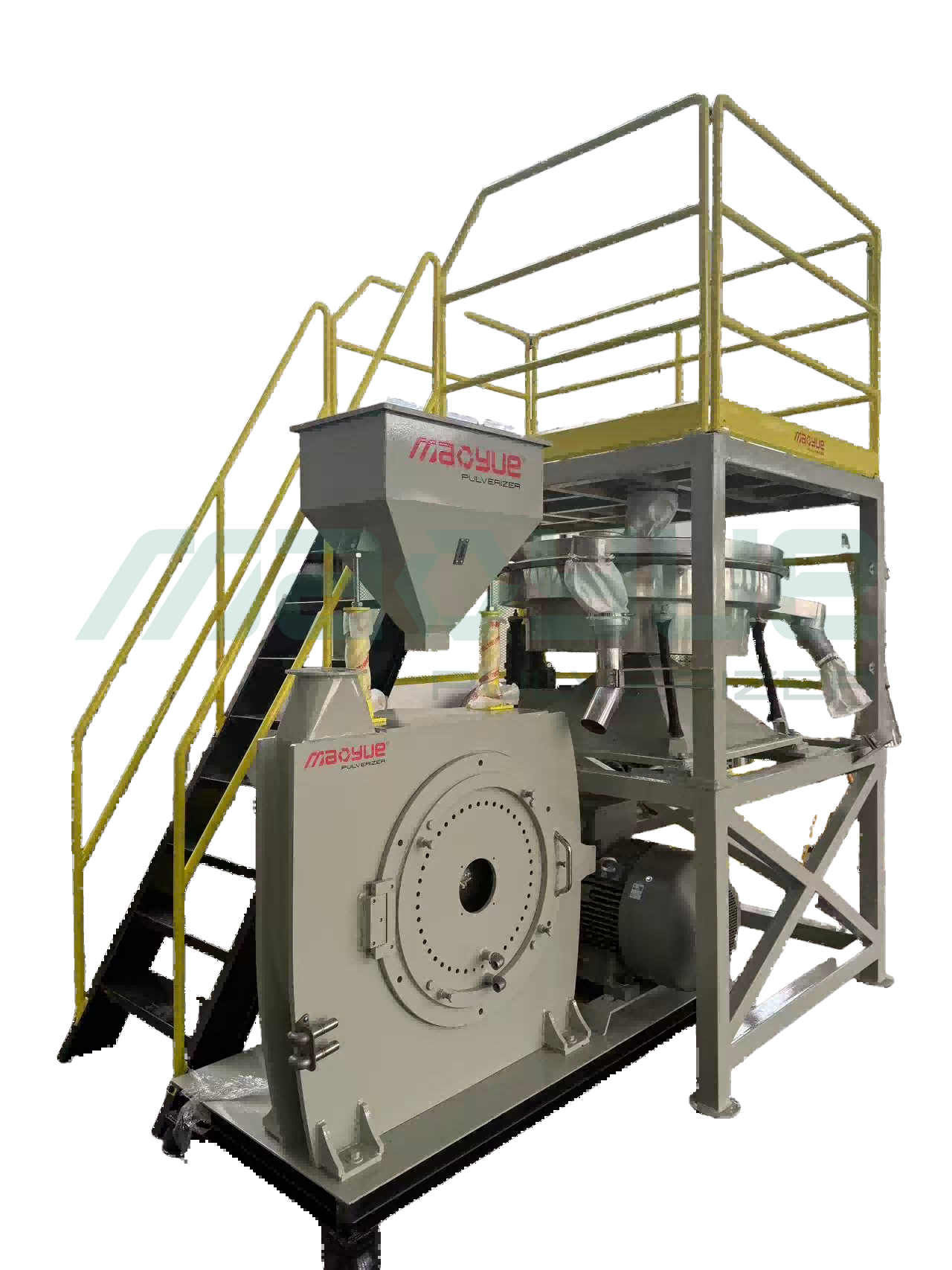
A lot of buyers think a Plastic Pulverizer is “done” the moment the granules drop. That’s the grind stage, not the spec stage. It reduces size, yes. But it also creates a mix of particle sizes that downstream equipment will feel.
A Plastic Pulverizer with vibrating screen finishes the job. They grind plastic into powder first, then classify it. The screen separates what can go straight to product, from what needs another pass.
Here’s the simplest way to picture it: the system makes two streams from one run.
Plastic Pulverizer mills plastic scraps into powder
The built-in vibrating screen classifies powder into:
On-spec fines → final product
Oversize coarse particles → regrind loop
In practice, that second stream is not “trash.” It’s material the system routes back into the pulverizing chamber. So they keep chasing the target particle size during normal operation.
Think of the line like a short relay race. Each step passes the work to the next step. In this system, screening sits right after grinding.
Stage | What happens | Why it matters |
Grinding chamber | Plastic gets pulverized by rotating/grinding action | Produces a particle-size mix |
Airflow transport | Powder moves to the screening deck | Keeps screening conditions stable |
Vibrating screen | Particles separate by mesh openings and motion | Controls fineness and distribution |
Final collection | On-spec powder goes to the product point | Ready for extrusion, molding, or compounding |
(That “sealed classification stage” part matters too: it’s often integrated with airflow and dust control so powder stays contained.)
Most lines handle more than one material over time. That’s why the screen design and mesh target matter. A PVC run can behave differently from PE/PP. Waste profiles can vary even more, especially when bottles, films, or foamed scraps get mixed.
Here are common material categories that usually benefit from this setup:
PVC (often needs careful fineness for downstream stability)
PE/PP (profiles, scrap pieces, and reprocessed resin)
Waste plastics (bottles, films, aluminum-plastic film scraps)
You can tune the outcome by changing the mesh. If the goal is 20–200 mesh, the screen becomes the lever. They don’t rely on “hoping” the pulverizer outputs the right cut every time.
If you’ve looked at Maoyue equipment, you’ll notice the design philosophy is system-first. The vibrating screen is treated as a core component, not a standalone add-on. That matters because classification depends on stable airflow, correct routing, and consistent screening conditions.
In real production, operators care about repeatability. When the screen and transport are integrated, they can keep powder quality steadier across runs. That’s exactly why many Plastic Pulverizer lines include a built-in vibrating screen rather than leaving classification to later bins.
A Plastic Pulverizer can make plastic smaller fast. But “smaller” isn’t the same as “uniform.” We’ve seen lines stall because powder looks fine on day one, then drifts after a few hours.
Grinding changes everything inside the chamber. They crush particles, create a spread of sizes, and move on. That mix still needs sorting before downstream equipment sees it.
Grinding disc and chamber work like a size-mixer. They rarely produce one clean cut size. Instead, they output a particle-size distribution made of fines, target-size powder, and oversize pieces.
Without a screen, those fractions reach the next step together. They don’t “blend nicely.” They trigger real process variability when feed rates and flow behavior change.
Here’s what usually happens in a production run when screening is missing or weak:
Fines increase or decrease over time, because mesh conditions shift and dust dynamics change
Oversize stays in the powder stream, so flow becomes less predictable
Operators adjust manually, because the machine “responds” to the variability, not the other way around
The vibrating screen adds control after grinding. Its job is classification, not re-crushing. It separates on-spec fines from oversize coarse particles and routes the coarse portion back to regrind.
Conceptually, it works like this:
Fine particles drop through mesh openings and become product
Coarse particles keep moving along the deck and get redirected back into the grinder
The system runs inside a sealed, airflow-supported stage so screening stays consistent
This is where after grinding screening becomes practical. The system stops treating powder as a one-way output.
To make it easy, use this mental model:
Powder fraction | What the screen does | Where it goes next |
Fine/on-spec | Passes through mesh openings | Final product collection |
Oversize/coarse | Slides across the deck | Regrind loop back to grinding chamber |
When powder fineness shifts, downstream equipment feels it. In extrusion and molding-style processes, even small changes show up as clogged zones, pressure swings, and surface defects.
You’ll often see the same symptoms across different plants:
Inconsistent feeding into extruders or compounders
Clogs and pressure surges, especially during continuous operation
Defects in output, including uneven surface finish and unstable runs
It’s not magic. Uneven particle size changes bulk density and flow. Then the screw, die, and mold react to that inconsistency.
Screening also protects your yield. Oversize doesn’t become waste. The system returns it for another grind pass, so material utilization stays high.
That loop reduces manual handling. Operators spend less time recovering off-spec material. Material loss drops because coarse fraction gets reprocessed automatically.
In a steady line, that means:
less downtime caused by “stop and clean” cycles
fewer batch variations when the feedstock changes
better consistency across shifts, not just at start-up
Oversize is heavy on wear. If too much coarse fraction keeps hitting grinding discs and blades, load spikes increase. Parts degrade faster. That’s where maintenance costs climb quietly until they hit hard.
Screening removes oversize early, so the grinder handles what it should handle. The result is smoother operation and fewer abnormal events.
What you feel on the floor:
quieter, steadier grinder operation
fewer unexpected stops
reduced abnormal wear on grinding disc/chamber components
Screening doesn’t run alone. It works with dust removal and sealed airflow concepts. That’s important because fine plastic dust behaves differently from larger chips.
With sealed or negative-pressure-style design principles, powder leakage reduces. Airborne dust concerns also reduce when the classification stage is contained and tied into dust collection.
When you keep the environment controlled, the production line tends to run calmer. Less dust means fewer cleanliness problems around fittings, platforms, and nearby equipment.
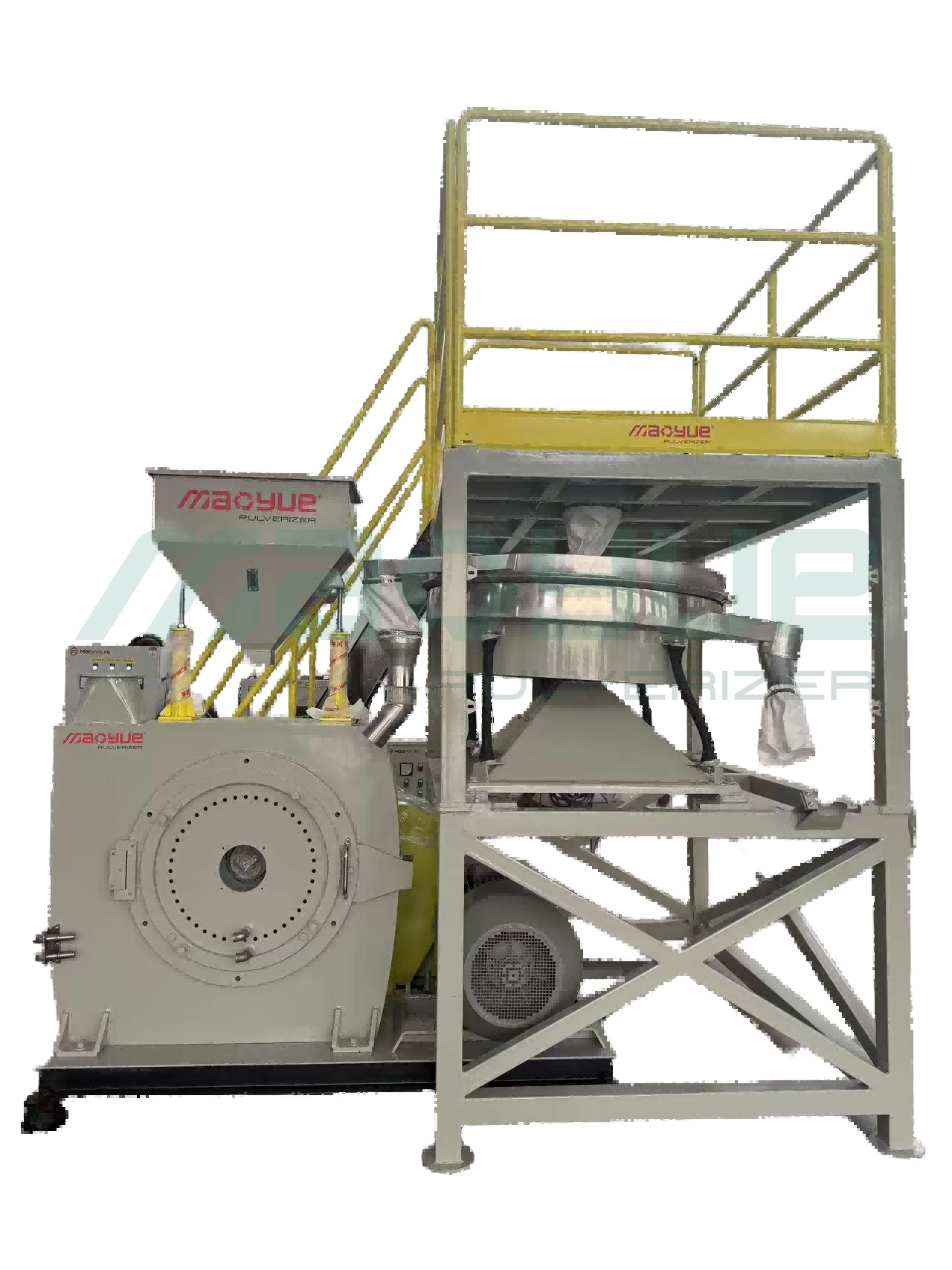
When you’re building a stable powder line, integration matters more than any single machine spec. We’ve watched too many lines struggle because the grinder, airflow, and screening were treated like separate boxes. A [Plastic Pulverizer] system needs them to “talk” to each other.
Maoyue positions itself as an integrated R&D/manufacturing/sales/after-sales enterprise for plastic pulverizers. The key point isn’t marketing polish—it’s how they treat classification as part of the whole workflow. In their system thinking, screening + sealed airflow integration helps classification stay steady, even when the input material changes.
The mechanism is simple to explain, but tricky to execute. The vibrating screen wants a consistent powder stream. Airflow transport wants stable pressure conditions. When those two don’t match, the screen can’t keep the same cut size, and fineness drifts.
Maoyue’s approach ties the pieces together:
The vibrating screen provides particle size classification, routing on-spec fines forward
Negative-pressure circulation supports powder transport, limiting leakage and keeping flow conditions stable
The loop returns oversize back into regrind so the Plastic Pulverizer targets the specification over time
Here’s a practical way to see the integration logic:
System element | What it controls | What improves on the floor |
Vibrating screen | classification cut between fines and oversize | more stable fineness, fewer spec swings |
Sealed airflow + negative pressure | transport consistency and containment | less powder escape, smoother screening conditions |
Regrind routing | closed-loop recovery of oversize | higher material utilization, fewer manual interventions |
Think about it like sorting socks in a laundry room. If the pile keeps shifting randomly, sorting accuracy drops. Powder behaves the same way when airflow distribution or pressure isn’t stable. With a controlled, sealed classification stage, the screen receives a steadier feed, so it performs repeatable separation.
Operators also appreciate the knock-on effects. When screening stays stable, downstream equipment sees fewer fluctuations in bulk flow and feeding. That usually means fewer clogs, less pressure surging, and calmer production rhythms.
A: Yes. The built-in vibrating screen classifies by mesh size, commonly targeting 20–200 mesh.
A: Typically yes. Screening runs in a sealed negative-pressure circulating airflow system, coordinated with dust removal.
A: Yes. Oversize coarse particles return automatically to the grinding chamber for regrind.
A: It’s designed for simple replacement and cleaning, supporting quick spec changes and routine maintenance.
Grinding creates a mixed spectrum of plastic powder sizes.
Screening after grinding in a vibrating-screen Plastic Pulverizer makes that blend consistent.
The key takeaway is simple: accurate classification plus closed-loop recirculation improves yield and stability.
Sealed airflow and dust control keep production cleaner. Routine mesh maintenance keeps specs steady.


