Specializing in the production of Plastic Pulverizer Machines.

Views: 0 Author: Site Editor Publish Time: 2026-09-12 Origin: Site
Uniform PE powder can decide whether a finished product succeeds or fails.
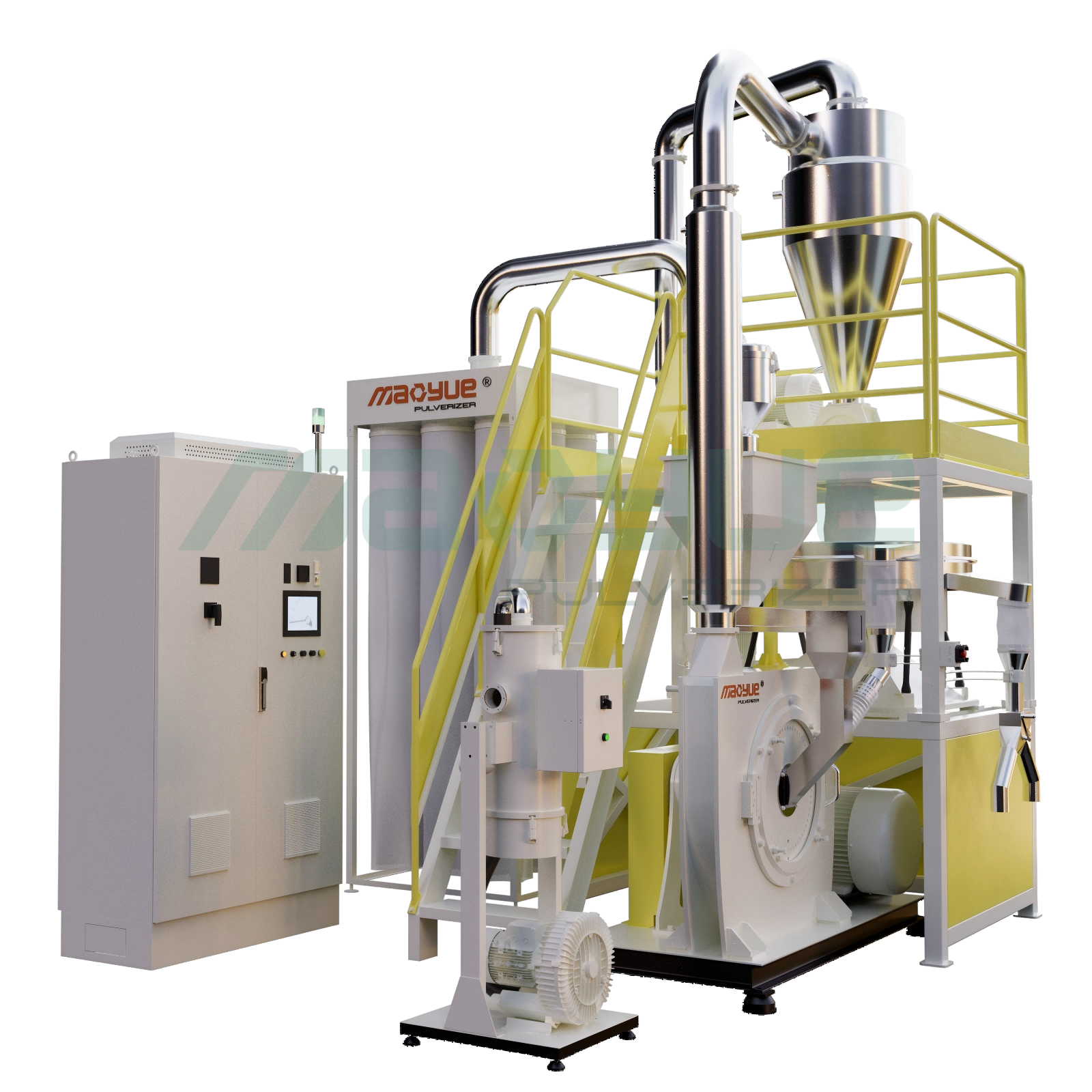
A PE Pulverizer Machine turns HDPE, LDPE, and LLDPE pellets, flakes, or scraps into consistent powder.
However, fineness alone is not enough.
Particle distribution, flowability, and grinding temperature also shape downstream quality.
In this article, you will learn how PE powder supports rotomolding, masterbatch production, plastic coating, and reprocessing.
We will also explain the machine features that improve consistency and reduce processing problems.
Maoyue Pulverizer provides adjustable grinding solutions for different materials, capacities, and application requirements.
Rotomolding depends on even powder movement inside a heated mold. Standard PE pellets are too large and heavy to spread across every surface. They often collect in low areas, so melting becomes slow and uneven.
Fine, free-flowing powder behaves differently. As the mold rotates, it rolls across corners, curves, and vertical walls. Heat then melts each particle, helping the material fuse into one continuous hollow shell.
A PE Pulverizer Machine prepares HDPE, LDPE, or LLDPE pellets, flakes, and scrap for this process. It controls powder size more closely than a granulator, which usually leaves coarse regrind.
A common industry reference is 35 mesh, or about 500 microns. This size often provides a useful balance between flow, melting speed, and surface coverage. Still, one size does not suit every mold or resin grade.
Powder Size | Typical Use | Main Processing Effect |
30 mesh | Large tanks and simple hollow parts | Faster coating, but less detail |
35 mesh | General rotomolding production | Balanced flow and fusion |
40 mesh | Complex molds and smoother finishes | Better detail, but tighter heat control |
We usually adjust the target mesh after checking part geometry, wall thickness, cycle time, and resin melt index. Finer powder may capture small details better. Coarser powder can work well for large, basic shapes.
Uniform fineness helps the powder cover the mold at a steady rate. It supports more consistent wall thickness, smoother surfaces, and stronger corners. It also reduces visible texture changes across the finished part.
Poor flow creates familiar problems. Powder may bridge, clump, or remain trapped away from heated surfaces. This can lead to air pockets, incomplete fusion, thin areas, or weak spots.
Several machine features help control these risks:
Adjustable grinding gaps: They keep particle size closer to the target range. A screening system removes oversized particles. It also supports steadier powder flow between batches.
Water and air cooling: These systems limit heat buildup during grinding. PE stays less sticky, so agglomeration is easier to control. Production can remain stable during longer runs.
Metal separation and dust collection: They protect powder purity and reduce foreign particles. Clean powder is especially important for light colors, smooth finishes, and visible product surfaces.
Maoyue Pulverizer combines adjustable grinding, dual cooling, screening, and contamination control. These features support repeatable PE powder production across different materials, capacities, and rotomolding requirements.
LLDPE is widely used because it offers good impact resistance and flexible processing. LDPE produces softer, more flexible parts. HDPE creates stiffer products, although it usually needs closer heat and powder control.
Melt index also matters. A higher melt index can improve flow during heating, while a lower value may support toughness. Grinding settings, screening, and cooling should match the behavior of each resin.
Common applications include:
Water tanks and chemical storage vessels: These products need even walls, reliable fusion, and consistent thickness across large surfaces.
Kayaks, playground equipment, and fuel tanks: These curved products require good impact resistance and complete powder coverage around complex shapes.
Hollow containers and industrial housings: Clean powder supports smoother surfaces, stable dimensions, and fewer visible defects after molding.
Masterbatch production depends on even contact between resin, pigments, fillers, and functional additives. Large PE pellets offer limited surface area, so dry ingredients may gather in separate zones. Fine carrier powder creates more contact points during premixing and extrusion. A PE Pulverizer Machine turns PE pellets, flakes, or clean production scrap into consistent carrier powder. It helps each additive spread through the resin more evenly. The extruder then receives a stable mixture instead of concentrated pigment clusters. PE carrier powder supports several common formulations:
Color masterbatch: It carries organic or inorganic pigments throughout the base resin. Better contact reduces streaks and shade differences. It also helps processors maintain color consistency across production batches.
Filling masterbatch: It distributes calcium carbonate and similar mineral fillers more evenly. Stable powder size reduces dense filler pockets. This supports smoother feeding and more predictable extrusion.
Functional masterbatch: It blends UV stabilizers, flame retardants, antioxidants, and antistatic additives. Uniform distribution helps each additive perform across the finished product. Poor mixing may leave some areas underprotected.
A range of 20–80 mesh is common in masterbatch processing. The correct fineness depends on pigment type, additive loading, carrier resin, and mixing equipment. Finer powder is not automatically better for every formula. Smaller particles provide greater surface contact between PE and dry ingredients. Pigments can attach to more resin particles before melting. This often improves homogeneous blending and reduces visible clumps. However, very fine powder needs careful temperature and dust control. Heat may soften PE during grinding, while excess fines can reduce flow. A stable cooling system helps keep powder loose and easier to handle. Uniformity matters as much as the target mesh:
A narrow particle distribution supports predictable feeding into mixers and extruders. It also lowers the risk of heavier ingredients separating during transport. Consistent batches become easier to repeat.
Adjustable grinding disc gaps allow operators to change powder size for different formulas. Accurate screening removes oversized material. It keeps coarse particles from weakening dispersion.
Water and air cooling limit heat inside the grinding chamber. They reduce sticking and agglomeration during longer runs. This is especially useful for softer PE grades.
Small contaminants can create large defects after extrusion. Metal fragments may cause black spots, while mixed dust can shift the final shade. Coarse impurities may also appear as fisheyes in films or molded products. Color fidelity becomes harder to control when recycled scrap contains unknown residues. The raw material should be sorted and cleaned before pulverizing. Grinding equipment must also prevent wear particles from entering the powder. Useful protection measures include metal separators, magnetic filters, and sealed dust collection. A pulse dust collector keeps airborne particles inside the system. It also limits cross-contamination around nearby production lines. Maoyue Pulverizer uses metal separation and enclosed powder collection options. Its wear-resistant grinding parts also support cleaner processing. These features help plants protect light colors and demanding functional formulations.
Machine capacity should follow actual production volume, not future estimates alone. Small masterbatch plants often change colors and formulas several times daily. They usually value quick cleaning, flexible batches, and lower material loss.
Machine Scale | Typical Capacity | Suitable Production Need |
MYMF-500 | 100–300 kg/h | Trials, custom colors, flexible small batches |
800 large-scale model | 550–950 kg/h | Continuous production and high-volume masterbatch lines |

Pulverized polyethylene forms a dense protective layer after heating and melting. It resists corrosion, moisture, abrasion, and many common chemicals. It can also provide electrical insulation for coated metal components. PE powder works for both protective and decorative finishes. Manufacturers can create smooth surfaces, soft-touch layers, or rigid exterior skins. The final result depends on resin grade, powder size, and coating conditions. A PE Pulverizer Machine converts PE pellets, flakes, or clean production scraps into application-ready powder. Uniform particles spread more evenly across the target surface. They also melt at a more consistent rate during heating.
A range of 40–80 mesh is common for many PE coating applications. Coarser powder can build thicker layers faster, but surface texture may appear rougher. Finer powder usually melts quickly and creates smoother coverage. Particle size also affects transfer efficiency. Oversized particles may fall away before they melt. Excessively fine powder can create dust, weak flow, or uneven spray patterns. PE powder is commonly applied through three processes:
Fluid bed dipping: A heated metal part enters a suspended bed of PE powder. The particles melt on contact and fuse around the surface. This method works well for thicker, continuous protective coatings.
Electrostatic spraying: Charged powder particles move toward a grounded metal surface. The coated part then enters an oven for melting and curing. It supports controlled coverage on complex shapes and edges.
Electrostatic powder coating: This process offers accurate powder placement and easier thickness control. It is suitable for decorative surfaces and repeatable production. Clean, free-flowing powder remains essential for stable spraying.
LDPE and HDPE behave differently after melting. We should select them according to flexibility, hardness, texture, and service conditions. One resin grade rarely suits every coating project.
PE Material | Coating Character | Common Product Uses |
LDPE powder | Flexible, smooth, soft, impact absorbing | Dishwasher baskets, wire products, flexible linings |
HDPE powder | Rigid, durable, scratch resistant | Pipes, outdoor furniture, industrial metal parts |
Selected PE blends | Balanced flexibility and strength | PVC flooring layers, artificial turf backing, specialized linings |
Good coating begins before the powder enters the spray booth or dipping tank. Uniform fineness supports steady melting, even surface coverage, and better adhesion. A narrow particle range also helps operators control coating thickness. Several powder defects can quickly damage the finished surface:
Oversized particles: They melt slowly and may create bumps or rough patches. Some remain partly fused after heating. Accurate screening reduces this risk.
Dust and excessive fines: They may disturb spray flow or escape during handling. They also increase housekeeping demands. A sealed collection system keeps production cleaner.
Metal or foreign contamination: These particles may produce dark spots, pinholes, or visible surface defects. Magnetic filters and metal separators protect powder purity. They also reduce damage to grinding parts.
Heat-related agglomeration: Warm PE can soften inside the grinding chamber. Particles then stick together and lose flowability. Water and air cooling help maintain stable grinding temperatures. Maoyue Pulverizer uses adjustable grinding gaps, precision screening, dual cooling, and sealed dust collection options. Its PE Pulverizer Machine can be configured for different coating powders, hourly outputs, and resin grades. Wear-resistant grinding parts also support consistent particle quality during longer production runs.
A PE Pulverizer Machine prepares uniform powder for rotomolding, masterbatch, plastic coating, and plastic reprocessing.
Correct fineness, cooling, grinding disc design, and capacity directly affect powder quality and production stability.
The right configuration should match material type, target mesh size, required output, and downstream use.
Contact Maoyue Pulverizer for a customized PE powder grinding solution suited to your application.
A: It converts PE pellets, flakes, scraps, and regrind into fine, uniform powder for downstream processing.
A: Around 35 mesh is common. Use 30 mesh for larger parts and 40 mesh for finer details.
A: Yes. Operators should adjust disc gaps, cooling, and feeding based on hardness, melt index, and fineness.
A: Yes, after cleaning, size reduction, stable feeding, and proper cooling.
A: Use low-temperature grinding, water-air cooling, steady feeding, and controlled chamber temperature.


