Specializing in the production of Plastic Pulverizer Machines.

Views: 0 Author: Site Editor Publish Time: 2026-09-15 Origin: Site
A PE pulverizer is only as effective as the production line supporting it.
Poor feeding, screening, or dust control can reduce powder quality and output.
A complete PE Pulverizer Machine Line converts pellets, flakes, and recycled scraps into uniform plastic powder.
Its core systems include the feeder, pulverizer mill, vibrating sieve, and dust collector.
Buyers should evaluate how these units work together, not just the main machine.
This article explains each component, its function, and its impact on production.
You will also learn how the line supports rotational molding, recycling, compounding, and powder processing.
The feeder may look simple, but it controls the pace of the entire production line. If material enters too quickly, the main motor faces excess load. If feeding slows or stops, powder output becomes unstable. A well-matched feeding system keeps the PE Pulverizer Machine running near its ideal load. It also helps operators maintain steady capacity, uniform particle size, and lower energy use.
The feeder moves PE pellets, flakes, or film scraps into the grinding chamber. It delivers them at a controlled and repeatable rate. This control matters because PE materials often vary in shape, size, and bulk density. Stable feeding supports several production goals:
It reduces motor overload. A sudden material surge raises motor current and grinding pressure. The machine may slow down, overheat, or stop. Controlled feeding keeps the load within a safer range.
It limits clogging and bridging. Lightweight film scraps may collect inside a hopper. Large flakes may block the outlet. A suitable feeder keeps material moving toward the grinding chamber.
It improves powder consistency. Uneven feeding changes residence time inside the mill. Some particles receive more grinding, while others leave too coarse. Stable flow produces a narrower particle-size range. Operators should watch motor current, feed volume, and chamber temperature together. These values show whether the feed rate suits the selected PE material.
Each feeding method serves a different material condition. Buyers should match the feeder to material shape, density, and production capacity.
Feeder type | Best suited materials | Main operating advantage | Common limitation |
Vacuum feeder | Small pellets, light flakes, clean PE particles | Enclosed pneumatic transfer and fast loading | Very light film may require careful airflow adjustment |
Screw feeder | Dense flakes, pellets, regular regrind | Stable and measurable material delivery | Irregular scraps may bridge inside the hopper |
Vibrating feeder | Mixed particles, free-flowing regrind | Smooth feeding and simple speed control | Sticky or damp material may flow unevenly |
The feeder cannot correct every raw-material problem. PE scraps often contain metal, moisture, dust, or oversized pieces. These issues should be removed before material reaches the grinding discs. Useful preparation equipment includes:
Metal separators and magnetic nets: They remove iron particles, screws, wire fragments, and other metal contamination. Metal can chip the grinding discs, create sparks, or damage the chamber.
Storage hoppers: They hold enough prepared material for continuous feeding. A proper hopper angle also reduces bridging. Level sensors can prevent empty running or overfilling.
Pre-crushers or granulators: They reduce large containers, thick sheets, and bulky scraps into smaller pieces. Uniform feed size improves flow and lowers impact load inside the pulverizer.
Drying equipment: Wet PE may stick inside pipes, screens, or collection systems. Moisture can also disturb screening accuracy. Dry material flows more smoothly through the full line. Material preparation should match the final powder target. A line producing fine rotational molding powder needs cleaner, more uniform feed. Recycled PE containing mixed scrap requires stronger impurity control before grinding begins.
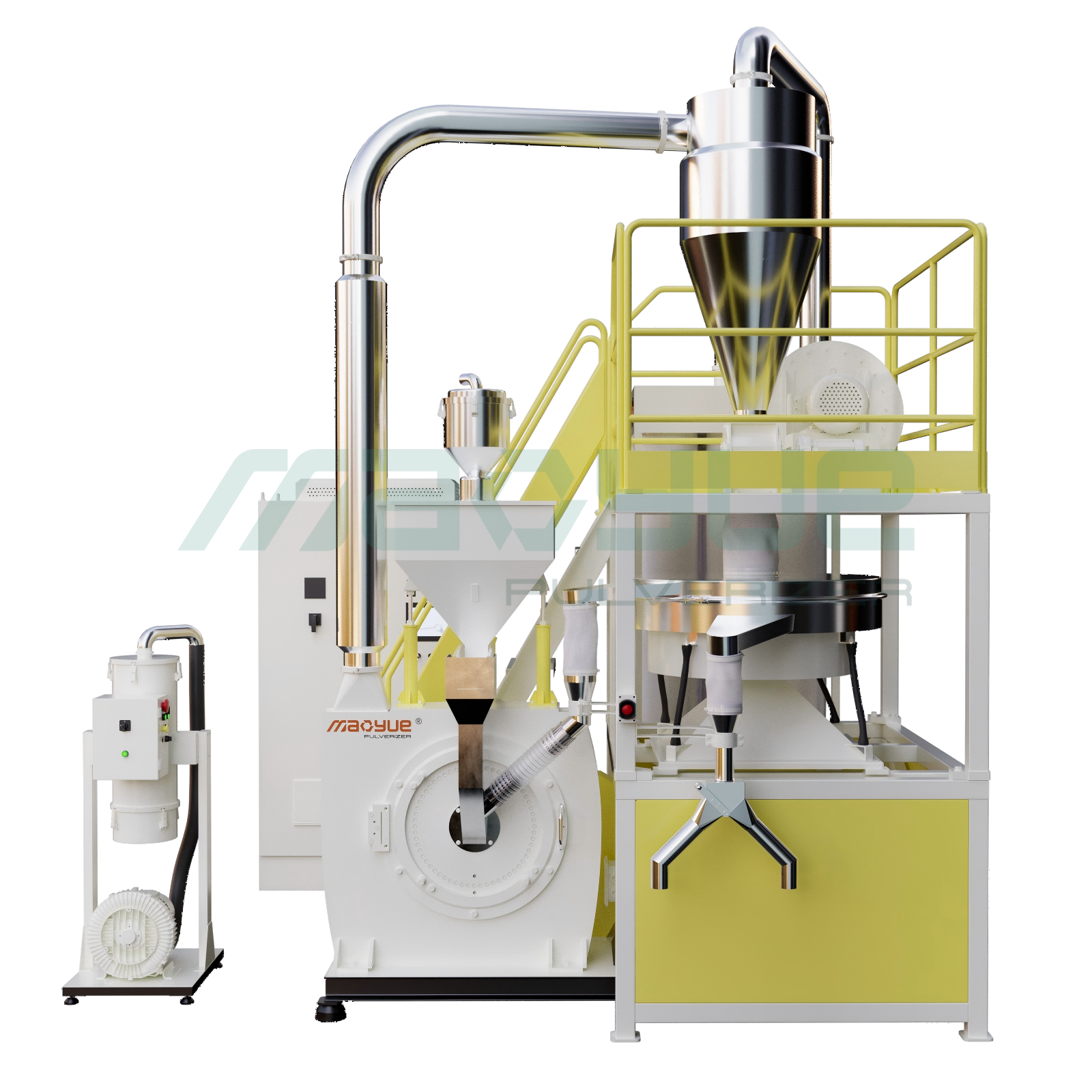
The grinding chamber determines how efficiently the full PE Pulverizer Machine Line operates. It controls powder fineness, production stability, heat buildup, and overall energy use. A well-designed chamber also reduces sticking, uneven powder, and frequent cleaning.
Prepared PE pellets or flakes enter the space between two grinding discs. One disc remains fixed, while the other rotates at high speed. The narrow gap creates strong friction, impact, and shearing forces. These forces reduce the material step by step:
Initial cutting: Larger particles meet the outer grinding teeth first. They are cut into smaller pieces before moving inward. This stage prevents sudden pressure inside the chamber.
Fine grinding: Smaller particles pass through tighter grinding zones. Repeated friction and shearing turn them into powder. The final size depends on the disc gap and screen setting.
Powder discharge: A built-in airflow system carries ground powder away. It prevents excess material from staying inside the chamber. It also moves powder toward the sieve and collection system. The process must remain balanced. Feeding too much material raises motor load and chamber temperature. Feeding too little lowers output and wastes installed motor capacity.
Grinding discs are the main wear parts inside the PE Pulverizer Machine Line. Their material, hardness, tooth design, and machining accuracy affect every production batch. Poor discs wear unevenly and produce a wider particle-size range. Maoyue Pulverizer uses DC53 steel for its grinding disc system. This material offers high hardness and strong wear resistance. Its service life can reach about twice that of standard grinding discs under suitable conditions. Several disc factors deserve attention:
Disc factor | Effect on production | Possible problem |
Material hardness | Extends wear life | Soft discs lose sharp edges quickly |
Machining accuracy | Keeps the gap even | Poor alignment creates uneven powder |
Tooth condition | Maintains cutting efficiency | Worn teeth reduce output |
Disc clearance | Controls final fineness | A gap too narrow increases heat |
PE softens when friction heat rises inside the chamber. It may smear across the grinding discs or collect near the outlet. Once sticking begins, output drops and particle size becomes less stable. A reliable line normally combines several cooling methods:
Water cooling removes heat from the grinding chamber and bearing areas. It supports longer production cycles. Stable water flow also protects temperature-sensitive PE materials.
Air cooling carries heat away during powder transport. It helps keep loose powder moving through the line. It also reduces material buildup near the discharge path.
Cooling jackets surround key chamber sections. They provide continuous heat exchange during operation. Operators should inspect them for scale, leakage, or blocked water channels.
Industrial water chillers maintain a steady inlet temperature. They are useful in hot factories or high-capacity lines. They also reduce seasonal changes in powder quality. Cooling settings should follow motor load and powder temperature. More cooling is not always better. Excessively low temperatures may cause condensation and moisture inside the system.
A PE Pulverizer Machine Line can process clean pellets, factory scraps, and prepared recycled materials. Common materials include HDPE, LDPE, PP, EVA, PET, and NBR. Each one behaves differently inside the grinding chamber. HDPE is harder and usually needs steady feeding plus a controlled disc gap. LDPE is softer, so it requires stronger cooling and a lower feed rate. Film scraps may also need pre-crushing before they enter the feeder. PP often grinds efficiently under moderate cooling. EVA may soften quickly, especially during long production runs. PET and NBR require careful testing because their hardness and heat behavior differ from PE. Recycled plastic scraps may contain mixed shapes, dust, or remaining moisture. We usually recommend trial grinding before final line configuration. The test helps confirm feed rate, disc clearance, cooling demand, target mesh, and expected capacity.
The grinding chamber creates powder, but the sieve decides whether it meets production standards. It separates usable material from coarse particles. It also keeps each batch closer to the required particle-size range. In a complete PE Pulverizer Machine Line, screening is not an optional final step. It acts as the main quality checkpoint. Without stable classification, even a powerful mill may produce mixed and unreliable powder.
Ground PE powder moves from the pulverizer into the vibrating sieve through an enclosed conveying system. The screen surface shakes at a controlled frequency. Smaller particles pass through, while larger particles remain above the mesh. The sieve performs several important tasks:
It separates qualified powder. Particles meeting the selected mesh size pass into the collection bin. They can then move toward storage, blending, or packaging.
It holds oversized material. Coarse particles stay on the screen surface. They do not mix directly into the finished powder.
It controls batch consistency. Stable screening reduces large particle differences. This matters for rotational molding, compounding, and coating production. A double-deck vibrating sieve can separate more than one particle range. It may produce a fine grade and a medium grade during one process. This setup suits plants serving several downstream requirements. Screen condition also affects accuracy. Torn mesh, blocked openings, or loose tension can change the final result. Operators should inspect it during routine maintenance.
Oversized material does not need to become waste. A return pipe sends it back toward the PE Pulverizer Machine. It then enters the grinding chamber for another reduction cycle. This closed-loop process improves production in several ways:
Higher material utilization: More feedstock becomes qualified powder. Less usable PE remains in the waste stream. It also reduces manual handling.
Better powder consistency: Coarse particles receive additional grinding. The finished batch contains fewer large pieces. Downstream processing becomes more stable.
Lower labor demand: Workers do not need to collect and reload coarse powder manually. The system handles this step continuously. It also reduces powder exposure. The return rate should remain controlled. Too much recirculated material may raise motor load and chamber temperature. It can also reduce the amount of fresh feed entering the system. Operators often monitor motor current, sieve output, and coarse powder volume together. These values help balance fresh feeding and secondary grinding.
Mesh size depends on more than one setting. The screen determines which particles pass, but the grinding chamber creates the size distribution. Both systems must work together.
Adjustment factor | Main effect | Operating concern |
Screen mesh | Sets the final passing size | Fine mesh may reduce throughput |
Grinding disc gap | Controls powder fineness | Narrow gaps create more heat |
Feed rate | Changes grinding load | Excess feeding creates coarse powder |
Machine speed | Affects cutting intensity | Higher speed may raise temperature |
Cooling level | Controls material softness | Poor cooling increases sticking |
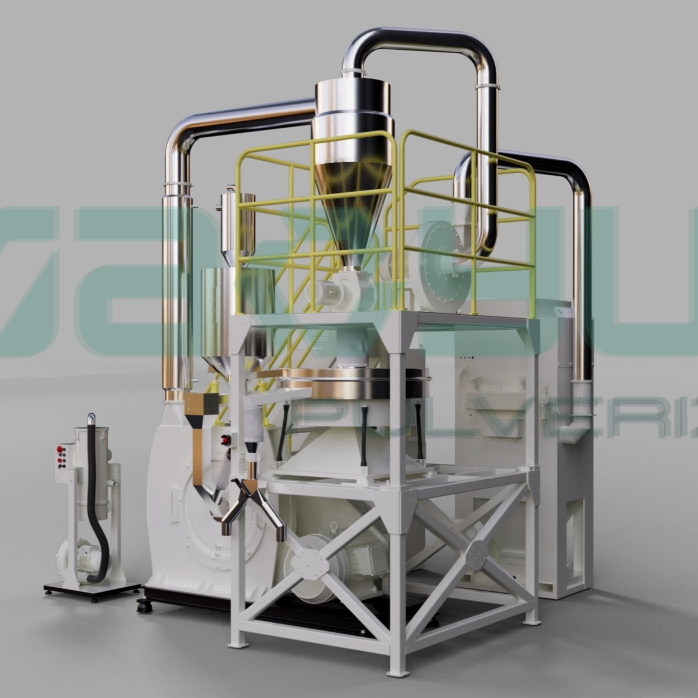
Fine PE powder moves easily through pipes, joints, screens, and collection points. Without proper airflow control, part of it may escape into the workshop. A matched recovery system keeps the PE Pulverizer Machine Line cleaner, safer, and more efficient.
Dust can appear during feeding, grinding, screening, conveying, and final discharge. The smallest particles remain suspended longer than heavy powder. They may settle on motors, electrical cabinets, floors, and nearby equipment. A dust collection system supports four practical goals:
Cleaner production areas: It captures loose powder before it spreads through the factory. Cleaning time falls, while equipment surfaces stay easier to inspect. Less buildup also supports safer maintenance.
Better worker protection: Fine particles may irritate the eyes, skin, or breathing system. Enclosed collection reduces direct exposure during normal operation. Workers should still use suitable protective equipment during cleaning.
Higher material recovery: Airborne powder still has production value. Recovering it improves total yield and reduces raw-material loss. This benefit becomes more important during continuous, high-capacity production.
Stronger process control: Dust collection stabilizes airflow through the line. It helps powder move smoothly from the mill to the sieve. It also limits pressure changes near transfer points.
A blower pulls ground PE powder through enclosed airflow channels. The powder then enters the cyclone separator at high speed. Its round chamber forces the air and particles into a spinning movement. Centrifugal force pushes heavier particles toward the cyclone wall. They lose speed, move downward, and enter a bag, bin, or storage silo. Cleaner air leaves through the upper outlet.
Cyclone function | Production benefit | Point to monitor |
Separates heavier powder | Reduces the load on filter bags | Air velocity |
Collects usable PE powder | Improves overall material yield | Discharge valve sealing |
Supports pneumatic transport | Keeps powder moving between units | Pipe blockage |
Reduces dust concentration | Extends filter service intervals | Cyclone wear |
The pulse dust collector captures particles too fine for the cyclone. Air passes through fabric filter bags inside the housing. Fine PE dust stays on the filter surface, while cleaned air exits the system. As dust builds up, airflow resistance rises. Compressed-air pulses shake the collected powder from the bags. It falls into a lower hopper, where it can be recovered or removed. Operators should check several items regularly:
Filter bag condition: Holes, loose seams, or worn fabric allow fine dust to escape. Damaged bags should be replaced early. This protects both air quality and collection efficiency.
Pulse cleaning pressure: Weak pulses leave thick dust layers on the bags. Excess pressure may shorten filter life. Stable cleaning keeps airflow resistance within a practical range.
Differential pressure: A rising pressure reading may indicate blocked filters or poor cleaning. Sudden drops may signal leakage. Tracking this value helps plan maintenance before output falls.
A closed negative-pressure system pulls air inward at feeder openings, pipe joints, and screen connections. It limits outward powder leakage. It also keeps material moving in one controlled direction. Stable negative pressure protects the airflow balance of the PE Pulverizer Machine Line. Too little suction may cause dust escape or blocked pipes. Too much suction may carry useful powder past the cyclone. Good sealing matters just as much as fan power. Operators should inspect flexible connectors, access doors, valves, and pipe joints. Small leaks can reduce collection efficiency, increase energy use, and disturb grinding performance.
A complete PE Pulverizer Machine Line relies on four systems working together.
The feeder controls material flow, while the mill produces fine powder under stable cooling.
The vibrating sieve separates qualified powder and returns coarse particles for regrinding.
The dust collector recovers fine material and keeps airflow stable.
Before purchasing, buyers should test their PE material and confirm mesh size, capacity, cooling needs, and line configuration.
A: It usually includes a feeder, pulverizer mill, vibrating sieve, cyclone separator, dust collector, and collection system.
A: Yes. Operators can change screen meshes and adjust the grinding disc clearance.
A: Maoyue systems commonly process PE powder from 20 to 120 mesh.
A: Excess friction heat softens PE. Stable feeding, air cooling, and water cooling help prevent sticking.
A: Yes. It separates qualified powder and returns oversized particles for secondary grinding.


