Specializing in the production of Plastic Pulverizer Machines.

Views: 0 Author: Site Editor Publish Time: 2026-09-09 Origin: Site
Plastic regrind may look reusable, but coarse particles can still disrupt production.
Shredders and granulators often leave flakes too large for precise downstream processing.
A Plastic Pulverizer converts plastic scrap and regrind into uniform fine powder.
Finer powder improves feeding, melting, additive mixing, surface quality, and recycled material value.
In this article, you will learn why manufacturers use pulverizers when standard regrind is not fine enough.
You will also see how Maoyue Pulverizer supports efficient grinding with precision discs, cooling systems, cutting tools, and complete production lines.
A Plastic Pulverizer reduces plastic regrind into controlled, uniform powder. It uses high-speed grinding discs, cutting tools, or both systems. These parts create strong cutting and friction forces. They process material beyond the limits of standard granulators. A shredder handles large plastic scrap first. A granulator then produces smaller flakes or coarse regrind. However, many manufacturing processes need powder instead of irregular pieces. The pulverizer completes this final size-reduction stage. The usual processing sequence looks like this:
1. Plastic scrap enters a shredder or granulator. Large products become manageable flakes or granules. This protects the pulverizer from oversized feed. It also creates a steady input size.
2. The coarse regrind enters the Plastic Pulverizer. Grinding discs cut and rub the material at high speed. The particles become smaller during each contact. Airflow then carries them away from the grinding zone.
3. Screens classify the finished powder. Qualified particles move toward collection equipment. Oversized particles return for another grinding cycle. The powder can then re-enter production.
A pulverizing line includes several connected stages. Each stage affects powder consistency, operating temperature, and final yield. Poor control at one point can create coarse particles, melting, or material loss.
Processing stage | Main function | Effect on powder quality |
Feeding | Delivers regrind at a stable rate | Prevents chamber overload and uneven grinding |
Initial cutting | Breaks coarse flakes into smaller pieces | Prepares material for finer grinding |
Friction grinding | Reduces particles through repeated disc contact | Produces finer and more uniform powder |
Cooling | Removes heat from high-speed friction | Limits softening, caking, and yellowing |
Airflow conveying | Moves powder from the grinding area | Reduces heat buildup and material retention |
Screening | Separates qualified and oversized particles | Maintains a narrow particle size range |
Powder collection | Recovers finished material in a closed system | Reduces dust loss and improves yield |
The grinding disc gap is the main adjustment point. A smaller gap generally produces finer powder. A wider gap allows faster processing but creates larger particles. Operators must balance fineness, capacity, temperature, and material behavior. Maoyue Pulverizer systems typically produce powder from 20 to 120 mesh. The practical result depends on resin type, feed size, disc condition, and operating speed. Hard plastics often grind differently from soft, heat-sensitive materials. Trial testing helps confirm the best machine settings. Several controls help maintain the selected mesh range:
Disc gap adjustment controls the grinding intensity. Operators set the distance according to the required powder size. They check the output after each adjustment. Small changes can affect capacity and chamber temperature.
Stable feeding protects particle consistency. Excess material can overload the grinding area. Low feeding may reduce production efficiency. PLC controls help keep the input rate more consistent.
Vibrating screens remove oversized particles. Qualified powder passes through the selected screen mesh. Larger particles return to the Plastic Pulverizer. They continue grinding until they meet the required size. This return loop reduces coarse contamination in the final product. It also improves material use during PVC extrusion, rotomolding, and compounding. Manufacturers can maintain a more repeatable powder specification across production batches.
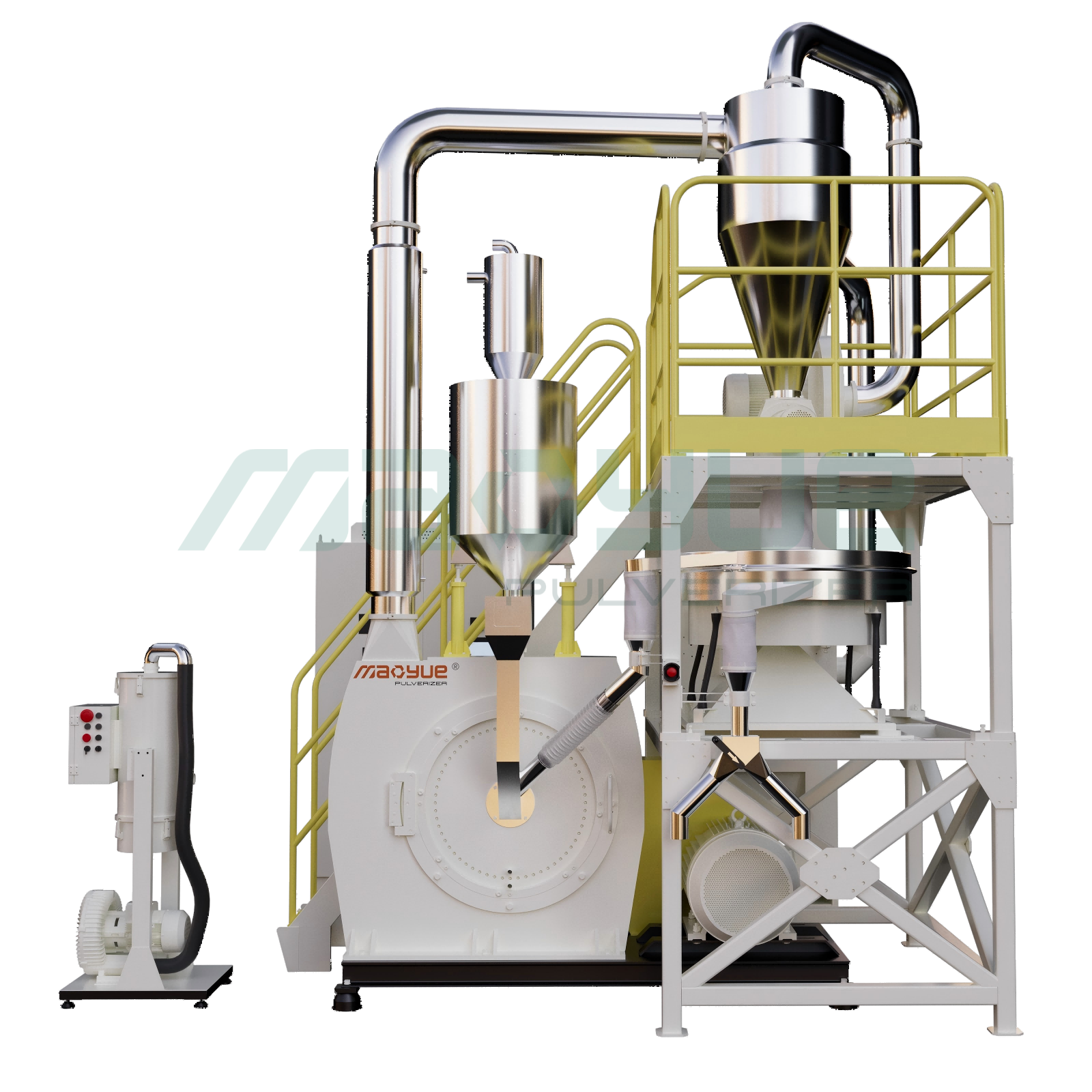
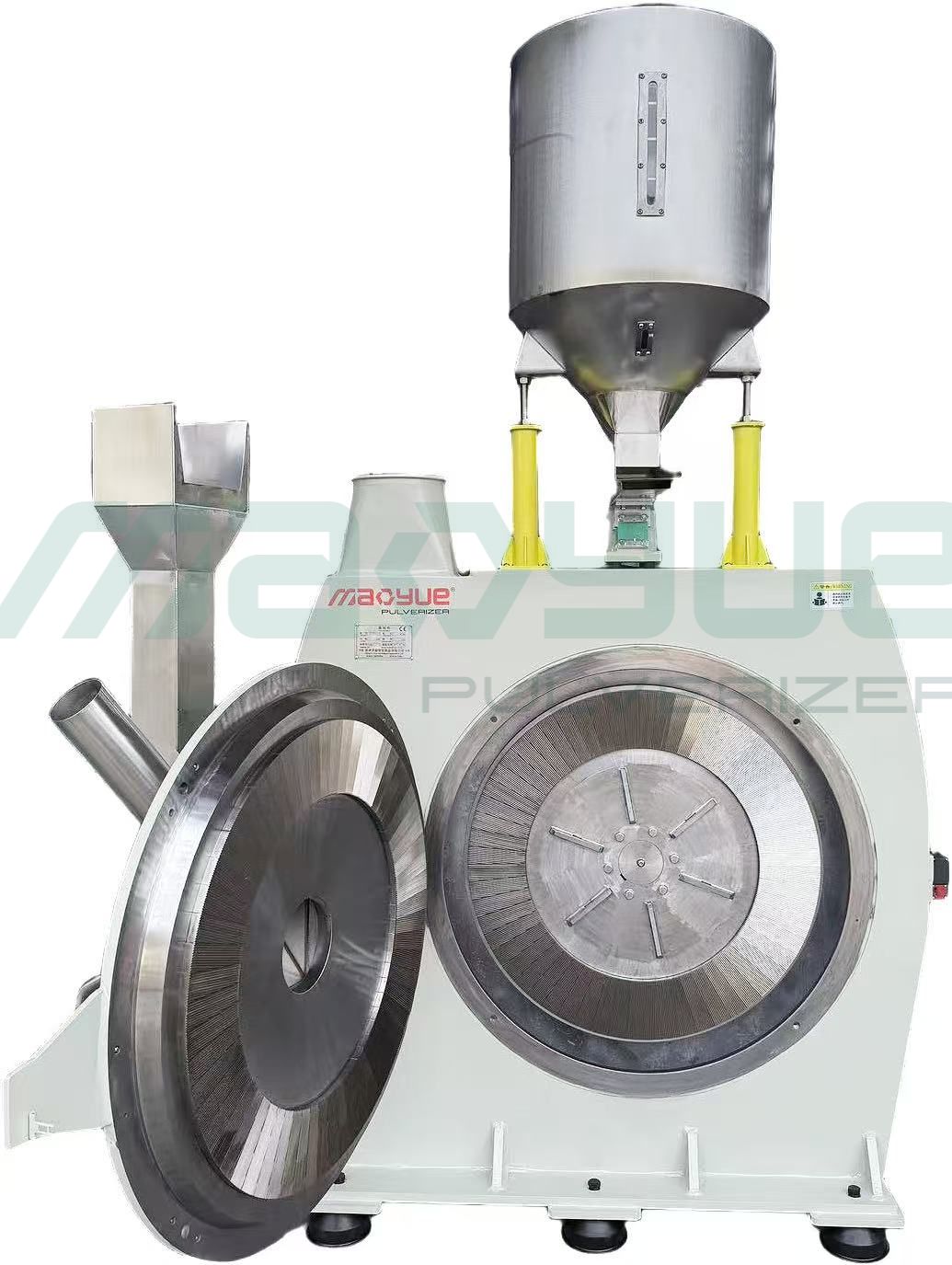
Powder quality begins at the grinding disc. A CNC-machined disc has more accurate teeth, flatter surfaces, and a controlled working gap. It cuts plastic regrind at a steady rate, so fewer oversized particles enter the finished powder. Disc design also changes how material moves inside a Plastic Pulverizer. Tooth shape controls the first cutting action. Tooth density affects friction and grinding frequency. A layered tooth structure can shear coarse flakes first, then reduce them through finer grinding.
Grinding factor | Effect on powder quality | Common problem when poorly controlled |
Disc precision | Supports stable particle sizes | Uneven powder and coarse contamination |
Tooth structure | Controls cutting and friction | Low output or excessive heat |
Disc gap | Sets the general powder range | Powder becomes too coarse or too hot |
Cutting sharpness | Maintains clean size reduction | Higher energy use and irregular particles |
Disc wear | Changes grinding clearance | Batch quality slowly becomes inconsistent |
High-speed grinding creates friction every second. That friction becomes heat inside the chamber. Soft plastics and heat-sensitive resins may change quickly once the temperature exceeds their stable processing range. Common heat-related problems include:
Plastic softening and powder agglomeration: Warm particles become sticky during repeated grinding. They attach to each other and form larger clusters. These clusters can fail the required mesh specification.
Material caking and chamber blockage: Softened powder collects around discs, screens, and discharge channels. Airflow becomes weaker as deposits grow. Production may stop for cleaning before the batch is completed.
PVC yellowing and thermal degradation: PVC can discolor after excessive heat exposure. Its processing stability may also decline. The recycled powder may no longer suit high-quality pipe or profile production. A stable cooling system protects the material and the machine. Air cooling removes heat from the chamber and transports powder away from hot grinding surfaces. Water cooling supports critical metal areas where friction remains highest. Maoyue Plastic Pulverizer systems combine air and water cooling for continuous operation. Temperature sensors track changes during production. When heat rises, operators or the control system can adjust feeding, airflow, or cooling power.
Fine plastic powder is light, so it does not leave the chamber by gravity alone. Negative-pressure airflow pulls it through the conveying pipe toward screening and collection equipment. This movement also reduces powder retention near the grinding discs. A closed airflow system offers several practical benefits:
It captures more fine powder instead of losing it around the machine.
It helps control airborne dust near operators and nearby equipment.
It supports smoother conveying from pulverizing to screening and collection.
It keeps the production area cleaner during long operating shifts. Enclosed powder collection also improves material accounting. Manufacturers can compare input weight against collected powder more accurately. They lose fewer valuable fines during PVC, PE, PP, or masterbatch processing.
Even a precise machine can produce unstable powder when feeding changes constantly. Too much regrind overloads the chamber and raises heat. Too little material lowers output and may create unnecessary disc contact. A PLC and HMI system helps operators watch the main operating values. It can display chamber temperature, disc speed, feeding volume, and alarm conditions. The team can see process changes before powder quality falls outside the target range. Automatic feeding control makes smaller adjustments during production. It may slow the feeder when temperature rises. It can maintain a steady load as regrind density changes. These corrections support more consistent powder between morning, afternoon, and later production batches. Material recipes can also store preferred settings for PVC, HDPE, LDPE, PP, EVA, and masterbatch. Operators spend less time repeating manual adjustments. They can start each batch closer to its proven operating range.
Coarse regrind works in some basic recycling processes. However, many applications need smaller and more consistent particles. A Plastic Pulverizer prepares powder for stable heating, mixing, feeding, and final product forming.
Rotational molding depends on powder moving freely inside a heated mold. The mold rotates slowly while the polymer melts across its inner surface. Large HDPE or LDPE particles cannot spread or melt at the same rate. A narrow particle size distribution helps each powder grain behave more consistently. Fine particles reach corners, ribs, and complex mold areas more easily. They also absorb heat faster than coarse plastic flakes. Rotomolding manufacturers usually focus on four powder results:
Better mold coverage: Fine powder flows across the mold surface during rotation. It fills small features before full melting begins. Coarse particles may leave thin sections or uncovered areas.
Faster heat transfer: Smaller particles offer more surface area. They heat and melt more evenly during each cycle. This can reduce partially fused material inside the finished part.
More uniform wall thickness: Consistent particles distribute at a similar rate. They reduce heavy areas, thin walls, and structural weak points. This matters for tanks, toys, containers, and technical parts. Maoyue Plastic Pulverizer systems can process HDPE and LDPE regrind into controlled powder. Operators adjust the disc gap according to the target mesh and molding requirements.
PVC scrap often comes from trimming, startup waste, rejected pipes, and profile cutting. A granulator can reduce this waste into chips. However, those chips may remain too large for smooth return feeding. Fine PVC powder enters the extruder more evenly. It blends better alongside virgin resin, calcium fillers, stabilizers, and processing aids. Stable feeding also helps the screw maintain a more consistent material load. Temperature control remains critical during PVC pulverizing. Excess heat may soften the material, create agglomerates, or cause yellowing. Air and water cooling help protect the powder before it returns to extrusion. The powder specification affects several production results:
Application need | Problem from coarse regrind | Benefit of fine powder |
Extruder feeding | Bridging and feed fluctuation | Smoother material flow |
PVC melting | Uneven fusion inside the barrel | More consistent processing |
Pipe surface | Roughness and visible defects | Smoother finished surfaces |
Physical properties | Irregular recycled material distribution | More stable batch performance |
Masterbatch production requires pigments and additives to spread evenly through the carrier resin. Fine PE or PP powder gives these ingredients more contact area. It also reduces concentrated pigment spots inside the mixture. Consistent powder size supports accurate weighing and dosing. Each batch receives a more predictable ratio of resin, colorant, filler, and stabilizer. This helps manufacturers maintain color and performance between production runs. Fine powder also improves homogeneous mixing during plastic modification. Reinforcing additives can spread through the resin more evenly. Fillers are less likely to form visible clusters or weak areas.
Recycled plastic powder can serve as a useful input for SPC flooring and modified compounds. It may replace part of the virgin material in selected formulations. The powder must still meet limits for size, cleanliness, moisture, and thermal stability. Plastic filler producers often need fine particles for easier blending. Uneven regrind can separate during transport or feeding. A controlled mesh range helps the mixture remain more stable. Powder-coating applications may require even finer particles. Fine powder supports smooth deposition and more uniform film formation. Large particles can create rough surfaces, pinholes, or poor coating coverage. The correct mesh range depends on the resin and final process. Rotomolding, extrusion, filling, and coating do not share one universal specification. Manufacturers should test the material before setting the Plastic Pulverizer disc gap, screen size, and feeding rate.
Coarse plastic regrind cannot meet every rotational molding, extrusion, compounding, or powder-processing requirement.
A Plastic Pulverizer creates consistent particles, steadier feeding, smoother melting, and better additive dispersion.
It also helps manufacturers recover more value from recycled material.
Choose the system around resin behavior, target mesh, required output, cooling demand, and downstream use.
Contact Maoyue Pulverizer for material testing and a customized plastic pulverizing solution.
A: A granulator makes flakes or granules. A Plastic Pulverizer produces finer powder for specialized manufacturing processes.
A: Maoyue systems typically produce 20–120 mesh powder, depending on material properties and machine settings.
A: Yes. Reliable cooling, temperature control, and correct grinding settings help prevent yellowing, melting, and blockage.
A: Yes. They suit rotomolding, compounding, masterbatch production, plastic modification, and recycled filler applications.
A: Excess friction heat, overfeeding, worn discs, or weak cooling can cause softening, caking, and agglomeration.


