Specializing in the production of Plastic Pulverizer Machines.

Views: 0 Author: Site Editor Publish Time: 2026-09-03 Origin: Site
Choosing the wrong plastic recycling machine can reduce efficiency and increase production costs.
Do you need fine powder, uniform granules, or simple waste reduction?
A Plastic Pulverizer, plastic grinder, and granulator serve different processing stages.
This guide explains their differences based on materials, output size, and applications.
You’ll learn how to select the right size reduction equipment for your production needs.
When choosing plastic size reduction equipment, buyers usually focus on three questions: What material will be processed? What output size is required? What will the recycled material be used for? The differences between Plastic Pulverizer vs Plastic Grinder vs Granulator are mainly reflected in their processing stages, output results, and final applications.
A machine that works well for one recycling process may not fit another. A plastic grinder is designed for reducing large waste volume, a granulator produces reusable plastic flakes, while a Plastic Pulverizer creates fine powder for higher-value applications.
The first step is checking the condition of your raw material. Different machines are designed for different material sizes and characteristics.
A Plastic Pulverizer usually works after pre-crushing. It receives smaller plastic pieces or granules and turns them into fine powder through high-speed grinding. It is commonly used for brittle materials and applications that require consistent powder quality.
A plastic grinder handles larger and tougher materials. It focuses on reducing the size of bulky plastic waste before further processing.
A plastic granulator sits between crushing and fine grinding. It cuts production waste into uniform pieces that can often return directly to injection molding or extrusion processes.
Machine Type | Suitable Input Materials | Typical Processing Purpose |
Pre-crushed flakes, plastic granules, brittle plastics | Fine powder production for advanced processing | |
Plastic Granulator | Production scraps, runners, films, medium-sized plastic waste | Producing uniform recycled flakes |
Plastic Grinder | Large plastic waste, thick plastic products, oversized parts | Reducing waste volume before further processing |
For example, PVC scraps from pipe production may need different treatment compared with large plastic blocks from industrial recycling. Selecting the correct machine prevents unnecessary processing steps and improves production efficiency.
Output size directly affects where recycled plastic can be used. This is one of the most important factors buyers should consider before purchasing equipment.
A Plastic Pulverizer focuses on producing fine plastic powder. It uses grinding discs to reduce plastic particles to a much smaller size, often below 1 mm. The powder quality is important for industries such as masterbatch production, plastic modification, and compounding.
Granulators and grinders produce larger outputs because they serve earlier recycling stages.
Machine Type | Output Size | Final Material Characteristics |
Plastic Pulverizer | Fine powder under 1 mm | Uniform powder, suitable for high-value plastic processing |
Plastic Granulator | Around 3–12 mm flakes or granules | Consistent regrind for extrusion and molding |
Plastic Grinder | 10 mm–50 mm+ coarse pieces | Reduced-size waste for additional processing |
Particle size control matters because inconsistent material can affect melting behavior, mixing performance, and final product quality. For companies producing recycled plastic powder, stable particle size is often a key requirement.
Maoyue Plastic Pulverizer uses an adjustable grinding disc gap design to help control powder fineness. Its disc-on-disc grinding structure supports stable processing for materials such as PVC, PE, PP, and masterbatch applications.
The right machine depends on what you want to achieve at the end of the process.
If your goal is producing fine powder for specialized plastic applications, a Plastic Pulverizer is usually the right choice. It supports industries that need better powder flow, uniform particles, and controlled material performance.
If your goal is recycling production waste into reusable plastic pieces, a granulator may be more suitable. It creates consistent regrind that can return to manufacturing lines.
For large-scale waste handling, grinders are often used as the first step because they quickly reduce bulky materials into manageable sizes.
Powder production → Plastic Pulverizer
Used for fine plastic powder.
Suitable for masterbatch, compounding, and plastic modification.
Requires better control of grinding temperature and particle size.
Regrind recycling → Plastic Granulator
Produces reusable plastic flakes.
Common in injection molding and extrusion recycling.
Helps reduce production waste.
Waste volume reduction → Plastic Grinder
Handles large and heavy plastic waste.
Prepares materials for later processing stages.
Often works together with granulators and pulverizers in complete recycling systems.
In many industrial recycling lines, these machines are not competitors. They often work together as a complete size reduction solution. Large waste can be reduced first, processed into uniform granules, and finally converted into fine powder when required. Maoyue provides plastic pulverizing solutions and related equipment, including grinding discs, cutting tools, feeders, and dust removal systems for different production needs.
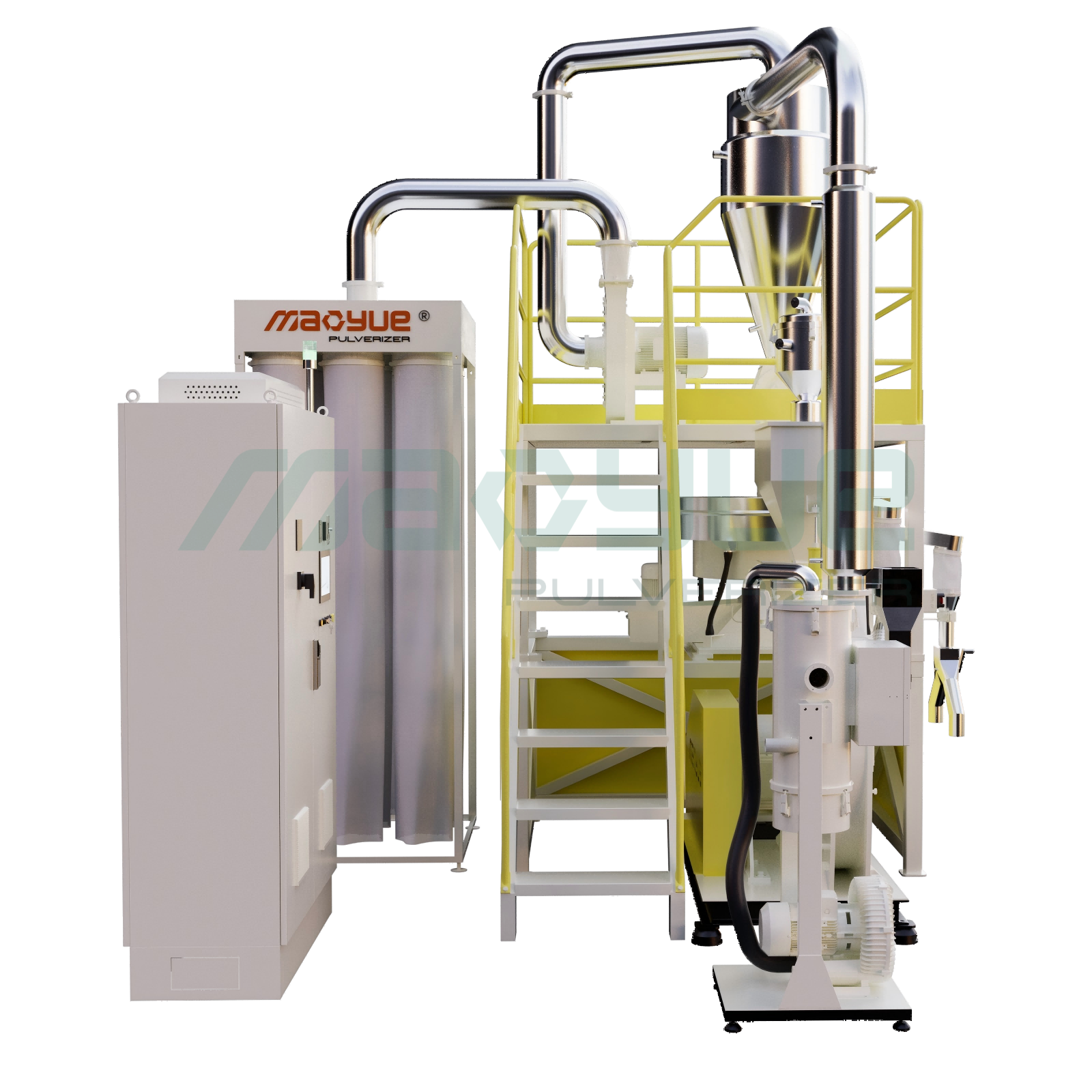
Fine grinding is not only about making plastic particles smaller. In many recycling and compounding applications, the quality of the final powder affects mixing performance, production stability, and product consistency.
Compared with a plastic grinder or granulator, a Plastic Pulverizer focuses on producing controlled fine powder. In the Plastic Pulverizer vs Plastic Grinder vs Granulator comparison, powder quality is where pulverizers show their biggest advantage.
A high-quality plastic powder requires more than simple size reduction. The particles need to remain consistent because uneven powder can create problems during blending, melting, and downstream processing.
A Plastic Pulverizer controls particle size through the interaction between rotating and fixed grinding discs. The grinding gap can be adjusted based on different materials and production targets.
Quality Factor | How a Plastic Pulverizer Helps |
Particle size control | Adjustable grinding disc clearance allows precise powder fineness adjustment |
Powder consistency | Stable grinding conditions create more uniform particle distribution |
Mixing performance | Fine and even powder improves blending in plastic compounding |
For applications such as masterbatch production, plastic modification, and filler blending, consistent powder quality is especially important. Uneven particles may affect color dispersion, material strength, and final product performance.
Maoyue Plastic Pulverizer uses a disc-on-disc grinding structure and adjustable grinding gaps to support different powder requirements. It can produce plastic powder ranging from around 20 mesh to 120 mesh or finer, depending on material characteristics and processing needs.
High-speed grinding creates friction, and friction generates heat. This becomes a major challenge when processing heat-sensitive plastics such as PVC, PE, and PP.
If temperature control is poor, several problems may appear during continuous production:
Plastic particles may soften or melt during grinding.
Melted material can stick to grinding components.
Powder may form unwanted agglomerates.
Excessive heat can cause material degradation.
These issues reduce powder quality and may interrupt production. That is why cooling performance is a key factor when choosing a plastic pulverizer.
A reliable cooling system helps maintain stable grinding conditions. It removes excess heat and allows the machine to operate continuously while protecting the material structure.
For heat-sensitive applications, buyers should pay attention to:
Real-time temperature monitoring.
Cooling airflow efficiency.
Stable operation during long production cycles.
Prevention of melting and material buildup.
Fine plastic powder is easy to disperse during processing. Without proper dust management, it can affect the working environment, equipment cleanliness, and production efficiency.
Modern Plastic Pulverizer systems often include airflow management and dust control designs to keep the grinding process more stable.
Maoyue Plastic Pulverizer adopts a closed negative-pressure airflow circulation system and forced water cooling design. The system helps monitor grinding temperature in real time, reduce dust leakage, and prevent powder agglomeration during continuous operation.
Production Challenge | Pulverizer Solution |
Dust escaping during grinding | Closed negative-pressure airflow circulation |
Unstable powder quality | Controlled grinding environment |
Heat buildup during operation | Forced cooling and temperature monitoring |
Long-term production difficulties | Stable automatic control system |
A cleaner grinding process also supports safer factory operations. Combined with PLC automatic control, the equipment can adjust feeding speed, rotation conditions, and cooling intensity based on production requirements.
For companies producing recycled plastic powder, these details often determine whether the final material can meet higher-value applications.
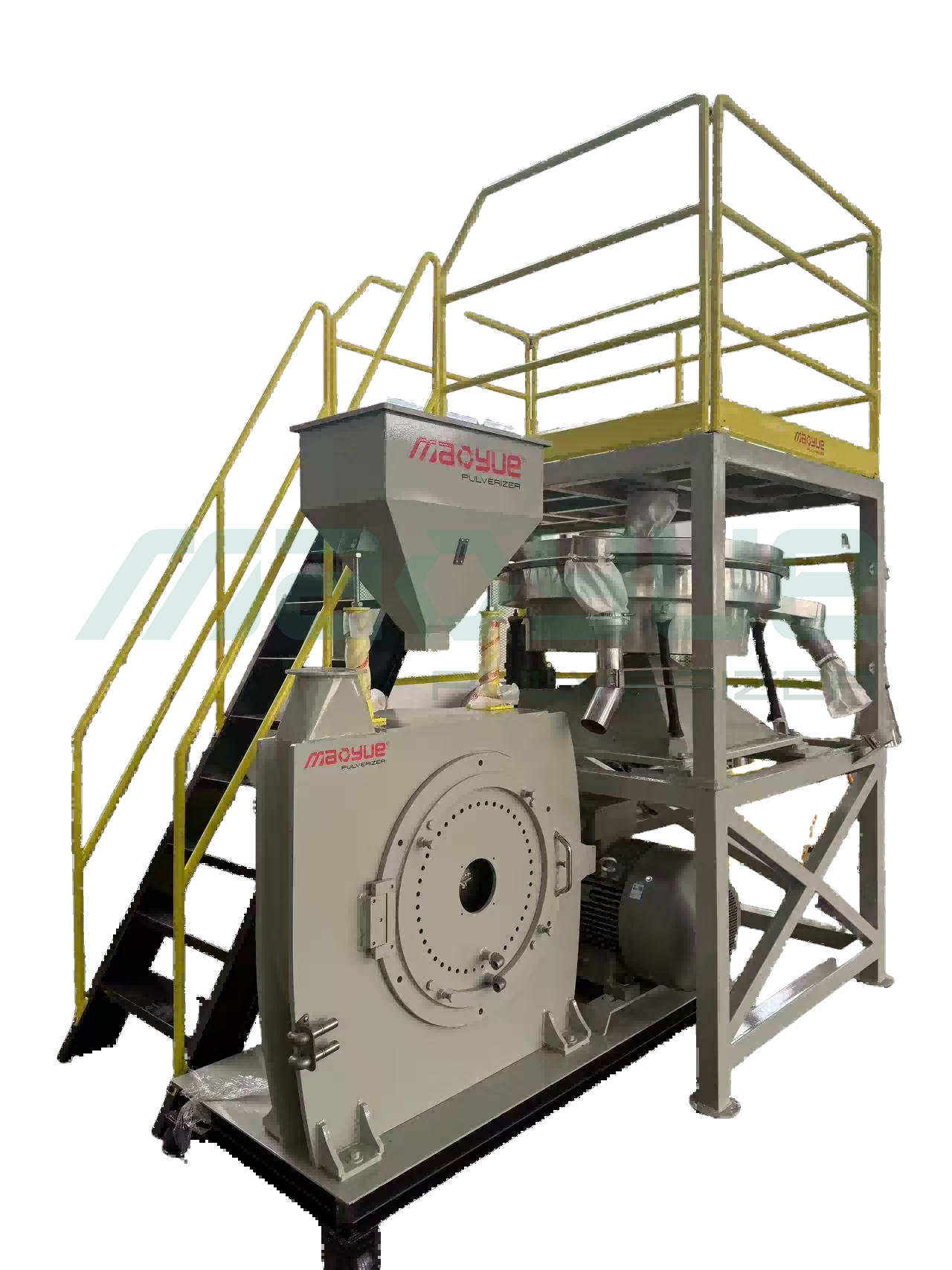
Choosing the right plastic size reduction machine starts with understanding your material. Different plastics have different hardness, melting points, and processing behaviors. A machine that works well for one material may not deliver the same results for another.
In the Plastic Pulverizer vs Plastic Grinder vs Granulator selection process, material type is one of the most important factors. PVC, PE, PP, and engineering plastics all require different grinding conditions to achieve stable powder quality.
PVC is one of the most common materials processed by plastic pulverizers. It is widely used in pipes, profiles, sheets, and other plastic products. During recycling, PVC scrap often needs fine grinding to create reusable powder.
However, PVC is also a heat-sensitive material. Excessive temperature during pulverizing can cause softening, sticking, or thermal degradation. This makes temperature control a key requirement.
For PVC powder production, buyers should consider:
Stable cooling performance during high-speed grinding.
Accurate control of grinding temperature.
Uniform powder size for recycling and compounding.
Reduced risk of material agglomeration.
Material | Common Source | Main Pulverizing Concern |
PVC | Pipes, profiles, plastic scraps | Prevent overheating and powder sticking |
Rigid PVC waste | Construction and industrial products | Maintain stable particle size |
PVC recycled material | Post-production waste | Improve powder consistency |
Maoyue Plastic Pulverizer is designed for PVC scrap pulverizing applications. Its closed airflow circulation and cooling system help control heat during continuous grinding, supporting stable PVC powder production.
PE and PP are widely used in packaging, containers, films, and industrial plastic products. They are common materials for recycling, but their properties require suitable processing conditions.
For PE and PP applications, a Plastic Pulverizer is often used when companies need fine powder instead of regular granules. This is especially useful for masterbatch production, plastic modification, and compounding processes.
Typical applications include:
HDPE powder production for recycled plastic applications.
LDPE fine powder processing.
PP recycling powder preparation.
Plastic filler and masterbatch manufacturing.
PE and PP materials usually require good control of grinding temperature because friction can affect powder quality. Proper cooling helps maintain stable output and prevents particles from sticking together.
Maoyue provides PE/PP plastic pulverizing solutions for fine powder production, including applications involving HDPE, LDPE, and masterbatch materials. The equipment supports adjustable powder fineness to meet different production requirements.
Engineering plastics and modified plastics often have higher performance requirements. Materials such as EVA, ABS, PET, and modified compounds may need customized grinding conditions based on hardness, toughness, and application goals.
Unlike standard plastics, these materials can behave differently during pulverizing. Some may generate more heat, while others may require stronger grinding performance to achieve the desired particle size.
Material Type | Typical Applications | Key Processing Considerations |
EVA | Flexible products, foam materials | Control heat and maintain powder consistency |
ABS | Engineering parts, industrial components | Balance grinding efficiency and material quality |
PET | Recycled plastic applications | Require suitable particle control |
Modified plastics | Compounding materials | Need stable mixing performance |
For these materials, buyers should evaluate several factors before selecting equipment:
Required powder fineness.
Material hardness and toughness.
Production capacity.
Cooling requirements.
Final application standards.
A complete plastic pulverizing solution should match the machine design with the material characteristics. This approach helps avoid unstable output and improves the performance of recycled plastic powder in downstream production.
Choosing between a Plastic Pulverizer, plastic grinder, and granulator depends on your material, output needs, and production goals.
Each machine plays a different role in plastic processing, from waste reduction to fine powder production.
As recycling technology continues to improve, selecting the right size reduction equipment helps companies achieve better efficiency and higher-value recycled materials.
A: A plastic granulator produces uniform flakes or granules, usually 3–12 mm, for recycling and reprocessing. A Plastic Pulverizer creates fine powder, often under 1 mm, for applications like masterbatch production and plastic modification.
A: Yes. A Plastic Pulverizer can process PVC, PE, and PP materials. It is commonly used for PVC scrap recycling, HDPE/LDPE powder production, PP recycling powder, and plastic compounding applications.
A: A Plastic Pulverizer can produce adjustable fine powder. Maoyue equipment supports powder fineness from around 20 mesh to 120 mesh or finer, depending on material and processing requirements.
A: It depends on the material size. Large plastic waste may require a grinder or granulator first. The common process is grinder/granulator for size reduction, then pulverizer for fine powder production.
A: A Plastic Pulverizer uses cooling systems, airflow circulation, and temperature monitoring to control heat. These features help prevent melting, sticking, and powder agglomeration during continuous operation.
A: Temperature control protects heat-sensitive materials like PVC, PE, and PP. It helps maintain powder quality, prevents thermal degradation, and ensures stable production performance.


