Specializing in the production of Plastic Pulverizer Machines.

Views: 0 Author: Site Editor Publish Time: 2026-08-27 Origin: Site
Fine PVC dust is not just a cleaning issue—it can become a serious safety challenge.
During PVC pulverizing, uncontrolled dust may affect worker health, increase fire risks, and reduce production quality.
This article explains how a PVC Pulverizer with advanced dust control, filtration, cooling, and safety systems helps create safer operations.
Changzhou Mao Yue Intelligent Equipment Co., Ltd., with over 28 years of experience, provides integrated PVC grinding and dust control solutions for global plastic processors.
Fine PVC dust often starts as a small production issue, but it can quickly become a major challenge. During high-speed grinding, tiny particles can escape from feeding areas, grinding chambers, and discharge points. If they stay uncontrolled, they may affect air quality, increase cleaning costs, and reduce the consistency of PVC powder.
A well-designed PVC Pulverizer should not only focus on grinding performance. It should also control dust from the beginning of the process through sealing, airflow management, and efficient recovery systems.
An enclosed grinding chamber is one of the most effective ways to stop fine PVC particles from spreading into the workshop. Instead of allowing dust to escape during pulverizing, the sealed structure keeps the grinding process inside a controlled space.
For PVC processing plants, key sealing areas include:
Area | Dust Control Purpose |
Feeding port | Prevents fine powder from leaking during material input |
Grinding chamber | Keeps high-speed grinding dust inside the machine |
Discharge outlet | Reduces dust release during powder collection |
A closed design also makes daily operation cleaner. Operators spend less time removing scattered powder around the machine. It helps maintain a more stable working environment, especially when processing materials such as PVC pipes, profiles, sheets, and SPC flooring.
Changzhou Mao Yue Intelligent Equipment Co., Ltd. applies enclosed grinding structures in its PVC pulverizer solutions. The system works together with dust collection equipment to reduce leakage points and improve workshop cleanliness. Its 28+ years of experience in plastic pulverizing equipment helps optimize machine structures for different PVC applications.
Sealing alone is not enough. Fine PVC particles can still move inside the machine during grinding. This is where negative pressure dust collection becomes important.
The system creates controlled airflow inside the grinding chamber. It pulls dust toward the collection unit instead of allowing particles to escape outward. This approach captures dust at the source before it reaches the factory environment.
A properly designed negative pressure system should achieve three goals:
Capture fine dust immediately: It removes airborne particles during the grinding process instead of waiting for cleanup.
Maintain powder quality: Optimized airflow avoids excessive suction that may affect particle size distribution.
Reduce material waste: Recovered PVC powder can return to production, improving raw material utilization.
Maoyue PVC pulverizers use customized airflow circulation designs to balance dust removal and grinding efficiency. The closed-loop airflow system helps reduce dust leakage while supporting stable powder output for continuous production.
After dust is collected, filtration quality determines how effectively the system handles fine PVC particles. A single filter stage may not be enough because PVC grinding produces particles of different sizes.
A multi-stage filtration system separates dust step by step:
Filtration Stage | Function | Benefit |
Cyclone separation | Removes larger powder particles first | Reduces load on fine filters |
Fine filter cartridges | Captures ultra-fine PVC dust | Improves dust removal efficiency |
Automatic pulse cleaning | Removes dust buildup on filters | Maintains long-term airflow performance |
This structure helps prevent filter blockage and keeps the dust collection system working consistently. Automatic pulse cleaning also reduces manual maintenance and avoids secondary dust pollution during cleaning.
For PVC processing factories, efficient dust recovery brings additional value. It reduces powder loss, protects downstream product quality, and supports cleaner production requirements. Maoyue provides matching dust collection configurations for PVC pulverizer systems, allowing factories to select solutions based on materials, production capacity, and operating conditions.
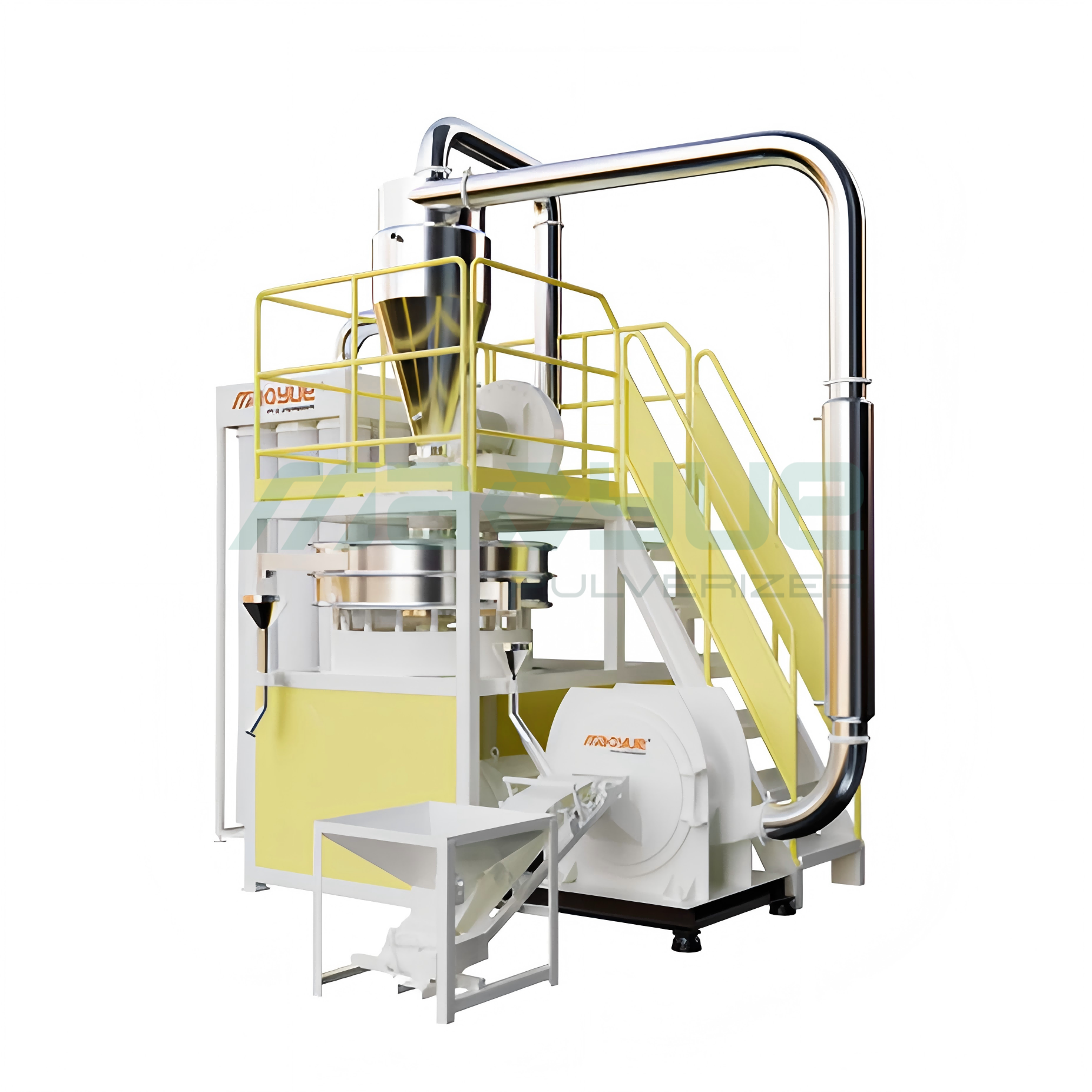
Fine PVC dust is more than a housekeeping problem. In a plastic processing factory, it can affect air quality, worker comfort, equipment performance, and overall production safety. A reliable PVC Pulverizer should control dust from the grinding process itself, keeping airborne particles at a lower level.
Integrated dust collection systems help capture fine PVC particles before they spread across the workshop. By combining sealed structures, airflow control, and filtration units, they reduce dust exposure around grinding equipment and create a cleaner working area.
Factories should also maintain proper daily safety practices:
Regular dust inspection: Check equipment surfaces, pipelines, and collection areas to identify dust buildup before it becomes a risk.
Proper protective equipment: Operators should use suitable respiratory protection when working near grinding operations.
Industrial vacuum cleaning: Avoid compressed air cleaning because it can spread fine dust back into the workplace. Use professional industrial vacuum systems instead.
A clean production environment not only protects workers but also helps maintain stable machine operation. Less dust accumulation around motors, electrical parts, and processing areas can reduce maintenance pressure over time.
During PVC grinding, friction between materials, grinding discs, and internal machine components can create static electricity. When fine PVC powder accumulates in enclosed areas, static discharge may become an ignition source.
For this reason, safety design should focus on controlling both dust concentration and potential sparks.
Safety Feature | How It Helps |
Anti-static machine structures | Reduces static charge buildup during high-speed grinding |
Grounding and bonding systems | Transfers electrical charges safely to the ground |
Explosion-proof electrical components | Improves protection around dust-processing areas |
Spark prevention design | Lowers the chance of ignition inside the system |
A well-designed PVC Pulverizer should consider these risks during machine development. Maoyue integrates anti-static structural designs and safety-focused components into its plastic pulverizing solutions. These features help factories handle PVC materials more safely, especially during continuous production.
Dust control also supports fire prevention because less accumulated powder means fewer combustible materials inside the workshop. When dust collection works properly, it reduces one of the major conditions required for dust-related incidents.
Temperature control is another important part of PVC pulverizer safety. During high-speed grinding, excessive friction can increase heat inside the grinding chamber. If temperatures become too high, PVC materials may soften, degrade, or release unwanted substances.
Monitoring temperature during operation allows factories to react before problems occur. Important monitoring points usually include:
Grinding chamber temperature: Helps identify heat buildup during pulverizing.
Spindle bearing temperature: Detects abnormal operation caused by friction or overload.
Discharge area temperature: Prevents overheating during powder output.
Maoyue PVC pulverizers use temperature monitoring and cooling solutions to support stable operation. The system can adjust operating conditions when temperatures approach unsafe levels, helping reduce material degradation and dust accumulation caused by thermal adhesion.
For factories running continuous PVC grinding lines, cooling performance becomes even more important. Stable temperature control improves powder consistency, protects key machine components, and supports longer equipment service life. The combination of dust collection, anti-static protection, and intelligent temperature management creates a safer working environment for plastic processing operations.
A modern PVC Pulverizer needs more than strong grinding power. It must control powder quality, reduce unnecessary dust generation, and maintain stable performance during long production cycles.
Small design improvements inside the machine can make a big difference. They help factories produce consistent PVC powder while reducing maintenance costs and safety concerns.
The grinding disc gap directly affects the final PVC powder size. When the gap is adjusted accurately, the machine can achieve the required fineness without creating excessive ultra-fine particles.
Too small of a grinding gap may increase friction and generate more dust. Too large of a gap may reduce grinding efficiency and create uneven powder output.
A precise adjustment system helps operators balance performance and dust control:
Better particle size control: The machine produces more uniform PVC powder for downstream applications.
Lower fine dust generation: Reducing unnecessary ultra-fine particles makes dust collection easier.
Improved energy efficiency: The grinding system works under suitable conditions without excessive load.
For materials such as PVC pipes, profiles, SPC flooring, and foam boards, controlling powder consistency is important. It directly affects the quality of final products and production stability.
Grinding discs and blades are core components of any PVC Pulverizer. Their condition affects grinding accuracy, dust generation, and machine lifespan.
When discs wear unevenly, the grinding process becomes unstable. It may increase vibration, reduce powder consistency, and create more unwanted fine particles.
High-quality grinding components help maintain reliable operation:
Component | Function | Production Benefit |
Wear-resistant grinding discs | Maintain stable grinding performance | Longer service life and fewer replacements |
Precision blades | Support efficient material cutting | More consistent powder output |
Balanced rotating parts | Reduce vibration during operation | Lower mechanical stress and noise |
Changzhou Mao Yue Intelligent Equipment Co., Ltd. develops matching grinding discs and blades for different plastic materials. Its experience in plastic pulverizing equipment allows the company to provide customized components based on production requirements, material types, and powder specifications.
Stable components also protect other machine parts. Less vibration and wear reduce stress on motors, bearings, and internal structures, helping factories maintain continuous operation.
Material feeding control is another important factor affecting PVC grinding performance. Uneven feeding can overload the grinding chamber, increase heat, and create additional fine dust.
An intelligent feeding system keeps material flow stable. It allows the PVC Pulverizer to process materials smoothly instead of operating under sudden pressure changes.
Key control functions include:
Automatic feeding adjustment: Maintains consistent material input and prevents overload conditions.
PLC monitoring system: Tracks important operating conditions in real time.
Temperature control functions: Detects abnormal heat changes and supports safer operation.
Temperature monitoring is especially important during continuous PVC grinding. Excessive heat can cause PVC materials to soften, stick, or create unstable powder conditions.
Maoyue PVC pulverizers use intelligent monitoring solutions to help control grinding temperature, improve operation stability, and support long-term production. These systems work together to maintain powder quality while reducing risks caused by overload, overheating, and dust accumulation.
Effective dust control is essential for safer PVC pulverizing operations.
A reliable PVC Pulverizer combines sealed grinding, negative pressure collection, filtration, temperature control, and anti-static protection.
Choosing an experienced plastic pulverizer manufacturer ensures better equipment design, technical support, and long-term production stability.
A: Fine dust is generated during high-speed grinding when PVC materials are processed into smaller particles. Poor sealing, unstable feeding, and excessive friction can increase dust production.
A: It uses enclosed grinding chambers and negative pressure airflow to capture dust at the source. Multi-stage filtration helps collect fine particles and maintain a cleaner workspace.
A: A properly designed PVC pulverizer can reduce risks through anti-static structures, temperature monitoring, dust collection, and explosion-proof safety components.
A: Key features include sealed structures, negative pressure systems, filtration units, anti-static protection, temperature control, and automatic safety monitoring.
A: Factories should use efficient dust collection, regular inspections, proper protective equipment, and industrial vacuum cleaning instead of compressed air.


