Specializing in the production of Plastic Pulverizer Machines.

Views: 0 Author: Site Editor Publish Time: 2026-07-28 Origin: Site
Choosing a plastic pulverizer is about far more than comparing prices or motor power. Different plastics have different physical properties, melting points, hardness, toughness, and grinding characteristics. A pulverizer that performs well with PE may not be suitable for PVC, PA, or TPU.
Selecting the right plastic pulverizer not only improves production efficiency but also ensures consistent powder particle size, enhances product quality, and reduces long-term energy consumption, maintenance costs, and downtime. In contrast, an improperly matched machine may fail to achieve the desired performance even with a larger motor, leading to rapid grinding disc wear, inconsistent powder quality, frequent equipment failures, and higher production costs.
Whether you produce rotomolding powder, masterbatch powder, modified plastic powder, engineering plastic powder, or recycled plastic powder, understanding the processing characteristics of different materials and choosing the appropriate pulverizing solution are essential for achieving stable production and strengthening your competitive advantage.
With more than 30 years of experience in plastic pulverizer research, development, and manufacturing, MaoYue Intelligent Equipment continuously optimizes its machines for a wide range of materials, including PE, PP, PVC, PA, TPU, and ABS. From grinding disc design and cooling systems to power configuration, we provide precise, efficient, and reliable plastic pulverizing solutions for customers worldwide.
Every type of plastic behaves differently during the pulverizing process.
Some plastics are naturally brittle and can be quickly reduced into uniform powder under the cutting and impact forces of high-speed rotating grinding discs. Others have high toughness and elasticity, allowing them to absorb more energy during grinding and generate significant heat. Without an efficient cooling system, these materials may soften, stick to the grinding discs, or even form powder agglomerates.
For example:
PE is relatively soft with good flowability, making it one of the easiest plastics to pulverize.
PVC is a heat-sensitive material. High-speed grinding generates frictional heat, so it requires an efficient air and water cooling system along with precise temperature control. Otherwise, powder quality may deteriorate.
PA features high strength, toughness, and excellent wear resistance. Standard pulverizers often struggle to achieve satisfactory output and may experience accelerated grinding disc wear. It therefore requires a more powerful drive system, highly wear-resistant grinding discs, and an advanced cooling solution.
TPU is extremely elastic and flexible, making it prone to sticking to the grinding discs as the material temperature rises during pulverizing.
For this reason, a single machine configuration is rarely suitable for processing all types of plastics. Choosing a pulverizer specifically designed for the material being processed is essential for achieving high productivity, consistent powder quality, and reliable long-term operation.

A plastic pulverizer is an industrial machine specifically designed to process plastic pellets, flakes, edge trim, or recycled plastic into fine powder. It is an essential piece of equipment in plastic recycling, plastic modification, and plastic product manufacturing.
Unlike a plastic crusher, which reduces material into coarse flakes or granules, a plastic pulverizer produces uniform plastic powder ranging from 20 to 120 mesh**,** meeting the requirements of a wide variety of industrial applications.
Today, plastic pulverizers are widely used across many industries, including:
Plastic Recycling – Converting post-industrial and post-consumer plastic waste into reusable plastic powder, improving resource utilization and supporting sustainable production.
Rotational Molding – Producing uniform PE powder for manufacturing water tanks, chemical tanks, playground equipment, kayaks, and other rotomolded products.
PVC Pipe & Profile Manufacturing – Processing PVC powder for pipes, window and door profiles, cable conduits, and other PVC products.
Plastic Modification – Providing consistent plastic powder for compounding processes such as filling, reinforcement, and flame-retardant modification.
Color Masterbatch Production – Improving the dispersion and mixing uniformity of color masterbatch with resin for better coloring performance.
Blending & Compounding – Ensuring homogeneous mixing of different plastic powders and additives to enhance material performance.
Powder Coatings & Specialty Industrial Materials – Meeting the production requirements of specialty plastic powders and industrial powder materials.
The quality of the plastic powder directly affects the performance and competitiveness of the final product. Factors such as particle size uniformity, powder flowability, and temperature control during pulverizing all have a significant impact on product quality, production efficiency, and overall manufacturing costs. That is why selecting the right plastic pulverizer is critical for achieving stable production and long-term profitability.
Different plastic materials have different physical properties and processing characteristics. Therefore, the requirements for plastic pulverizers vary depending on the material being processed.

PE is one of the most commonly processed materials in the plastic pulverizing industry. Common types of PE include LDPE, HDPE, and LLDPE.
Main applications include:
Rotomolding powder
PE pipes
Plastic sheets
Plastic packaging
Plastic films
PE has relatively low hardness and is easy to pulverize, but stable cooling is still required to prevent powder agglomeration.
For companies processing PE, the key factors when selecting a plastic pulverizer usually include:
High production capacity
Uniform particle size
Energy efficiency
Long-term stable operation

PVC is one of the most widely used materials in the plastics industry. It is commonly used for producing water supply and drainage pipes, cable insulation, door and window profiles, flooring, decorative materials, and various industrial products.
PVC is highly sensitive to temperature. If the pulverizing temperature becomes too high, PVC may soften, discolor, or even degrade, directly affecting powder quality.
Therefore, a PVC pulverizer usually requires:
Efficient air cooling system
Water cooling system
Precise grinding disc gap adjustment
Stable feeding system
Temperature control system
These features help maintain stable powder fineness while protecting the material properties.

PP is widely used in plastic recycling, injection molding, packaging, household products, woven bags, automotive components, and plastic modification industries.
Compared with PE, PP has higher rigidity and a slightly higher melting point, which means it requires better pulverizing stability.
When processing recycled PP, the quality of raw materials often varies significantly. Some materials may contain fillers such as calcium carbonate and talc, while others may contain moisture or impurities. Therefore, the pulverizer must maintain stable powder fineness under different operating conditions.
An ideal PP pulverizer should have:
High pulverizing efficiency
Stable powder fineness (typically 20–80 mesh)
Low vibration
Excellent cooling performance
Long service life grinding discs
For companies producing modified PP or recycled PP powder, stability is often more important than achieving the highest possible output.

ABS is an engineering plastic with excellent impact resistance and dimensional stability. It is widely used in automotive parts, electronic housings, home appliances, and consumer products.
Compared with general-purpose plastics such as PE and PP, ABS has higher hardness and a higher friction coefficient. Therefore, temperature control is especially important. Excessive temperature not only affects powder quality but also accelerates grinding disc wear.
When selecting an ABS pulverizer, attention should be paid to:
High-strength wear-resistant grinding discs
Efficient airflow design
Stable feeding system
High-precision dynamic balancing
High-quality bearing system
Good overall machine balance can improve powder quality while reducing vibration, noise, and maintenance costs.

PA is one of the most difficult engineering plastics to pulverize due to its extremely high toughness, wear resistance, and elasticity. Standard pulverizers often struggle to achieve both high output and uniform powder quality.
For nylon materials, the pulverizer usually requires:
Higher power motor — Providing continuous and stable power output to meet high-intensity pulverizing requirements.
Stronger cutting performance — Optimizing grinding disc structure to improve shearing efficiency for high-toughness materials.
Low-temperature pulverizing system — Effectively controlling heat generated during pulverizing to prevent material performance degradation caused by excessive temperature.
Efficient cooling system — Using air cooling, water cooling, or combined cooling methods to ensure long-term stable operation.
Highly wear-resistant grinding discs — Manufactured with high-hardness wear-resistant materials to extend disc life and reduce replacement frequency and maintenance costs.
Stable feeding and airflow system — Ensuring uniform material feeding into the grinding chamber and improving particle size consistency.
A pulverizer specifically designed for engineering plastics can significantly improve production efficiency while reducing equipment wear.

For the plastic pulverizing industry, TPU is also one of the most challenging materials to process.
Due to frictional heat generation, TPU can easily soften and stick to the grinding disc surface during pulverizing.
Therefore, processing TPU usually requires:
Low-temperature pulverizing
Efficient cooling system
Optimized airflow design
Precise feeding control
Specialized grinding disc design
Without sufficient cooling, powder quality can quickly deteriorate.
When purchasing a plastic pulverizer, you should not focus only on the price. A comprehensive evaluation should include equipment performance, operating stability, maintenance costs, and long-term return on investment.
Different plastics require different pulverizing solutions.
Before purchasing, it is recommended to clearly understand:
Is the material brittle or tough?
Does the material easily generate heat during processing?
Is the material prone to moisture absorption?
Is low-temperature pulverizing required?
Does the raw material contain fillers or impurities?
These factors directly affect the required machine configuration.

Different applications have different requirements for plastic powder particle size.
Particle size not only affects the appearance of the final product but also directly influences powder flowability, mixing uniformity, molding quality, and subsequent processing efficiency. Therefore, when selecting a plastic pulverizer, it is important to define the target particle size range and ensure that the equipment can continuously produce qualified powder with stable performance.
For example:
Rotational molding industry: Usually requires 30–40 mesh powder to ensure good flowability and uniform sintering performance.
PVC pipes and profiles: Generally requires 20–80 mesh, depending on different formulations and processing conditions.
Color masterbatch production: Particle size requirements should be customized according to customer formulations and dispersion requirements.
Plastic modification: Requires higher particle size consistency to ensure uniform mixing of fillers, additives, and resin.
The finer the powder requirement, the higher the demands on equipment processing accuracy, grinding disc manufacturing precision, cooling efficiency, and airflow system design.
Many buyers believe that higher machine output is always better, but this is not necessarily true.
The most suitable pulverizer for a company should be able to meet daily production requirements while maintaining stable powder quality and low energy consumption over long-term operation, rather than simply pursuing the maximum possible output.
If the machine capacity is too small, the equipment may operate under overload conditions for extended periods. This not only reduces production efficiency but also accelerates the wear of key components such as grinding discs and bearings.
On the other hand, if the machine is oversized, it will increase the initial investment cost while also raising electricity consumption and maintenance expenses, reducing the overall return on investment.
The cooling system is one of the most critical components of a plastic pulverizer, yet it is often overlooked.
An efficient cooling system can help companies:
Prevent material softening and sticking, ensuring stable processing conditions
Improve powder particle size consistency and enhance product quality
Extend the service life of grinding discs and bearings while reducing replacement frequency of wear parts
Reduce machine downtime and improve continuous production capacity
Lower pulverizing temperature and increase overall production efficiency
Especially for engineering plastics, processing stability is highly dependent on cooling performance.
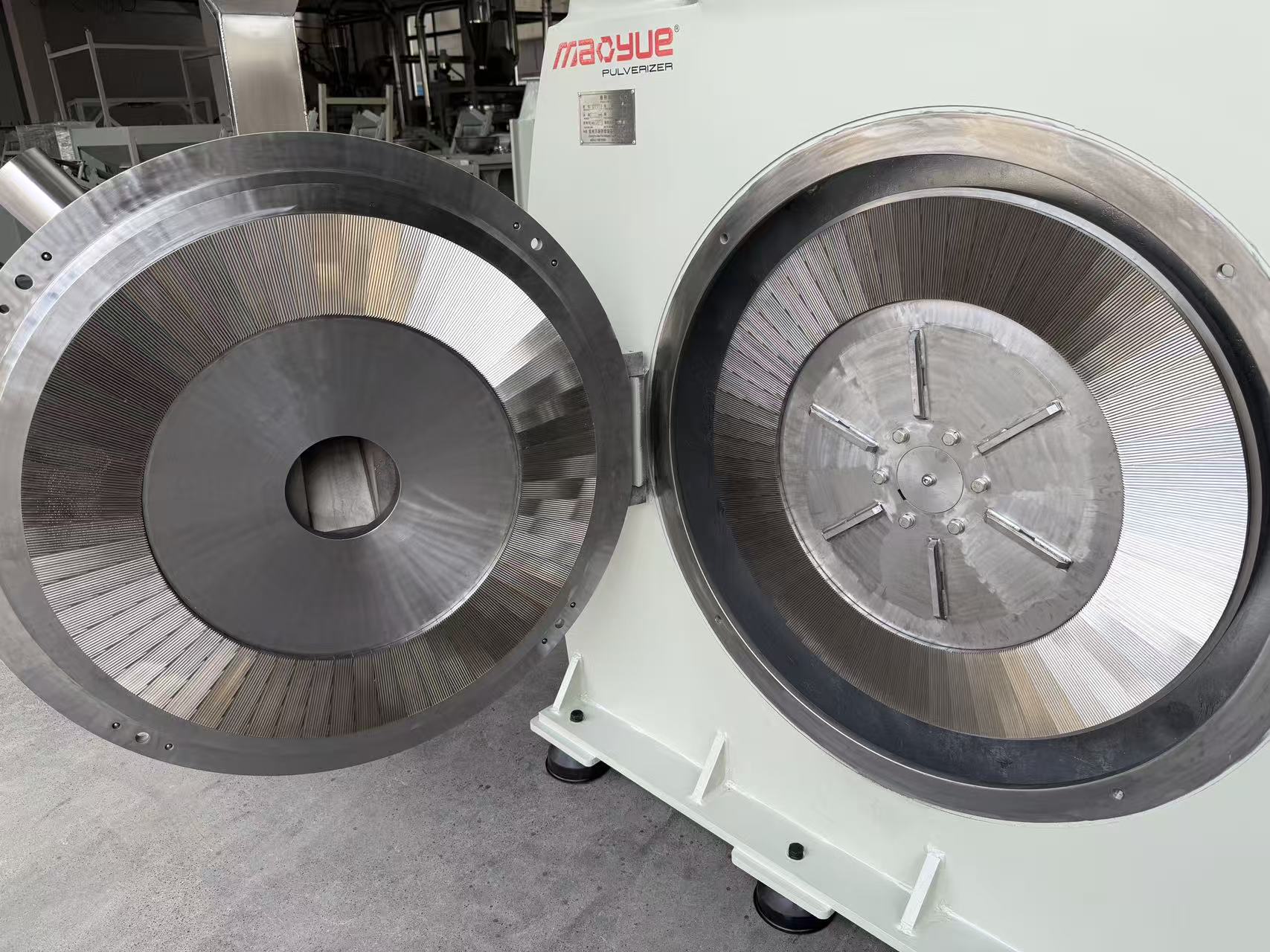
The grinding disc is regarded as the core component of a plastic pulverizer. Its performance directly determines the machine's pulverizing efficiency, powder quality, and service life.
A high-quality grinding disc can provide:
Higher wear resistance — Reducing wear rate and extending service life
More uniform powder particle size — Improving product quality and processing stability
Higher pulverizing efficiency — Increasing production capacity per unit of time
More stable continuous operation — Reducing equipment failure rates
In the long term, high-quality grinding discs can significantly reduce maintenance costs and improve overall production efficiency.
Modern plastic processing companies are moving toward smarter and more efficient production. Today, a plastic pulverizer is no longer just a single grinding machine, but an important part of an automated production system.
A high-quality pulverizing system can be integrated with:
PLC control system
Automatic feeding system
Temperature monitoring system
Motor current overload protection
Powder collection system
Remote operation functions
Automation helps reduce human errors, improve production stability, and support continuous operation.
For large-scale plastic powder production enterprises, automation is not an additional expense, but an important investment in improving long-term competitiveness.
Purchasing a plastic pulverizer is a long-term investment, not just a simple equipment purchase.
Many buyers focus only on the equipment quotation when comparing suppliers, while ignoring manufacturing quality, core component performance, and long-term operating reliability.
Although a low-priced machine may appear to save on the initial budget, it can lead to higher costs during future production.
Low-cost equipment may have issues such as:
Poor grinding disc quality
Insufficient cooling performance
Higher energy consumption
Shorter service life
Frequent maintenance requirements
The real cost of a plastic pulverizer is not the purchase price, but the total cost throughout years of operation.
A reliable machine may require a slightly higher initial investment, but it can create greater value through stable production, lower maintenance costs, and improved long-term efficiency.

Different plastics have significant differences in physical properties and processing characteristics. It is difficult to achieve the best pulverizing results with exactly the same machine configuration for every material.
Different materials require different combinations of:
Motor power
Grinding disc structure
Cooling method
Feeding system design
Rotating speed parameters
Professional plastic pulverizer manufacturers usually provide customized solutions based on the specific characteristics of different materials to ensure optimal grinding performance, stable powder quality, and efficient production.
In industrial plastic processing, choosing a plastic pulverizer is not simply about purchasing a machine. It means choosing a long-term partner that can support stable production and continuous business growth.
For companies involved in plastic recycling, rotational molding, plastic modification, and engineering plastic processing, equipment must handle long-term continuous operation, changing raw material conditions, and strict powder quality requirements. Therefore, the manufacturer's experience, core technical capabilities, manufacturing precision, and after-sales service directly affect production efficiency and operating costs in the coming years.

Choosing a pulverizer manufacturer is essentially choosing a long-term production partner.
With more than 30 years of experience in plastic pulverizer research, development, and manufacturing, MaoYue Intelligent Equipment continuously optimizes pulverizing technologies for different plastic materials.
From PE and PVC to engineering plastics such as PA, TPU, ABS, and PBT, MaoYue develops stable and reliable solutions based on customers' actual production requirements.
Years of industry experience enable MaoYue to provide more precise and efficient equipment solutions according to different material characteristics, rather than simply offering standardized products.

The performance of a plastic pulverizer largely depends on the quality of its core components.
One of Mao Yue Intelligent Equipment's key advantages is its strong capability in manufacturing critical components independently. Compared with some manufacturers that rely heavily on external suppliers, MaoYue can manage the entire process of design, machining, and quality control for important components.
Key components independently manufactured and strictly controlled by MaoYue include:
High-precision grinding discs
Core pulverizing components
Main shaft structures
Precision mechanical parts
This allows better control over:
Machining accuracy
Equipment stability
Delivery time
Customization requirements
The grinding disc can be considered one of the most important core components of a plastic pulverizer, similar to the "heart" of the machine.
The performance of the grinding disc directly determines powder quality, production efficiency, and equipment service life. Only with reliable core components can the entire machine maintain stable operation during long-term industrial production.

Plastic pulverizers are high-speed rotating machines, making manufacturing precision extremely important.
During high-speed operation, even very small machining errors can be amplified over time, eventually resulting in:
Increased equipment vibration
Higher operating noise
Unstable powder particle size
Abnormal bearing loads
Shortened component service life
To improve equipment stability, MaoYue applies:
CNC precision machining
High-precision grinding equipment
Dynamic balancing technology
Strict quality inspection procedures
Especially for high-speed rotating components, dynamic balancing technology plays an important role in reducing vibration and extending equipment service life.

During plastic pulverizing, temperature control is one of the key factors affecting powder quality.
MaoYue pulverizers adopt optimized cooling solutions, including:
High-efficiency air cooling systems
Water cooling assistance
Low-temperature pulverizing solutions
Optimized airflow circulation design
For heat-sensitive materials such as PVC, PA, and TPU, efficient cooling helps ensure:
Stable powder quality
Continuous production
Reduced material degradation

Every customer has different requirements.
Even when processing the same material, different factors may require different equipment configurations, including:
Production capacity requirements
Powder fineness requirements
Production environment
Raw material conditions
MaoYue provides customized equipment solutions based on:
Raw material characteristics
Production capacity requirements
Powder application fields
Target particle size range
Operating environment
Before purchasing, customers can communicate with MaoYue engineers about material characteristics and expected production results to develop the most suitable pulverizing solution.
There are many plastic pulverizer suppliers in the market, but significant differences exist among manufacturers in terms of R&D capabilities, manufacturing standards, quality control, and after-sales service.
For purchasing companies, choosing a reliable plastic pulverizer manufacturer means more than simply buying a machine. It means selecting a long-term partner that can continuously support the company's development and production needs.

A professional plastic pulverizer manufacturer should have a complete production system, rather than being only an equipment trader or a simple assembly factory.
Choosing a manufacturer with real production capabilities can provide customers with greater assurance, including:
More stable equipment quality
More controllable delivery schedules
More flexible customized production
More reliable after-sales support
Plastic pulverizing is not only a mechanical manufacturing process, but also a comprehensive engineering field that combines material science, mechanical design, temperature control, and powder processing technology.
A professional manufacturer needs to understand:
Material characteristics
Pulverizing technology
Temperature control
Powder applications
Manufacturers with strong technical experience can provide the right solutions based on actual production requirements, rather than simply selling standardized equipment.

Before purchasing, customers are highly recommended to conduct actual material testing.
Different suppliers may achieve different testing results because machine structures, grinding disc designs, and cooling systems vary.
MaoYue supports customers with material testing to help confirm:
Target powder fineness
Actual production capacity
Suitable equipment configuration
Through real material testing and technical evaluation, customers can select the most suitable pulverizing solution and reduce risks before investment.
Today, plastic processing companies are facing increasing challenges:
Rising energy costs
Higher requirements for powder quality
Intensifying market competition
Growing demand for stable production
Facing these challenges, choosing an experienced and technically reliable plastic pulverizer manufacturer is far more important than simply purchasing a machine.
With more than 30 years of experience in plastic pulverizer R&D and manufacturing, MaoYue Intelligent Equipment always focuses on customers' actual production needs. We continuously optimize machine structures, grinding disc designs, cooling systems, and intelligent control technologies to help customers solve real production challenges — not just provide a piece of equipment.
MaoYue plastic pulverizers are widely used for processing various plastic materials, including:
PE
PP
PVC
PA
ABS
TPU
Engineering plastics
Based on your specific application requirements, MaoYue can help you select the most suitable pulverizing system to achieve higher efficiency, stable powder quality, and reliable long-term operation.
Selecting the right plastic pulverizer requires comprehensive consideration of material characteristics, technical specifications, and future production plans.
The best equipment is not necessarily the largest or the most expensive machine.
The truly suitable equipment is the one that matches your material requirements, production capacity needs, powder quality targets, and operating environment.
From PE and PP recycling to PVC production and high-performance engineering plastic processing, each material requires a professional pulverizing solution.
With strong manufacturing capabilities, advanced technologies, and years of industry experience, MaoYue helps customers achieve:
Stable production
Higher efficiency
Better powder quality
Lower operating costs
Choosing the right pulverizer is not simply purchasing equipment — it is an investment in the future development and long-term competitiveness of your business.
No. Different plastics have different levels of hardness, elasticity, and heat resistance. Materials such as PE, PVC, PA, and TPU require different machine configurations and pulverizing solutions.
Generally, PE and PP are relatively easier to process because they have lower hardness compared with engineering plastics.
The main causes include friction heat generation, insufficient cooling, improper feeding speed, and incorrect grinding disc gap settings.
MaoYue improves equipment stability through precision manufacturing, dynamic balancing technology, optimized cooling systems, and strict quality control processes.
Depending on the material characteristics and machine configuration, MaoYue pulverizers can produce plastic powder ranging approximately from 10 to 120 mesh.
If you are processing PE, PP, PVC, PA, TPU, ABS, or other plastic materials, choosing the correct pulverizer configuration is the key to achieving stable and efficient production.
Welcome to contact MaoYue Intelligent Equipment and communicate with our engineering team about your material characteristics, production capacity requirements, and customized pulverizing solutions.


