Specializing in the production of Plastic Pulverizer Machines.

Views: 0 Author: Site Editor Publish Time: 2026-07-21 Origin: Site
In the plastic powder production process, particle size distribution is one of the most important quality indicators. Whether you are producing PE powder for rotational molding, PVC powder for extrusion, or plastic powder for coating applications, a stable particle size distribution directly affects the performance of the final product.
Have you ever noticed that two batches of plastic powder produced by the same machine can sometimes perform completely differently? One batch may have excellent flowability, while another may experience feeding problems. This phenomenon may seem accidental, but in reality, it is often closely related to uneven particle size distribution.
Problems caused by uneven particle size distribution:
Reduced powder flowability, resulting in difficult feeding and unstable material supply;
Inconsistent melting rates, leading to uneven plasticization and product defects;
Poor surface quality of finished products, including rough texture, pinholes, or color variations;
Increased energy consumption, as the equipment requires more time to reach the ideal processing condition;
Higher scrap rates, increasing raw material consumption and production costs.
More importantly, particle size distribution affects not only the powder itself but also the efficiency and stability of the entire production system. So, what exactly causes uneven particle size distribution? Let’s take a closer look at the key factors.
Particle size distribution refers to the proportion of particles with different sizes within a powder. It does not describe the size of a single particle, but rather reflects the distribution of various particle sizes throughout the entire batch of powder.
A narrow particle size distribution means that most particles have very similar sizes. This type of powder usually provides better flowability, more uniform melting behavior, and more stable processing performance.
In contrast, a wide particle size distribution means that the powder contains a large amount of both coarse particles and excessively fine particles. This can easily lead to unstable production processes and reduce the quality of the final product.

A simple way to understand particle size distribution is to imagine a bag of rice. If every grain of rice is almost the same size, the rice will flow smoothly when poured, and processes such as packaging, transportation, and measurement will be more consistent.
However, if the bag contains whole rice grains, broken rice, and even a large amount of rice flour, the overall flowability will decrease significantly. Fine particles will fill the gaps between larger particles, increasing friction between particles and making the material more likely to experience problems such as bridging, segregation, or blockage.
In other words, particle size distribution is not just a laboratory testing value—it is also a direct reflection of the performance of the entire plastic pulverizing system.
The more uniform the particle size distribution, the more stable the downstream processing will be, resulting in higher production efficiency and better product consistency.

Uniform particle size distribution is one of the key factors determining plastic powder quality and processing stability.
When powder particles maintain consistent sizes, the material can flow, mix, melt, and form more smoothly during production. This is especially important for industries such as rotational molding, extrusion, coating, and plastic modification, where even small variations in powder characteristics can affect final product performance.
Uniform powder provides many advantages:
Better flowability
Higher mixing efficiency
More stable extrusion performance
Improved coating quality
More consistent molding results
Reduced material waste
Uneven particle size distribution is usually not caused by a single factor. During the plastic pulverizing process, it is often the result of multiple factors working together, including raw material characteristics, grinding conditions, equipment design, feeding stability, and cooling performance.
Just like different ingredients require different processing methods, different plastic materials also exhibit completely different behaviors during pulverizing. The material’s hardness, toughness, melting temperature, elasticity, and thermal sensitivity all directly affect whether it can be ground into powder with a stable and uniform particle size.

Different plastics behave very differently during the pulverizing process.
For example:
PVC has relatively high brittleness and is easier to pulverize;
PE has strong flexibility and is more difficult to grind;
TPU is soft and highly elastic;
PA is more sensitive to temperature changes.
Not all plastics can be processed using the same pulverizing parameters. When selecting suitable grinding conditions, factors such as material hardness, moisture content, feed size, and thermal sensitivity must be considered comprehensively.
A professional plastic pulverizing system should be capable of adapting to the characteristics of different materials. By adjusting the grinding disc design, grinding gap, feeding speed, and cooling method, it can achieve stable production of high-quality plastic powder with consistent particle size distribution.
Moisture content is a hidden factor that affects particle size distribution during the plastic pulverizing process. Even a small amount of moisture in the raw material can change the grinding conditions and reduce powder consistency.
Moisture acts like glue inside the pulverizing chamber. Wet materials tend to stick together instead of being evenly pulverized, resulting in agglomerated particles and irregular powder sizes.
Feeding stability is essential for maintaining consistent particle size during plastic pulverizing.
The pulverizer requires a continuous and uniform material supply to maintain stable grinding pressure and cutting conditions.
Imagine cutting vegetables while someone constantly changes the feeding speed. Sometimes the pieces will be evenly cut, while other times they will vary greatly in size. Plastic pulverizing works in a similar way.
Fluctuations in feeding speed can cause changes in grinding pressure, which directly affect the final particle size.
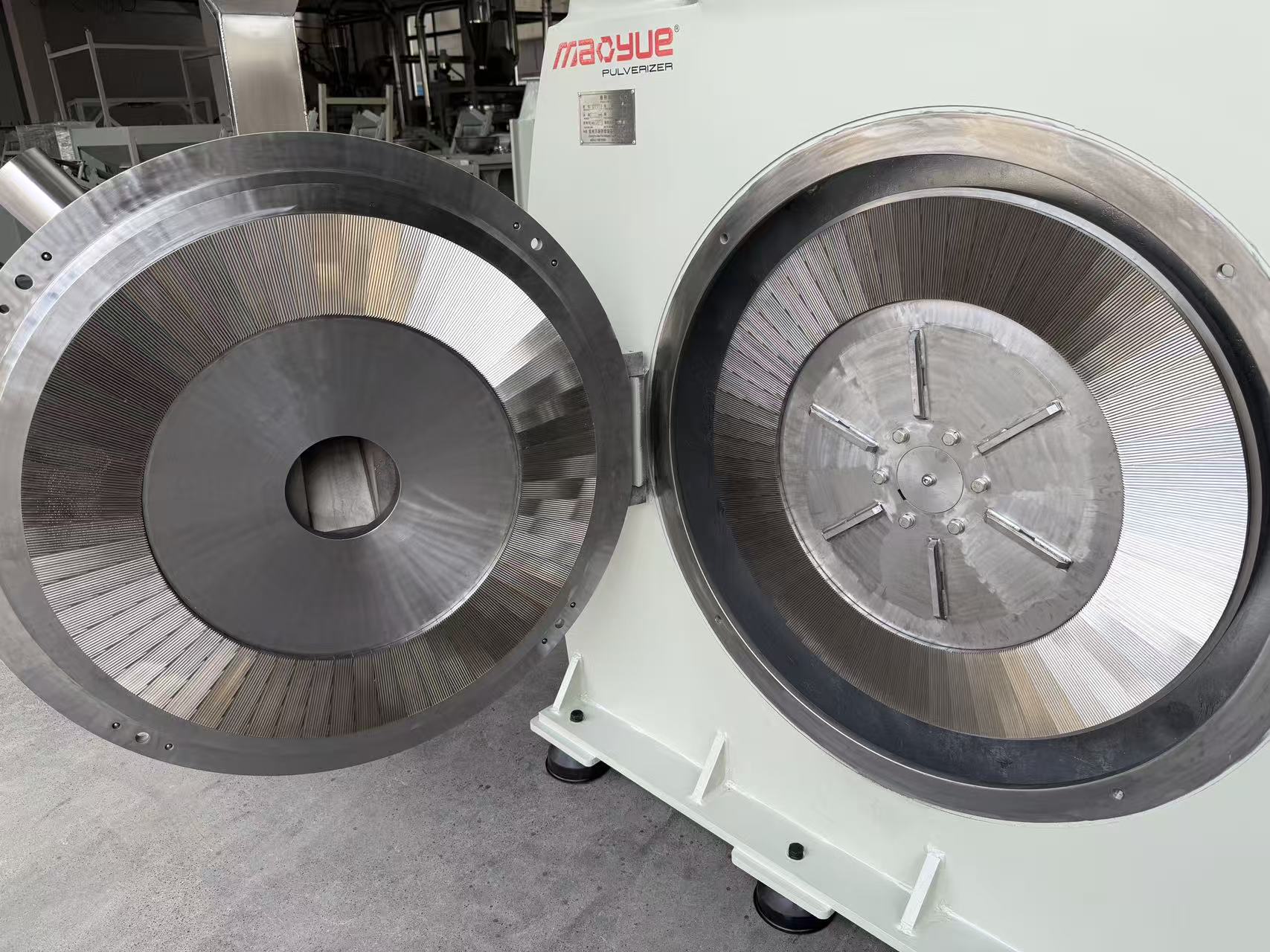
The grinding disc is the core component of a plastic pulverizer and plays a critical role in determining powder quality.
It is mainly responsible for cutting, shearing, and fine grinding plastic particles to achieve the target particle size.
The condition of the grinding disc directly affects grinding efficiency, energy consumption, and particle size stability.
As the grinding teeth wear over time, cutting efficiency gradually decreases. Some particles may be fully ground, while others may exit the grinding area before reaching the required size, eventually resulting in uneven particle size distribution.
The grinding disc gap is one of the key parameters that determines grinding intensity and final particle size distribution.
Even a small change in the gap can affect the contact pressure between the rotating and stationary discs, directly influencing cutting efficiency, powder fineness, and production stability.
The grinding disc gap directly determines grinding strength:
If the gap is too large, the grinding force between the discs becomes weaker. Some plastic particles may pass through the grinding zone without being sufficiently processed, resulting in more coarse particles and a wider particle size distribution.
If the gap is too small, the material will experience excessive grinding. Although this can produce finer powder, it can also generate too much fine powder and increase heat generation during operation.
Proper adjustment of the grinding disc gap is essential to achieve the best balance between fineness, efficiency, and stability.
Grinding disc speed is one of the key factors affecting grinding efficiency and particle size stability.
A stable rotational speed ensures a consistent grinding process.
Motor fluctuations, belt wear, or equipment overload can affect cutting stability and lead to variations in powder quality.

Temperature control is one of the most important factors affecting powder quality during plastic pulverizing.
High temperature is often the biggest hidden challenge in maintaining stable grinding performance.
When the temperature inside the pulverizing chamber becomes too high, plastic materials may soften instead of undergoing ideal brittle fracture.
This can eventually lead to:
Irregular particle shapes;
Wider particle size distribution;
Powder agglomeration;
Increased energy consumption.
During the plastic pulverizing process, the airflow system plays a crucial role in controlling particle size distribution.
The airflow is responsible for carrying qualified powder out of the pulverizing chamber.
Insufficient airflow can cause fine powder to remain in the chamber and be repeatedly ground, while coarse particles may remain trapped.
A properly designed classification system is essential to ensure consistent final powder quality.
Particle size distribution is not just a laboratory testing indicator; it directly affects the entire plastic production process.
From powder flowability and processing stability to final product performance and customer satisfaction, stable particle size control is an essential factor for achieving reliable production.

Uniform particle size helps plastic materials achieve more consistent melting, mixing, and forming during processing.
Whether used in rotational molding, extrusion, coating, or plastic modification industries, stable powder characteristics provide an important foundation for producing high-quality products.
Uneven particle size distribution can easily lead to:
Surface defects;
Uneven color distribution;
Reduced mechanical properties;
Unstable molding performance.
Uneven particle size distribution can increase:
Rework rates;
Raw material waste;
Downtime;
Energy consumption.
Achieving stable particle size distribution cannot be accomplished by simply adjusting one parameter of a plastic pulverizer. Instead, it requires a complete and systematic approach.
It involves multiple aspects, including raw material preparation, grinding disc condition, cooling performance, feeding stability, and powder classification capability.
Control the moisture content of raw materials and maintain consistent feed particle sizes.

Regularly inspect grinding disc wear and replace worn grinding blocks before they significantly affect grinding performance.
Select suitable cooling methods, such as air cooling, water cooling, or low-temperature cooling systems, according to different material characteristics.
Stable temperature control helps achieve more uniform powder quality.

An automatic feeding system can maintain a consistent feeding rate.
A stable process is the foundation for producing stable products.
Modern classification systems can continuously separate qualified powder from coarse particles.
This significantly improves particle size distribution consistency and ensures more stable final powder quality.

Producing uniform plastic powder is not achieved by chance. It is the result of precision engineering, reliable manufacturing, optimized processes, and strict process control.
During plastic pulverizing, every detail can affect the final result. Whether it is the grinding disc structure, feeding stability, temperature control, airflow classification, or equipment machining accuracy, each factor directly influences powder particle size distribution.
A small variation in any part of the system can lead to significant differences in powder quality.
Therefore, Mao Yue does not focus on optimizing only a single component. Instead, we improve the overall performance of the complete pulverizing system to help customers maintain stable powder quality during long-term continuous production.

The grinding disc is the core component of a plastic pulverizer and directly determines cutting efficiency and powder particle size stability.
MaoYue adopts optimized grinding disc structural design and high-precision machining technology to ensure stable grinding conditions between the rotating and stationary discs. This allows plastic materials to receive more uniform grinding forces, reducing particle size fluctuations.
Compared with conventional grinding systems, high-precision grinding discs provide:
More stable cutting performance;
More uniform powder particle size;
Lower equipment vibration and mechanical wear;
Longer service life under continuous production conditions.
A high-quality grinding disc is not only a wear-resistant component, but also an essential foundation for producing stable plastic powder.
Stable production starts with stable feeding.
If the feeding speed changes frequently, the internal load of the pulverizer will fluctuate accordingly, resulting in unstable grinding conditions.
MaoYue pulverizers optimize the feeding system to ensure continuous and uniform material delivery into the grinding chamber.
At the same time, temperature control is equally critical.
Excessive temperature can soften plastic materials, reduce cutting efficiency, and produce irregularly shaped particles.
By combining efficient air cooling, water cooling, and customized cooling solutions, MaoYue can maintain stable grinding temperatures for different materials, including PVC, PE, PP, TPU, and engineering plastics.
Stable feeding and efficient cooling work together to achieve:
A more stable grinding environment;
Reduced powder agglomeration;
Improved particle size uniformity;
Higher continuous production efficiency.

Powder quality depends not only on the grinding process; an efficient classification system is equally important.
After grinding, qualified powder needs to be separated quickly and accurately.
The optimized airflow classification system allows powder that meets the required specifications to be discharged efficiently, while larger particles are returned for further grinding.
This helps avoid two common problems:
Coarse particles entering the final product;
Excessive fine powder generation caused by repeated grinding.
Through optimized airflow design and advanced classification technology, MaoYue helps customers achieve more stable particle size distribution and higher-quality plastic powder production.
Possible causes include an excessively large grinding disc gap, worn grinding discs, insufficient rotational speed, or insufficient grinding time.
Possible reasons include an excessively small grinding disc gap, insufficient airflow, or over-grinding of the material.
No.
Powder quality depends on the performance of the entire pulverizing system, including grinding disc design, feeding stability, cooling efficiency, airflow control, and process parameters—not just motor power.
Particle size distribution is not only a laboratory testing indicator, but also a comprehensive reflection of the overall performance of a plastic pulverizing system.
From raw material characteristics and grinding disc condition to cooling efficiency, airflow control, and process management, every stage can influence the final powder quality.
By deeply understanding the root causes of uneven particle size distribution and continuously optimizing the pulverizing process, companies can achieve higher production efficiency, lower energy consumption, and more stable product quality.
If your goal is to produce high-quality PVC, PE, PP, TPU, or engineering plastic powders consistently, choosing a well-designed and reliable plastic pulverizing system, such as the equipment developed and manufactured by MaoYue, can help improve long-term production stability and enhance your company’s competitiveness.


