Specializing in the production of Plastic Pulverizer Machines.

Views: 0 Author: Site Editor Publish Time: 2026-08-11 Origin: Site
Plastic pulverizing machines are widely used in plastic recycling and plastic product manufacturing. They can process plastic materials into fine powder for applications such as rotomolding, PVC pipe production, masterbatch manufacturing, and plastic modification. A stable pulverizing process directly affects production efficiency, powder quality, and overall operating costs.
However, during actual production, material blockage is one of the most common problems. Blockages can reduce output, increase energy consumption, accelerate equipment wear, and shorten the service life of the machine. In severe cases, they may even cause the entire production line to shut down.
Fortunately, most material blockage problems can be prevented. In this article, we will explain the main causes of blockages in plastic pulverizing machines and provide practical solutions to help manufacturers improve production efficiency and maintain stable operation.
A plastic pulverizing machine is an industrial grinding machine designed to process plastic pellets, flakes, or scrap materials into fine powder. Depending on the specific application, the final powder fineness typically ranges from 20 to 120 mesh.
Plastic powder is widely used in various industries, including rotomolding, PVC pipe and profile production, masterbatch manufacturing, plastic modification, wood-plastic composites, coating processes, injection molding, and extrusion compounding. As a result, plastic pulverizers have become essential equipment in plastic recycling and plastic processing industries.
Common materials processed by plastic pulverizing machines include:
PVC
PE
PP
EVA
TPU
ABS
PA
PC
Color Masterbatch
The pulverizing process mainly relies on a high-speed rotating grinding disc and a stationary grinding disc. After the material enters the grinding chamber, it is processed into fine powder through high-speed shearing, friction, and impact. The powder is then transported to the collection system by airflow.
The entire process forms a continuous cycle of “feeding → grinding → classification → powder collection.” Therefore, grinding disc precision, cooling performance, airflow configuration, and proper grinding disc gap adjustment all have a direct impact on the machine's output, powder uniformity, and operational stability.

Material blockage refers to a situation where plastic materials cannot pass smoothly through the grinding chamber or conveying system. Instead, the material continuously accumulates inside the equipment, eventually restricting or completely blocking material flow.
Material blockage in a plastic pulverizing machine is rarely caused by a single factor. It is usually the result of multiple factors working together. Common causes include excessive moisture content in the raw material, excessive feeding speed, worn grinding discs, improper grinding disc gap adjustment, insufficient cooling efficiency, blockages in the powder collection system, and a mismatch between the machine configuration and the material being processed. In addition, operator practices and the quality of routine maintenance can also have a direct impact on the operational stability of the machine.
Below, we will analyze these common causes one by one.

Excessive moisture content is one of the most common causes of material blockage in plastic pulverizing machines. When plastic contains too much moisture, frictional heat generated during the pulverizing process can cause the surface of the material to soften and become sticky.
Plastic pulverizing mainly relies on the shearing and friction forces generated by high-speed rotating grinding discs. Sticky material can adhere to the grinding discs, grinding chamber, pipelines, and inner walls of the cyclone separator. As the material continues to accumulate over time, it can eventually cause blockages.
When the raw material contains excessive moisture, it can typically cause the following problems:
Powder can easily stick to the grinding disc surface, reducing grinding efficiency and increasing the machine load.
Bridging can occur at the feeding inlet, resulting in inconsistent feeding and unstable production.
Powder flowability decreases, making it more likely to accumulate inside pipelines and the powder collection system during conveying.
Grinding temperature continues to rise, further accelerating plastic softening and material adhesion, creating a vicious cycle.
Machine output decreases significantly, making it difficult to achieve the designed production capacity.
Powder particle size becomes less uniform, which can affect product quality in downstream processes such as rotomolding, PVC product manufacturing, and plastic modification.
Energy consumption increases and equipment wear becomes more severe, which may shorten the service life of critical components such as grinding discs and bearings during long-term operation.
It is recommended to thoroughly dry plastic materials before pulverizing. Depending on the type of material, a hot-air dryer or dehumidifying dryer can be selected. Keeping the moisture content of the raw material within an appropriate range can significantly reduce the risk of material blockage.
In addition, the raw material storage environment should be inspected regularly to prevent moisture absorption during transportation or storage. Controlling moisture at the source is an effective way to reduce material blockage problems.

Many manufacturers believe that increasing the feeding speed will automatically increase production output. In reality, excessive feeding is one of the most direct and common causes of material blockage in plastic pulverizing machines.
Every plastic pulverizing machine has a designed processing capacity. When the feeding rate exceeds the machine's actual pulverizing capacity, material enters the grinding chamber faster than it can be processed, causing continuous material accumulation.
As material continues to accumulate, the workload between the grinding discs gradually increases, while the available airflow space becomes restricted and powder conveying efficiency decreases. At the same time, the heat generated by the friction of a large amount of material cannot be dissipated quickly enough. This causes the grinding temperature to rise rapidly, resulting in softening and adhesion of some plastic materials. The blockage problem then becomes even more severe and may eventually trigger the machine's overload protection and cause an automatic shutdown, disrupting the entire production process.
If your plastic pulverizing machine shows the following symptoms, the feeding rate may be exceeding the machine's operating capacity:
Motor operating current continues to rise, indicating a significant increase in machine load.
Grinding temperature continues to increase, potentially exceeding the normal operating range.
Powder particle size becomes coarser and fails to meet the required fineness.
Machine output becomes unstable, fluctuating significantly during operation.
A large amount of material remains inside the grinding chamber, while powder discharge becomes slower.
Fan load increases, reducing the efficiency of the conveying system.
Frequent material blockages or automatic shutdowns occur due to overload protection.
To prevent material blockage caused by excessive feeding, first make sure that the feeding system is properly matched to the actual production capacity of the plastic pulverizing machine. A variable-frequency feeding system is recommended to regulate the feeding speed, allowing materials to enter the grinding chamber evenly and continuously while preventing excessive instantaneous feeding from overloading the machine.
For large-scale production lines, an electrical current monitoring system can also be integrated to automatically adjust the feeding speed. This helps prevent overload operation and ensures continuous and stable production.

The grinding disc is one of the most critical components of a plastic pulverizing machine. Its performance directly affects grinding efficiency, powder fineness, energy consumption, and the overall operational stability of the equipment.
As the machine operates continuously, the tooth profile of the grinding disc gradually wears down, causing the sharp cutting edges to become dull. At this point, the grinding disc can no longer efficiently cut the plastic material and instead generates more friction and heat.
Excessive friction not only produces a large amount of heat but also reduces the grinding efficiency of plastic particles, extending the material residence time inside the grinding chamber. As material continues to accumulate, internal circulation becomes less efficient. Eventually, this can create a vicious cycle:
Grinding disc wear → Reduced grinding efficiency → Increased friction and heat → Material adhesion → Slower discharge → Material accumulation → Material blockage
When the grinding disc becomes worn, it can lead to the following problems:
Reduced cutting performance: As the tooth profile becomes dull, plastic materials can no longer be quickly and effectively sheared and ground. Processing capacity per unit of time decreases, resulting in lower actual machine output.
Increased grinding temperature: As the sharp cutting edges wear down, ineffective friction increases and more mechanical energy is converted into heat. For plastics that are prone to softening, higher temperatures further increase the risk of material adhesion and blockage.
Uneven powder particle size: When the grinding disc is worn, some particles may fail to reach the required fineness, increasing the proportion of coarse particles and changing the overall particle size distribution. This can affect downstream processes such as rotomolding, PVC processing, and plastic modification.
Significantly higher energy consumption: To maintain the original output, the machine needs to consume more electrical energy for repeated grinding. This increases energy consumption per unit of product and raises production costs over the long term.
Longer material residence time: As grinding efficiency decreases, plastic materials need to circulate through the grinding chamber more times to reach the target particle size, increasing the possibility of localized material accumulation.
Reduced powder discharge efficiency: As the material load inside the grinding chamber increases, airflow circulation and powder conveying can be affected, preventing qualified powder from being discharged efficiently.
Significantly increased risk of blockage: As material continues to accumulate and the temperature rises, some plastics may adhere to the grinding discs and inner walls of the grinding chamber. In severe cases, this can block the grinding chamber and even trigger the machine's overload protection and automatic shutdown.

To ensure the long-term and stable operation of a plastic pulverizing machine, it is recommended to establish a regular inspection and maintenance program. Particular attention should be paid to the grinding disc tooth profile, wear condition, and grinding disc gap.
When the machine shows signs such as reduced output, increased energy consumption, or unstable powder fineness, the grinding discs should be reground or replaced in a timely manner.
High-quality grinding discs manufactured from DC53 tool steel can provide a longer service life than conventional D2 steel grinding discs while maintaining stable grinding performance over extended periods of operation.
The gap between the rotating grinding disc and the stationary grinding disc is one of the most critical parameters of a plastic pulverizing machine. Although the difference may be only a few millimeters or even less, it can directly affect grinding efficiency, powder particle size, grinding temperature, machine output, and energy consumption.
If the grinding disc gap is too large, the plastic material cannot be sufficiently ground and may remain in the grinding chamber for an extended period. If the gap is too small, excessive frictional heat can be generated, causing the plastic to soften and adhere to the grinding disc surface.
Therefore, whether the grinding disc gap is too large or too small, it can disrupt the normal pulverizing process and increase the risk of material blockage.
The grinding disc gap should be properly adjusted according to the material being processed, target particle size, and required production capacity. Regular calibration is also recommended to ensure stable grinding performance and consistent powder quality.
Modern plastic pulverizing machines are typically equipped with high-precision grinding disc gap adjustment mechanisms. These systems allow operators to quickly adjust the disc gap according to different plastic materials, reducing downtime and improving production efficiency.

Excessive heat is one of the most critical issues to watch for during plastic pulverizing.
During high-speed pulverizing, a significant amount of frictional heat is generated between the grinding discs and the plastic material. If the cooling performance is insufficient, the temperature inside the grinding chamber can rise rapidly.
When the plastic reaches its softening temperature, it may partially melt and adhere to the grinding discs, pipelines, and inner walls of the powder collection system, eventually causing material blockage.
When a plastic pulverizing machine experiences an abnormal temperature rise, reduced output, or frequent material blockages, the cooling system should be inspected carefully. Common problems include:
Insufficient cooling airflow: Improper fan selection, reduced fan efficiency, or excessive resistance in the airflow path can all result in insufficient actual cooling airflow.
Blocked cooling air ducts: Plastic powder, dust, or foreign materials accumulating inside the air ducts can restrict airflow, preventing heat generated in the grinding chamber from being discharged effectively.
Poor cooling water circulation: Blocked water pipes, insufficient pump flow, or abnormal pressure in the circulation system can reduce the heat exchange efficiency of the water-cooling system.
Fan failure: Damaged fan impellers, motor problems, or reduced fan performance after long-term operation can directly affect cooling and powder conveying efficiency.
Chiller failure: For machines equipped with circulating water cooling, if the chiller cannot continuously provide stable low-temperature cooling water, the grinding temperature can rise rapidly.
Dust accumulation on heat exchange components: During long-term production, dust and plastic powder may accumulate on heat-dissipation components, reducing the overall cooling efficiency of the system.
An efficient cooling system typically combines high-volume air cooling with effective water cooling to maintain a stable operating temperature throughout the pulverizing process.
Mao Yue plastic pulverizing machines feature optimized airflow channel designs and can be equipped with a closed-loop water-cooling system. This helps effectively control grinding temperature, improve powder quality, and significantly reduce the risk of material blockage during continuous production.
Not all plastics are suitable for pulverizing under the same processing conditions. Different polymers vary significantly in hardness, toughness, melting temperature, softening temperature, thermal conductivity, and flowability. If the machine parameters do not match the characteristics of the material, material blockage can easily occur.
For example, soft or highly elastic plastics tend to generate more heat and soften during high-speed friction. They therefore require more effective cooling and proper feeding control. In contrast, some high-hardness engineering plastics require stronger grinding performance, more suitable grinding disc materials, and a more efficient heat dissipation system.

The following types of plastics generally require stricter temperature and process control during pulverizing:
TPU — Soft and elastic, making it prone to material adhesion.
PA — Generates significant heat and typically requires low-temperature pulverizing.
EVA — Tends to soften at high temperatures.
LLDPE — Requires stable cooling and an ap propriately designed grinding disc.
PVC — Sensitive to temperature; excessive heat can affect powder quality.
To reduce the risk of material blockage caused by raw material characteristics, first confirm the plastic material, feed size, target powder fineness, and expected production capacity before production. The plastic pulverizing machine configuration should then be selected according to these requirements.
For difficult-to-pulverize materials such as PA and TPU, a low-temperature cooling system or specialized grinding discs can be added to ensure stable and reliable machine operation over the long term.
Even if the grinding chamber is operating normally, material blockage can still occur if the powder collection system cannot transport the powder efficiently.
After pulverizing, the powder is conveyed by airflow to the cyclone separator and dust collection system. If the airflow is insufficient or the conveying pipelines are blocked, powder can continuously accumulate and eventually cause a backflow blockage into the grinding chamber.

Material blockage caused by the powder collection system is usually related to the following problems:
Cyclone separator blockage: A large amount of powder adhering to or accumulating inside the cyclone separator can reduce separation efficiency and restrict airflow.
Clogged dust collector filters: After long-term operation, fine powder can accumulate on filter bags or filter cartridges, increasing system resistance and reducing the effective airflow.
Air leakage in conveying pipelines: Poor sealing at pipeline connections can cause a loss of negative pressure, preventing the powder from receiving sufficient conveying force.
Material accumulation inside conveying pipelines: Improper pipe diameter, excessive bends, or powder adhering to the inner walls of the pipelines can gradually reduce conveying efficiency.
Discharge valve or airlock failure: If the discharge device cannot properly remove the collected powder, material will continue to accumulate inside the powder collection equipment.
Insufficient fan capacity: If the fan capacity does not match the output of the plastic pulverizing machine, the generated airflow may be insufficient to remove large quantities of powder in time.
Reduced fan performance: Dust accumulation on the impeller, damaged blades, or abnormal motor operation can cause the actual airflow to fall below the designed capacity.
Excessive powder moisture content: Powder with high moisture content is more likely to adhere to the inner walls of conveying pipelines and powder collection equipment, further increasing the risk of material accumulation and blockage.
The entire conveying system should be inspected regularly. Clean the filters in a timely manner, check the airflow, and ensure that the conveying pipelines remain clear and unobstructed.
Stable pneumatic conveying not only helps prevent material blockage but also improves powder collection efficiency and contributes to a cleaner and better production environment.
An improper equipment configuration is another important factor that can cause frequent material blockages in plastic pulverizing machines.
Some manufacturers focus only on motor power while overlooking other critical factors such as grinding disc diameter, cooling system, airflow channel design, and feeding system configuration.
Even if the motor has sufficient power, stable production cannot be guaranteed if the grinding chamber is inadequately designed or the cooling capacity is insufficient.
The plastic pulverizing machine should be selected based on the material being processed, target production capacity, required powder fineness, and actual production environment.
An experienced manufacturer can recommend the most suitable equipment configuration according to the customer's specific requirements, helping reduce the risk of material blockage caused by improper equipment selection from the beginning.
Preventing material blockage is much easier and more cost-effective than dealing with a blockage after an unexpected shutdown. Developing good maintenance and operating habits can significantly improve equipment stability and production efficiency.
Make sure the raw materials are thoroughly dried before pulverizing.
Maintain a stable and uniform feeding rate.
Regularly inspect the grinding discs for wear.
Properly adjust the grinding disc gap.
Regularly clean the cyclone separator and dust collector.
Check the operating condition of the cooling system.
Monitor motor current and equipment temperature in real time.
Replace worn components promptly.

Reliable equipment is the foundation of efficient and stable plastic pulverizing production. For plastic processing companies, the value of a pulverizing machine is not simply its ability to turn plastic into powder. More importantly, it must maintain stable output, consistent powder fineness, reasonable energy consumption, and a low failure rate during long-term continuous operation.
Instead of frequently dealing with material blockages, overheating, declining output, and abnormal grinding disc wear during production, it is better to choose a well-designed and properly configured plastic pulverizing system from the equipment selection stage. A well-engineered system is like a carefully designed production chain, where every component works together to achieve stable and efficient production.
With more than 30 years of experience in the plastic pulverizing industry, Mao Yue has long focused on the R&D and manufacturing of plastic pulverizing machines, grinding discs, and related auxiliary systems. With extensive industry experience and continuous technological innovation, Mao Yue provides complete plastic pulverizing solutions tailored to different plastic materials and production requirements, covering the main machine, cooling, conveying, and powder collection systems.

Plastic pulverizing may seem simple, but it actually involves multiple technical factors, including material characteristics, grinding disc design, grinding disc gap, cooling control, and airflow conveying.
Different plastics vary in hardness, toughness, and thermal sensitivity. Even when using the same machine, processing PVC, PE, PP, TPU, or PA may require different grinding disc designs, cooling methods, and operating parameters.
With more than 30 years of industry experience, Mao Yue has continuously optimized the structural design and manufacturing processes of its plastic pulverizing equipment. Based on the customer's actual material, target production capacity, and required powder fineness, Mao Yue can match the appropriate equipment configuration to help reduce production problems caused by improper equipment selection or operating parameters.
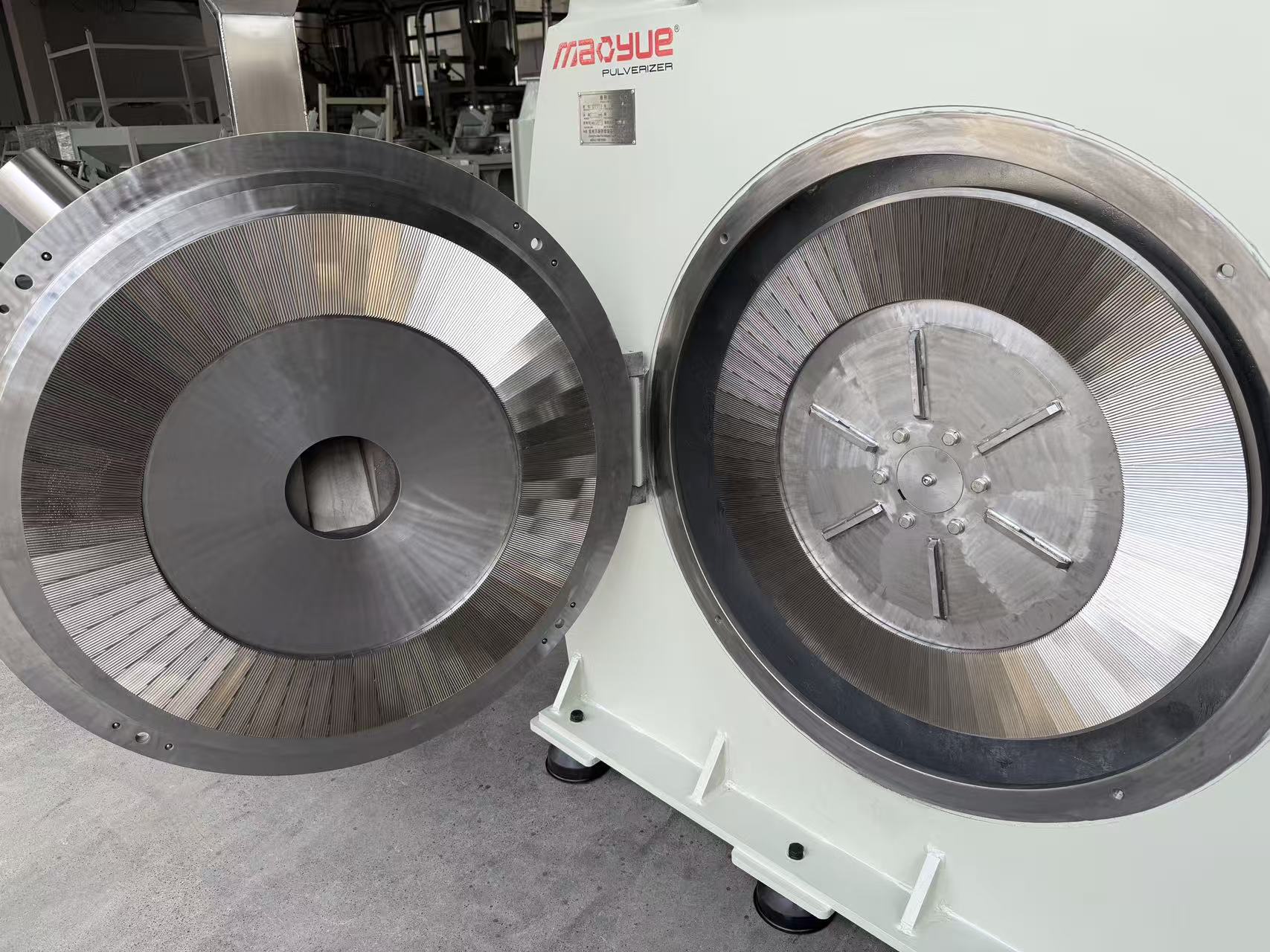
The grinding disc is one of the most important core components of a plastic pulverizing machine. Its material, tooth profile, machining accuracy, and dynamic balancing condition all have a direct impact on powder quality and equipment stability.
Mao Yue places strong emphasis on precision grinding disc manufacturing and quality control. Through high-precision machining processes and strict dynamic balancing tests, the rotating grinding disc can maintain stable operation at high speeds.
Different grinding disc structures and materials can also be selected according to specific plastic materials and production requirements, including grinding discs made from highly wear-resistant DC53 tool steel. These grinding discs help maintain stable grinding performance during long-term continuous operation.
Stable grinding disc performance not only helps achieve a more uniform powder particle size but also reduces abnormal friction, controls temperature rise, and lowers the risk of material blockage caused by severe grinding disc wear.
Temperature control is a critical part of the plastic pulverizing process. Especially when processing materials such as PVC, PE, PP, EVA, TPU, and PA, continuously increasing grinding temperatures can cause some plastics to soften, adhere, or even agglomerate, affecting powder quality and continuous machine operation.
Mao Yue plastic pulverizing machines are designed around the heat generated during the pulverizing process. The airflow channels, cooling methods, and pneumatic conveying system are comprehensively optimized. High-efficiency air cooling and optional circulating water cooling help rapidly remove heat generated during grinding.
For materials that are more sensitive to temperature, more targeted low-temperature cooling solutions can also be configured according to specific production requirements, helping maintain a more stable operating temperature during long-term operation.

High output does not simply mean increasing motor power. A truly stable plastic pulverizing system requires the feeding, grinding, cooling, pneumatic conveying, and powder collection systems to work in balance.
During equipment design, Mao Yue comprehensively configures the entire system according to the customer's actual material, target production capacity, and required powder fineness.
A properly designed feeding system can reduce excessive instantaneous feeding. An optimized grinding disc structure can improve grinding efficiency. A stable cooling system can control temperature rise. Proper airflow and pipeline design can help remove powder from the grinding chamber efficiently.
When these systems are properly matched, material residence time and accumulation inside the grinding chamber can be reduced, thereby lowering the risk of material blockage and improving continuous production capacity.
Material blockage is rarely an isolated problem. It is often the result of an imbalance between the raw material, feeding system, grinding discs, temperature, airflow, and powder collection system.
Therefore, solving blockage problems should not rely solely on operators repeatedly stopping the machine for cleaning. More importantly, the risk of blockage should be reduced at the equipment design and system configuration stages.
Through high-precision grinding discs, properly designed grinding disc gaps, optimized cooling systems, stable feeding, and efficient pneumatic conveying and powder collection systems, Mao Yue helps customers establish a more stable plastic pulverizing production process.
The ultimate goal is not simply to make the machine “grind faster,” but to ensure that materials can be fed smoothly, ground efficiently, cooled effectively, conveyed quickly, and collected consistently.
For companies requiring long-term continuous production, this systematic approach to equipment design can reduce unplanned downtime, lower maintenance frequency, and help achieve more stable production efficiency and powder quality.
Frequent material blockage in a plastic pulverizing machine is usually caused by excessive moisture in the raw materials, excessive feeding speed, worn grinding discs, improper grinding disc gap adjustment, insufficient cooling, blockage in the powder collection system, or a mismatch between the machine parameters and the material being processed. Identifying the root cause and carrying out regular maintenance can effectively prevent recurring material blockage.
Reducing grinding temperature requires sufficient airflow, an efficient cooling system, suitable grinding discs, and a stable feeding rate. Raw materials should also be thoroughly dried before processing, and the machine should not be operated under continuous overload conditions.
For heat-sensitive plastics such as PVC, PA, and TPU, a low-temperature plastic pulverizing system is recommended.
The replacement interval of grinding discs depends on the material being processed, production capacity, and grinding disc material. High-quality DC53 grinding discs generally offer a longer service life than conventional D2 grinding discs.
Regular inspection is recommended. When you notice reduced output, increased energy consumption, or unstable powder particle size, the grinding discs should be reground or replaced promptly.
Soft or heat-sensitive plastics such as TPU, EVA, PA, and some LLDPE materials are more likely to generate heat and become sticky during pulverizing. These materials typically require more effective cooling, specialized grinding discs, and more precise process control.
Yes. A plastic pulverizing machine equipped with high-precision grinding discs, optimized airflow channel design, an efficient cooling system, and intelligent feeding control can significantly reduce the risk of material blockage while improving production capacity and powder quality.
Material blockage in plastic pulverizing machines is not unavoidable. In most cases, blockages are related to improper raw material preparation, inappropriate equipment parameter settings, wear of critical components, or insufficient maintenance. By understanding these influencing factors and taking the right preventive measures, manufacturers can significantly improve production efficiency, reduce downtime, and extend equipment service life.
Whether it is controlling raw material moisture content, adjusting the feeding speed, or maintaining the grinding discs and cooling system, every detail can affect the stability of the pulverizing process.
If you are planning to upgrade your production line or looking for a reliable plastic pulverizing machine manufacturer, choosing a supplier with advanced technology and professional service capabilities can deliver long-term value to your business.
Looking for a plastic pulverizing machine with reduced blockage risk, high output, and stable performance?
Contact Mao Yue today for professional technical consultation, customized equipment recommendations, and complete plastic pulverizing solutions. Let us help you build a more efficient, stable, and energy-efficient production line.


