Specializing in the production of Plastic Pulverizer Machines.

Views: 0 Author: Site Editor Publish Time: 2026-08-19 Origin: Site
For plastic pulverizers, the grinding disc may look like nothing more than a simple round metal component. However, a closer look reveals that the tooth shape, tooth depth, tooth arrangement, grinding disc gap, and machining precision all work together to determine how efficiently plastic can be ground into powder.
So, why is grinding tooth design so important?
Because the grinding disc is the core area where the actual grinding takes place. It determines how plastic enters the grinding zone, how it is subjected to shearing and impact forces, how much heat is generated, and ultimately the fineness and uniformity of the finished powder.
For companies purchasing a plastic pulverizer, choosing the right grinding tooth design is far more than a technical detail. It directly affects the machine’s production capacity, energy consumption, powder quality, grinding disc service life, and maintenance costs.
Therefore, when designing plastic pulverizers, Maoyue does not simply use a “one grinding disc fits all materials” approach. Instead, we optimize the grinding tooth profile and grinding structure according to the characteristics of different plastics, such as PE, PP, PVC, and LLDPE, as well as the customer’s requirements for production capacity and powder fineness. This ensures that the grinding disc is properly matched to the actual production needs.
The grinding disc is one of the most important working components inside a disc-type plastic pulverizer. Typically, one grinding disc rotates at high speed, while the plastic material enters the grinding zone between the rotating and stationary discs.
During the grinding process, the plastic is subjected to a combination of impact, shearing, friction, and compression. Unlike conventional blades that simply “cut” the material, grinding discs continuously act on the plastic until it reaches the required powder particle size.
This is why grinding disc design is so important. If the tooth profile is poorly designed, even a higher-power motor cannot fully compensate for an inefficient grinding process.
At Mao Yue, we optimize the grinding disc structure and tooth profile according to the characteristics of different plastics and the customer’s requirements for production capacity and powder fineness. Combined with precision machining and dynamic balancing processes, this helps the grinding disc maintain stable grinding performance during high-speed operation, enabling the plastic pulverizer to achieve higher grinding efficiency, more uniform powder quality, and long-term operating stability.
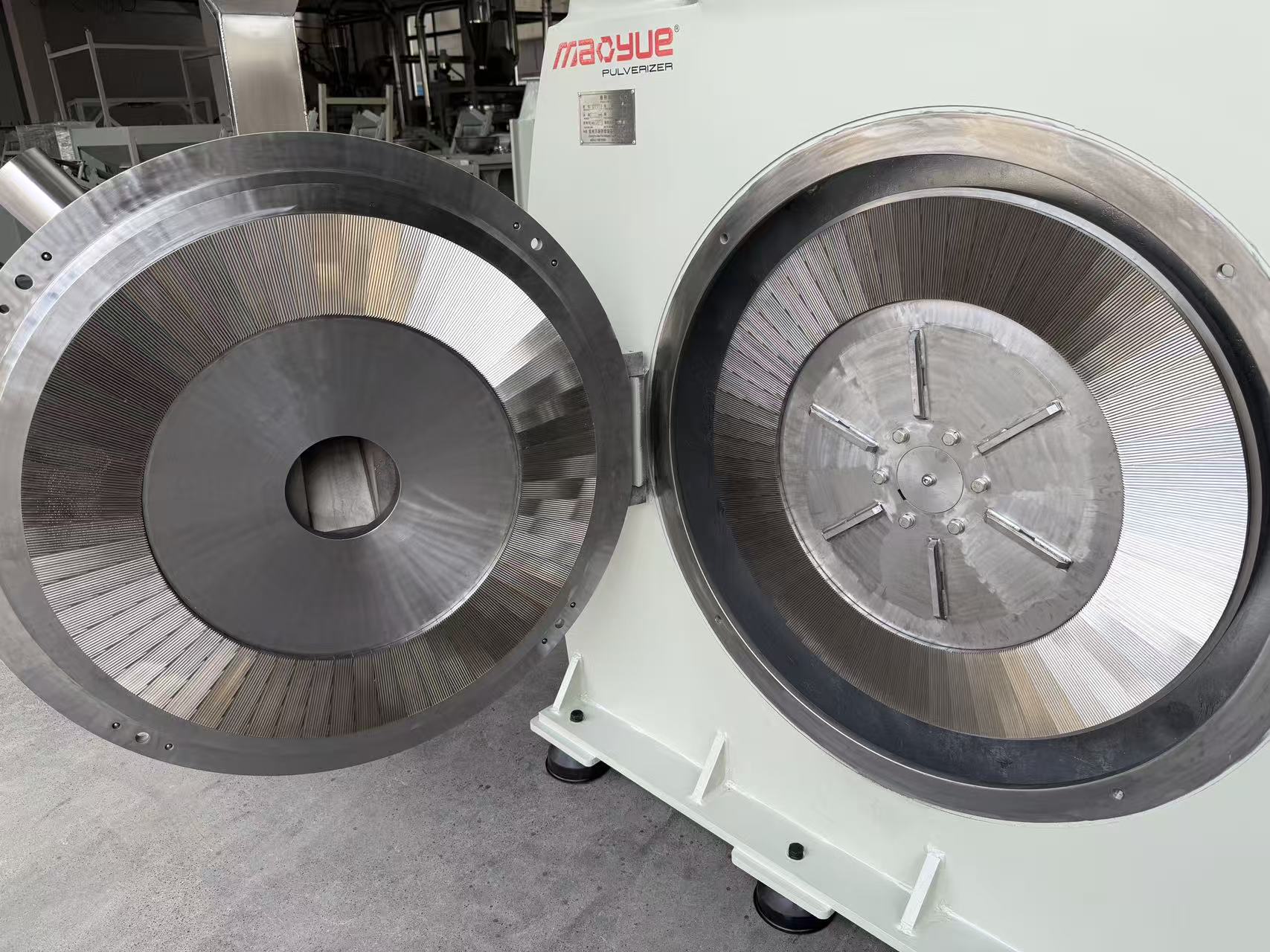
The grinding teeth on a disc can be thought of as the “working language” between the machine and the plastic material.
The motor provides the power, but the grinding disc’s tooth profile and structure determine how that power is actually transferred to and acts on the material.
A well-designed tooth profile can improve material gripping, grinding efficiency, powder uniformity, and production capacity. In contrast, an unsuitable tooth profile may result in excessive friction, unstable feeding, higher grinding temperatures, uneven powder, and unnecessary energy consumption.
The geometry of each grinding tooth affects whether the plastic is subjected to stronger shearing, impact, or friction forces.
Sharp and well-designed grinding teeth can grip the material more effectively and guide it through the grinding zone. At the same time, the spacing between the teeth also affects how long the material remains in the grinding zone.
The goal is not simply to make the grinding teeth as sharp as possible. A more “aggressive” tooth profile does not necessarily mean better performance. The tooth design needs to be matched to the type of plastic, target powder fineness, machine operating speed, and specific production requirements.
The arrangement of the grinding teeth is equally important. A grinding disc is not simply a collection of teeth placed together. Through the proper distribution, spacing, and orientation of the teeth, the disc needs to guide the material into a stable and orderly flow pattern during high-speed rotation.
Imagine driving on a road filled with randomly placed obstacles. The flow of material would naturally become unstable, and the machine load could fluctuate as a result. In contrast, a well-designed tooth arrangement can create a more stable material flow path.
For industrial plastic pulverizers, stable material movement is essential because consistent feeding leads to a more stable grinding process.

The depth of the grinding teeth affects the degree of contact between the material and the grinding disc surface, as well as how the material is subjected to grinding forces. This, in turn, influences the rate at which the plastic is refined and the overall grinding intensity within the grinding zone.
If the tooth profile is too shallow, it may not provide sufficient grinding action for certain materials. If the teeth are too deep or poorly matched to the material, they may generate excessive friction and heat.
Therefore, tooth depth should never be considered independently of the material characteristics and target particle size.
A well-designed grinding disc needs to balance three key factors: production capacity, powder fineness, and energy consumption.
Overemphasizing one of these factors may negatively affect the other two.
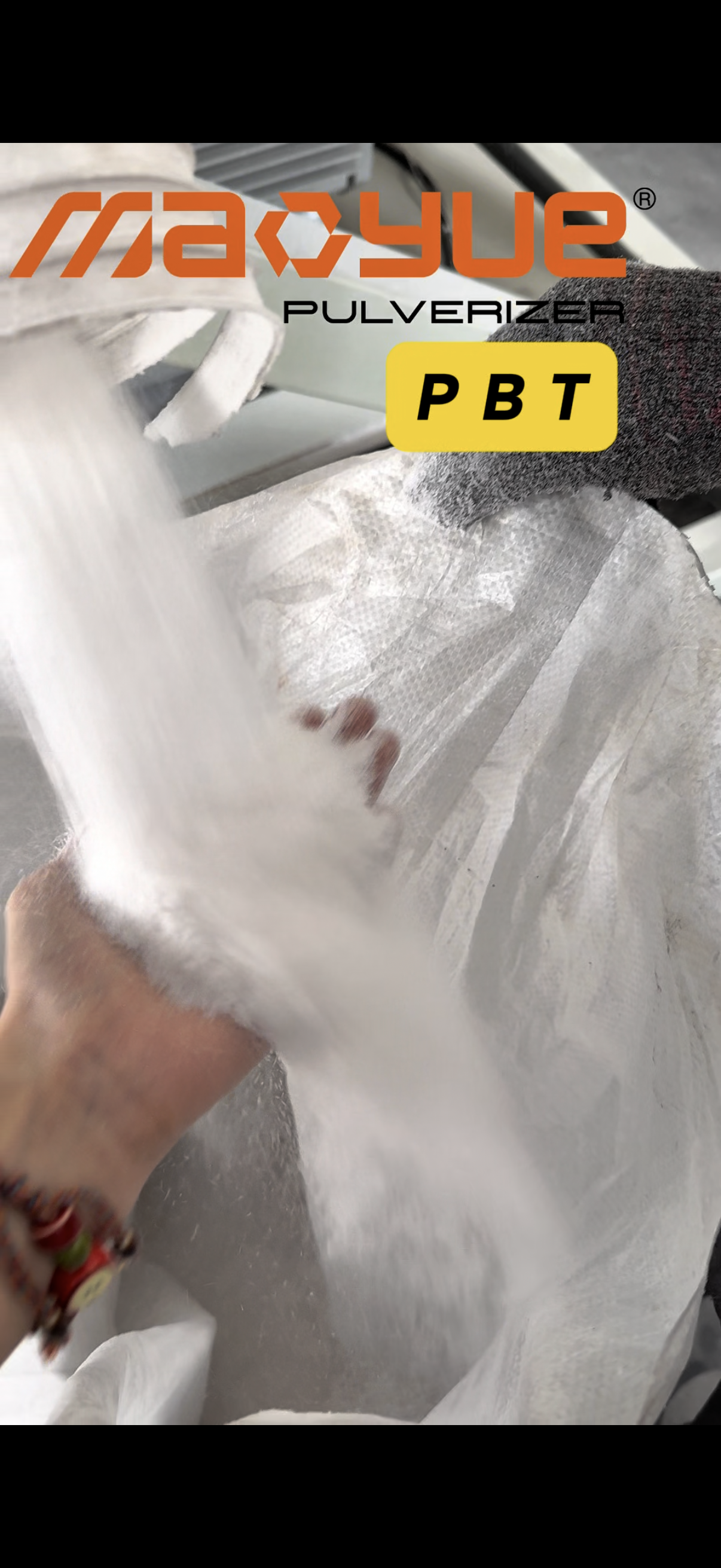
When the grinding teeth can effectively grip and engage with the plastic, more material can be processed within the same operating time.
This is particularly important for industrial customers who require continuous production. For large-scale plastic processing or recycling companies, a pulverizer that produces high-quality powder but has insufficient capacity may not necessarily be economically viable. Stable, high production capacity not only improves overall productivity but also directly affects the processing cost per unit of product.
Therefore, a professional plastic pulverizer manufacturer should match the grinding disc with the motor power, air-cooling system, cooling system, and feeding system as an integrated solution, rather than designing the grinding disc independently.
For many plastic applications, simply achieving the target mesh size is only the first step. Consistency and uniformity in powder particle size are equally important.
A properly designed tooth profile can make the grinding process more stable, reducing the risk of excessive coarse particles or an overly high proportion of fine powder.
For customers producing rotomolding powder, color masterbatch, modified plastics, or recycled plastic powder, consistent particle size can directly affect subsequent processing performance.
Plastic grinding is inherently a relatively energy-intensive process. If the grinding teeth cannot efficiently transfer mechanical energy to the material, more energy may be converted into unnecessary heat and friction losses.
This is why you should not compare plastic pulverizers based solely on motor power when making a purchasing decision.
A 90 kW machine is not necessarily better than a 75 kW machine. What really matters is whether the entire grinding system can efficiently convert electrical energy into effective pulverizing capacity.
Temperature is an often-overlooked factor in plastic pulverizing, yet it can directly affect production stability.
High-speed grinding naturally generates heat. If the tooth profile is poorly designed, the grinding disc gap is too small, or the material remains in the grinding zone for too long, friction can increase significantly, causing heat to build up rapidly.
For heat-sensitive plastics, this can affect powder quality and may even cause thermal degradation of the material.

An optimized grinding tooth structure allows the material to pass through the grinding zone more efficiently, rather than causing unnecessary material retention.
At Mao Yue, we consider grinding disc design together with cooling requirements such as air cooling and water cooling. This integrated approach is particularly important for customers who need stable production of PE, PP, PVC, PA, and other plastic powders.
There is no single grinding tooth design that can perform perfectly for every type of plastic. Different materials vary significantly in hardness, toughness, melting point, elasticity, thermal sensitivity, and feeding characteristics. As a result, they require different grinding forces and temperature control strategies during the pulverizing process.

PE and LLDPE are often processed into fine powders for applications such as rotational molding.
These materials have a certain degree of toughness and flexibility, so the grinding disc needs to provide effective shearing while keeping the grinding temperature under control.
For an LLDPE plastic pulverizer, the tooth profile, cooling system, feeding rate, and grinding disc gap need to work together for optimal performance.
PVC pulverizing requires particular attention to temperature control and powder consistency.
For materials such as PVC pipes, profiles, and cable sheathing, the grinding disc should be designed according to the actual raw material characteristics and the customer’s required powder specifications.

PP, PA, ABS, PET, PC, and other plastics have different thermal and mechanical properties.
Therefore, a professional plastic pulverizer supplier should first understand exactly what material the customer needs to grind before recommending the appropriate equipment.
Single-row and multi-row grinding teeth produce different grinding effects. In general, multi-row grinding teeth can increase the number of interactions between the material and the working surface within a limited grinding disc area, helping to improve grinding intensity and pulverizing efficiency. However, this does not mean that more teeth or a denser tooth arrangement will always result in better machine performance.
Tooth spacing, tooth height, material flow, rotational speed, and the cooling system all need to be considered as a whole.
At Mao Yue, we optimize the grinding tooth arrangement and disc structure according to the material type, target powder fineness, production requirements, and actual operating conditions, rather than using exactly the same configuration for every customer.
Even grinding discs with high design and manufacturing precision will gradually wear during long-term, high-load production.
As the grinding teeth continue to wear, their ability to grip and effectively act on the material decreases.
To achieve the same powder specifications as before, the machine may need to consume more time and energy.

As the grinding teeth wear, maintaining the target powder particle size becomes more difficult. During production, this may result in an increase in coarse particles, a wider particle size distribution, and fluctuations in powder fineness.
This is particularly important for customers who require a consistent supply of powder for downstream production processes.
A worn grinding disc may reduce grinding efficiency while increasing unnecessary friction. Over time, this can lead to higher operating costs.
At Mao Yue, we focus not only on grinding performance when the disc is new, but also on its long-term wear resistance. Through the use of wear-resistant materials, heat treatment, precision machining, and optimized grinding tooth designs, we improve the long-term stability of the grinding disc. At the same time, we provide suitable grinding discs and spare-parts solutions based on different materials and production conditions, helping plastic pulverizers maintain relatively stable production capacity and powder quality during long-term operation.
An excellent grinding tooth design is only the first step. The design can deliver its intended grinding performance only when it is accurately reproduced on the grinding disc through stable and precise manufacturing processes.
If the precision of the grinding surface is insufficient, the grinding disc gap may become uneven.
This can lead to unstable powder fineness, uneven machine loads, and accelerated grinding disc wear.

A high-speed rotating grinding disc must also maintain good dynamic balance.
When the grinding disc rotates at high speed, even a small imbalance can be amplified into a significant problem.
At Mao Yue, every stage—from grinding tooth design and CNC precision machining to dynamic balancing inspection—is carefully controlled. By maintaining high machining accuracy on the working surface and ensuring proper rotational balance, we help the grinding disc maintain a more stable grinding condition during high-speed operation.
For industrial customers, precision machining and dynamic balancing are not optional add-ons. They are fundamental to ensuring the long-term stability and efficient operation of a plastic pulverizer.
A grinding disc should not be viewed simply as an ordinary metal spare part. It is the core component of a plastic pulverizer that directly interacts with the material. The design of the grinding teeth, machining precision, and wear resistance of the material can all directly affect the machine’s production capacity, powder fineness, energy consumption, and long-term operating stability.

At Mao Yue, grinding disc development does not focus solely on the tooth profile. Instead, we take a comprehensive approach that considers material selection, grinding tooth structure, machining precision, heat treatment, dynamic balancing, grinding disc gap, cooling, and specific application requirements.

For plastic pulverizers operating under continuous, high-intensity grinding conditions, the grinding disc must withstand constant friction and impact. Therefore, wear resistance and long-term stability are particularly important.
For different applications, Maoyue uses wear-resistant materials, including DC53 for certain grinding disc components, and applies appropriate heat treatment processes to improve hardness and wear resistance. This helps the grinding teeth maintain their original grinding performance more effectively during long-term production.
Of course, a higher hardness does not necessarily mean a better grinding disc. Material properties need to be matched to the specific material being processed, grinding tooth structure, and operating conditions. The ultimate goal is to maintain good grinding efficiency while slowing down wear and reducing downtime and maintenance costs caused by frequent grinding disc replacement.

A good grinding tooth design also requires precision manufacturing to achieve its intended performance. Even if the tooth profile on the drawing is well designed, significant deviations in dimensions, angles, or working-surface accuracy during actual machining can still affect the final grinding performance.
With CNC machining and precision grinding equipment, Mao Yue pays close attention to grinding disc dimensional accuracy, working-surface precision, and consistency between different discs. High-speed rotating grinding discs also undergo dynamic balancing to reduce vibration during operation and help maintain a more stable working condition at high rotational speeds.

The right grinding disc is never a case of “one model fits all materials.” What the customer needs to grind determines how the grinding disc should be designed.
For example, PE film, LLDPE, PVC pipes, PP, PA, color masterbatch, and materials specifically used for rotational molding powder differ in hardness, toughness, thermal sensitivity, and grinding requirements. Therefore, their grinding tooth structures, grinding disc gaps, and cooling solutions may also need to be different.
This is why, before purchasing a plastic pulverizer, we recommend that customers provide the manufacturer with as much accurate information as possible, including the material type, feeding condition, target powder mesh size, required production capacity, and actual operating conditions. Mao Yue can then match the appropriate grinding disc and complete machine configuration based on these parameters, rather than simply providing a standard solution.
For B2B customers, this application-based grinding disc design affects more than the initial grinding performance of the equipment. It also has a direct impact on long-term production capacity, powder consistency, energy consumption, and maintenance costs.
If you are comparing different plastic pulverizer manufacturers, don’t just ask, “How many kilowatts is the machine?”
You should ask more professional and application-specific questions.
First, clearly tell the manufacturer what material you need to process.
Plastics such as PE, LLDPE, PVC, PP, PA, ABS, and PET may require different grinding solutions.
A customer requiring 20-mesh powder may not be suitable for the same grinding configuration as a customer requiring 80-mesh or even finer powder.
Clearly defining the target particle size helps the manufacturer select the appropriate grinding disc and machine parameters.
When evaluating a machine, you should focus on actual production capacity, rather than simply looking at the installed motor power.
If possible, it is best to ask the manufacturer to conduct a test run using your actual material.
Before purchasing an industrial plastic pulverizer, it is worth asking the manufacturer the following key questions:
What materials is this machine primarily designed to process?
What powder fineness can it achieve?
What is the actual production capacity for my specific material?
What manufacturing process is used to produce the grinding disc?
What material and heat treatment process are used for the grinding disc?
How is the grinding disc dynamically balanced?
How is the grinding temperature controlled?
How often does the grinding disc typically need to be maintained or replaced?
A reliable plastic pulverizer supplier should be able to answer these questions with specific engineering parameters rather than relying solely on vague marketing claims.
So, why does grinding tooth design affect plastic pulverizer performance?
Because every grinding tooth directly participates in the grinding process.
The tooth profile affects how the material is gripped, the tooth arrangement affects material flow, tooth depth affects grinding intensity, grinding disc machining precision affects the disc gap, and wear resistance affects service life. Ultimately, all of these factors influence production capacity, particle size, temperature, energy consumption, and powder quality.
Therefore, choosing a plastic pulverizer should not be based simply on motor power or equipment price.
A truly high-performance plastic pulverizer is an integrated system in which the grinding disc, grinding tooth design, motor, cooling system, feeding system, grinding disc gap, and manufacturing precision work together.
For companies looking for a reliable plastic pulverizer manufacturer, Maoyue places greater emphasis on this systematic engineering approach, combining more than 30 years of experience in plastic pulverizing equipment with precision manufacturing and application-specific grinding disc design.
If you plan to grind PE, LLDPE, PVC, PP, PA, color masterbatch, or other plastics, the most effective next step is not simply to request a product catalog. Instead, provide the manufacturer with information about your material, target powder fineness, and required production capacity, so the engineering team can recommend the appropriate grinding disc and equipment configuration based on your actual requirements.
After all, the best plastic pulverizer is not necessarily the one with the highest motor power. The right machine for you is the complete grinding system designed around your specific material and production goals.


