Specializing in the production of Plastic Pulverizer Machines.

Views: 0 Author: Site Editor Publish Time: 2026-08-23 Origin: Site
Choosing a plastic pulverizer is not simply a matter of assuming that “the larger the machine, the higher the output and the better the performance.” Plastic pulverizers with 500 mm, 600 mm, and 800 mm grinding discs can all be used for plastic grinding, but they are suited to different production capacities, materials, production requirements, and investment budgets.
If the machine is too small for the required production capacity, it may struggle to meet output demands and have to operate under high loads for extended periods. On the other hand, choosing an unnecessarily large machine will not only increase the initial investment but may also result in higher energy consumption and additional auxiliary equipment costs. Therefore, the key to selecting a plastic pulverizer is not to choose the largest machine, but to choose the most suitable one.
As a manufacturer with more than 30 years of experience in plastic pulverizing equipment, Mao Yue evaluates each customer's material type, target output, required powder fineness, and actual operating conditions. Based on these factors, we develop a suitable equipment solution, considering everything from grinding disc design and power configuration to the cooling system.
So, how should you choose between a 500 mm, 600 mm, and 800 mm plastic pulverizer?

The specifications of a plastic pulverizer are closely related to its grinding area, material processing capacity, motor configuration, cooling requirements, and overall production capacity.
The grinding disc can be considered the “heart” of a plastic pulverizer. A larger grinding disc generally provides a larger grinding area and higher potential processing capacity. However, it also requires a more powerful drive system, a more efficient cooling system, and a more reliable mechanical structure.
This is why Maoyue does not simply pursue “a larger grinding disc” when designing its equipment. Instead, we consider multiple factors, including tooth design, grinding disc gap, power configuration, cooling system, and dynamic balancing, to ensure that the machine size truly matches the production requirements.
Therefore, when selecting a plastic pulverizer, you should start with your actual production goals, rather than simply choosing a machine based on grinding disc diameter.
In the plastic pulverizer industry, 500 mm, 600 mm, and 800 mm generally refer to the diameter specifications of the machine’s grinding disc. Different grinding disc sizes mean different grinding areas, processing capacities, and overall equipment configurations.
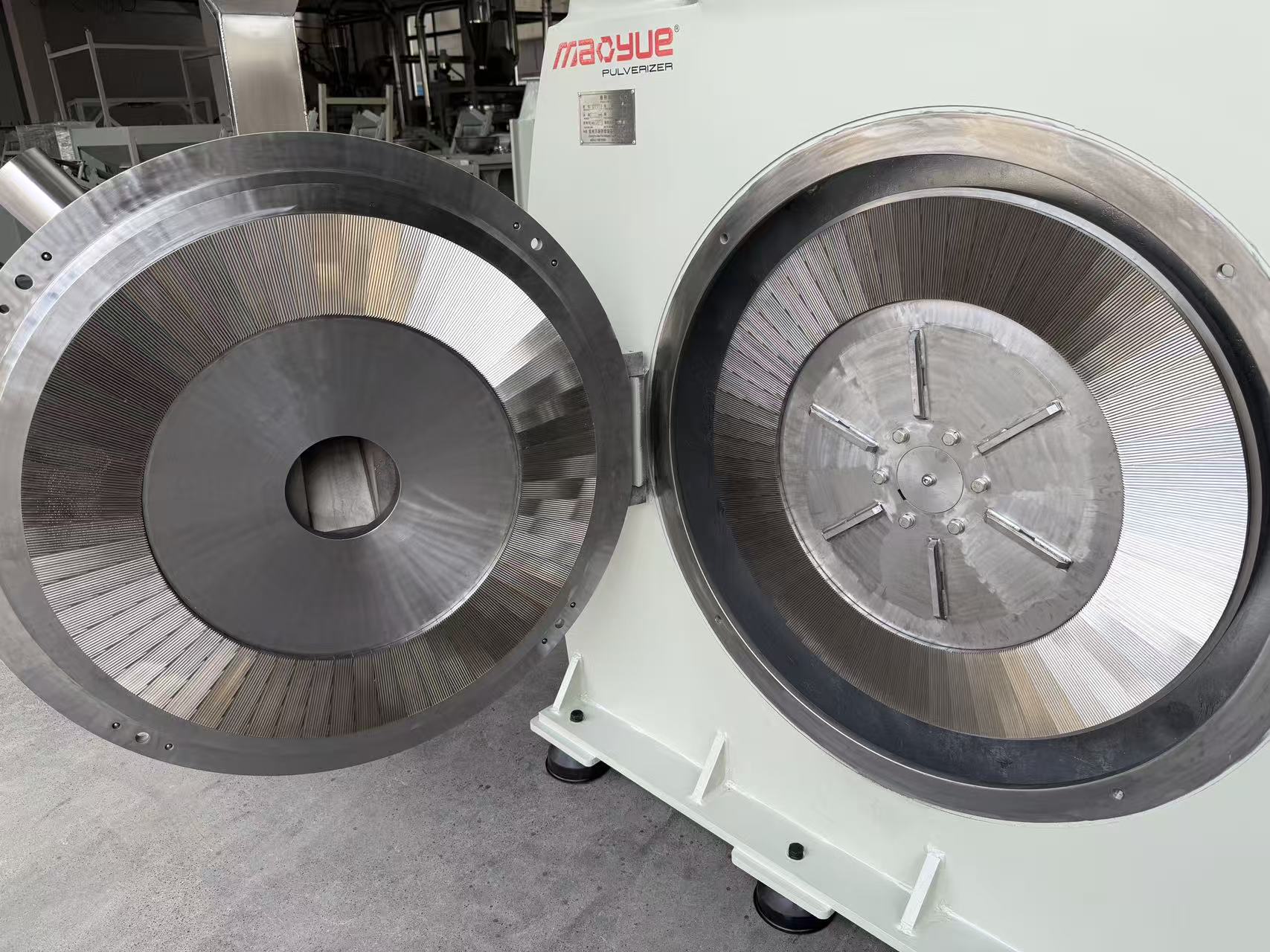
Inside a plastic pulverizer, the rotating grinding disc and stationary grinding disc form a high-speed grinding zone. After the plastic enters the grinding area, friction, shearing, and impact between the grinding discs gradually reduce the material into powder.
However, grinding disc diameter is only one factor. The tooth design, grinding disc gap, material selection, machining precision, and dynamic balancing can all affect grinding efficiency, powder fineness, temperature rise, and grinding disc service life.
Generally speaking, an 800 mm plastic pulverizer has a larger grinding area and higher potential processing capacity than a 500 mm machine. However, this does not mean that an 800 mm pulverizer is always the best choice.
If your actual production requirement is only medium or low output, choosing a large machine that significantly exceeds your production needs is like using a truck to deliver a small package—it certainly works, but it may not be the most economical option. A larger machine usually requires a higher initial investment, while also placing greater demands on the motor, cooling system, factory space, and auxiliary equipment.
Before comparing different machine sizes, we first need to understand a basic question: How is plastic transformed into uniform powder inside a pulverizer?
Plastic pulverizing is not simply a matter of “breaking the material into smaller pieces.” It is a process involving feeding, grinding, grinding gap control, and temperature management. Machine size is only one part of the equation. What truly determines grinding performance is whether all these systems can work together in a well-matched and stable configuration.


The material needs to enter the grinding chamber steadily and evenly. Feeding too quickly may overload the grinding chamber, while insufficient feeding can reduce equipment utilization.
Therefore, for continuous production, a stable feeding system and appropriate feeding speed are very important. Mao Yue matches the feeding method and operating parameters according to different materials and machine specifications, helping ensure that the material enters the grinding area more evenly.

Once the plastic enters the grinding area, the gap between the grinding discs becomes critical.
A smaller grinding disc gap can help achieve finer powder, but it may also increase friction and temperature rise. A larger gap allows the material to pass through more easily, but the resulting powder may be relatively coarser.
Therefore, simply looking at the grinding disc diameter is not enough to determine the overall performance of a plastic pulverizer.
Plastic materials can be sensitive to temperature. During high-speed grinding, friction continuously generates heat, causing the material temperature to rise. An effective cooling system helps control the temperature and maintain stable powder quality during continuous operation.
Therefore, a high-performance plastic pulverizer needs not only to “grind efficiently” but also to “control temperature effectively.” Mao Yue configures suitable cooling solutions based on different plastic materials and production requirements, helping the equipment maintain more stable operating conditions during continuous production.
The 500 mm plastic pulverizer is generally suitable for production applications with moderate output requirements where equipment flexibility is also important.

Its main advantages include a relatively compact design, lower initial investment, and easier integration with small- and medium-sized production lines.
For customers who are just starting plastic powder production or whose production requirements are not particularly high, a 500 mm plastic pulverizer can be a practical choice.
Depending on the specific grinding disc configuration and process conditions, a 500 mm pulverizer can be used for grinding PE, PP, and certain PVC applications.
The key is to ensure that the equipment is properly matched to the material characteristics and target production capacity.
If the capacity of a 500 mm plastic pulverizer can no longer meet your production requirements, while an 800 mm machine seems to require too much investment or an oversized configuration, a 600 mm plastic pulverizer is often an ideal middle-ground solution. It offers a good balance between grinding capacity, equipment investment, and production flexibility, making it an attractive option for many medium-sized plastic processing companies.

Compared with a 500 mm machine, a 600 mm plastic pulverizer has a larger grinding area and can handle higher material processing requirements. Compared with an 800 mm machine, it generally requires less investment and less complex production infrastructure.
Simply put, the 600 mm machine sits between “compact and flexible” and “large-scale and high-output.” For many medium-sized plastic processing companies, it can achieve a good balance between production capacity, energy consumption, investment cost, and production flexibility.
For many medium-sized plastic processing companies, this balance can be highly attractive.
Depending on the specific configuration, a 600 mm plastic pulverizer can be used to grind PE, PP, PVC, recycled plastics, and certain modified plastics. It is particularly suitable for companies whose production requirements have exceeded the capacity of entry-level equipment but who do not yet need a large-scale, high-output production line.
If your production target has already reached a higher capacity and the equipment needs to operate continuously and reliably for long periods, an 800 mm plastic pulverizer is usually worth considering. Compared with 500 mm and 600 mm models, the 800 mm machine has a larger grinding area and higher potential processing capacity, making it more suitable for industrial applications with high output and continuous production requirements.

The biggest advantages of an 800 mm plastic pulverizer are its high output and continuous production capability. The larger grinding disc provides a larger working area and supports high-throughput grinding configurations.
For large plastic recycling plants, masterbatch manufacturers, rotomolding companies, and industrial plastic powder producers, higher processing capacity can provide significant value.
If your target output is high and the equipment needs to operate continuously for long hours every day, an 800 mm plastic pulverizer may offer better overall economics.
However, there is one important prerequisite: your entire production line must be properly matched to the machine.
A large pulverizer will not automatically achieve high output if it is paired with an undersized feeding system or an insufficient cooling system.
Factor | 500mm | 600mm | 800mm |
|---|---|---|---|
Production level | Small–medium | Medium | Medium–high / high |
Investment | Lower | Moderate | Higher |
Footprint | Smaller | Medium | Larger |
Continuous production | Suitable | Very suitable | Excellent |
Typical users | Small/medium processors | Medium processors | Large industrial plants |
Best advantage | Flexibility | Balance | High throughput |
When choosing a plastic pulverizer, the first question should always be: How many kilograms do you actually need to produce per hour?
Instead of asking “Which machine is bigger?”, you should first determine your actual production target, daily operating hours, and future capacity plans.
For example, a customer who needs several hundred kilograms per hour will obviously have very different equipment requirements from a factory that needs more than one ton per hour.
Therefore, when selecting equipment for customers, Mao Yue does not recommend a machine based solely on a “kg/h” figure. Instead, we consider the material type, target output, powder fineness, operating hours, and cooling requirements before matching the appropriate grinding disc size and overall machine configuration.
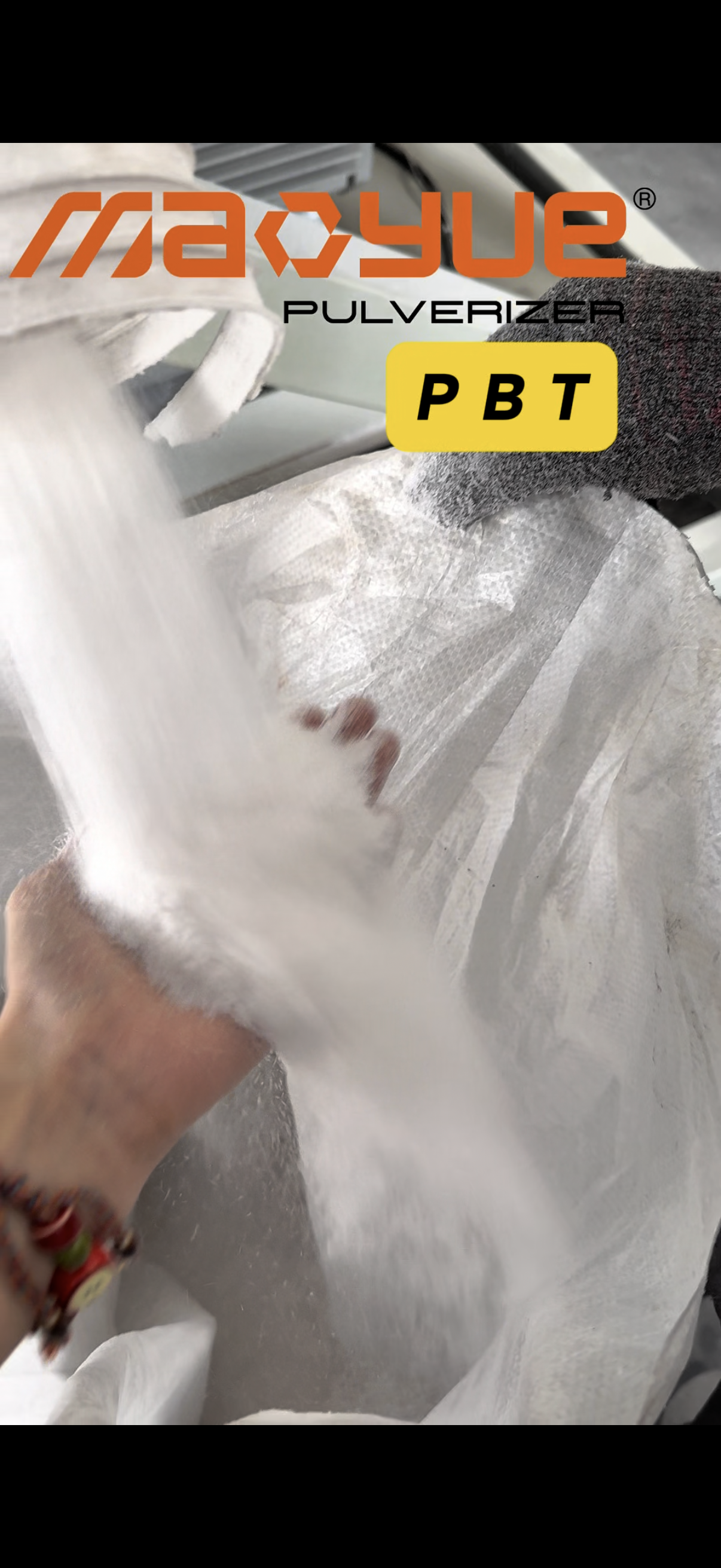
Production capacity is only half of the equation. Powder fineness and particle size consistency are equally important.
If the final powder needs to meet a specific mesh size or particle size distribution, grinding disc design and grinding gap adjustment become critical. If the gap is too large, the powder may not reach the required fineness. If the gap is too small, it may increase friction, temperature rise, and energy consumption.
A good plastic pulverizer should not only “grind fast” but also consistently produce powder that meets the required specifications.
When choosing a plastic pulverizer, the equipment purchase price is only one part of the total cost. Long-term electricity consumption, maintenance expenses, and the cost of auxiliary equipment also deserve careful consideration.
For B2B customers, equipment selection is therefore not simply a technical decision—it is also an economic decision.
Plastic pulverizers need to operate at high speed for extended periods, making maintenance and spare parts management important factors that should not be overlooked during equipment selection. Larger machines typically have larger and heavier core components, making a well-planned maintenance schedule even more important.
Grinding discs, bearings, seals, and other wear parts should all be selected according to the actual material characteristics and operating conditions.
The selection of plastic pulverizer size should never be determined separately from the material being processed. Even with the same 500 mm, 600 mm, or 800 mm machine, the actual output, powder fineness, and temperature control requirements can vary depending on the type of plastic being processed.

PE and LLDPE are common materials in plastic pulverizing and are widely used in recycled plastics, rotomolding powder, and other plastic powder production applications.
The final equipment configuration should be determined based on the required output, powder fineness, and the material’s sensitivity to temperature.

PP and masterbatch are also important applications for plastic pulverizers. In particular, during masterbatch production, powder particle size uniformity and consistency can directly affect subsequent processing performance.
For applications requiring high output, larger pulverizer models can provide higher processing capacity.
PVC pulverizing is another important application, particularly for producing PVC powder used in the processing of pipes, profiles, flooring, and other plastic products.
Compared with some other plastics, PVC applications can be more sensitive to powder fineness, particle size consistency, and grinding temperature. Therefore, grinding disc tooth design, grinding disc gap, machining precision, and cooling system are all particularly important.
Instead of immediately debating “500 mm, 600 mm, or 800 mm?”, it is better to answer several more important questions first.
First, determine how many kg/h you actually need. At the same time, consider how many hours the machine will operate each day and whether you have plans to expand production in the future.
This can quickly narrow down the range of suitable equipment.
Different plastics behave very differently during the pulverizing process. Materials such as PE, LLDPE, PP, PVC, PA, and masterbatch vary in hardness, toughness, melting characteristics, and temperature sensitivity.
Material hardness, toughness, melting point, and thermal sensitivity can all affect the equipment configuration.
Do you need coarse powder, fine powder, or a specific mesh size range?
This is a very important consideration because the target powder fineness directly affects the grinding disc design, grinding disc gap, feeding speed, and operating parameters.
Plastic continuously generates heat during high-speed grinding, especially during high-output and long-term continuous production. Cooling capacity can directly affect powder quality and equipment stability.
A high-output plastic pulverizer without sufficient cooling is like a powerful engine without a radiator—it can run, but it is difficult to maintain stable long-term operation.
This is also why material testing is so important.
Even machines with the same specifications can deliver different output and powder quality when processing different materials. Factors such as material form, moisture content, feed size, target fineness, and cooling conditions can all affect the final grinding performance.
At Mao Yue, we do not simply view a plastic pulverizer as “a motor + grinding chamber + grinding disc.” Whether a machine can consistently and efficiently produce plastic powder that meets the required specifications depends on the overall coordination of the grinding discs, power system, machining precision, cooling system, and feeding system.
Therefore, when working with different customers, we focus more on several key questions: What material are you processing? What production capacity do you need? What powder fineness do you require? And under what operating conditions will the machine run?


The grinding disc is one of the most critical working components of a plastic pulverizer and is also one of the key areas of Maoyue's R&D and optimization.
Grinding disc material, tooth design, grinding method, and grinding disc gap can all directly affect grinding efficiency, powder fineness, temperature rise, and grinding disc service life. Different plastics have different grinding characteristics, so the same grinding disc configuration cannot simply be used for every material.
Mao Yue matches the appropriate grinding disc configuration based on different materials such as PE, PP, PVC, and masterbatch, as well as the customer's target powder fineness and production capacity, helping the equipment better meet actual production requirements.

The grinding discs of a plastic pulverizer need to rotate continuously at high speed, making machining precision and dynamic balancing critical to stable equipment operation.
If rotating components have significant imbalance, they may generate additional vibration and noise, which can not only affect machine operation but also accelerate wear on bearings and other core components.
Mao Yue places strong emphasis on precision machining and dynamic balancing of core components. By maintaining a more stable mechanical structure, we help reduce operating vibration and provide a more reliable foundation for long-term continuous production.

For continuous plastic pulverizing production, cooling is not a minor detail. It is an important part of the overall pulverizing solution.
Depending on the application, Mao Yue can configure suitable air cooling, water cooling, or combined cooling systems to help control temperature during the pulverizing process.
There is no single machine that is suitable for every customer.
If you prioritize flexibility, compact equipment, and moderate production capacity, a 500 mm machine may be worth considering.
If you want to achieve a good balance between output, investment, and operating flexibility, a 600 mm machine may be the better choice.
If your primary goals are high output and long-term continuous production, an 800 mm machine may be the more suitable option.
But remember: the best plastic pulverizer is not necessarily the largest one. It is the machine that best matches your material, production capacity, required powder fineness, and operating conditions.
If you are still unsure whether to choose a 500 mm, 600 mm, or 800 mm plastic pulverizer, start with your actual production requirements.
You can provide Mao Yue with your material type, target production capacity, required powder fineness, and daily operating hours.
The Mao Yue team can then further evaluate the appropriate pulverizer size, grinding disc configuration, and cooling solution for your application.
Don't choose a plastic pulverizer simply based on machine size. Choose it based on the production results you actually need.
Mao Yue — The right equipment for producing plastic powder that truly meets your requirements.


